Shelli Vodovozov, Anna M Pederson, Oanh L Meyer, Adina Zeki Al Hazzouri, Rachel L Peterson, Claire C Meunier, Rachel A Whitmer, Chelsea Kuiper, Maria M Glymour
{"title":"移民一代与自我报告日常认知和客观测量认知水平和变化的关系。","authors":"Shelli Vodovozov, Anna M Pederson, Oanh L Meyer, Adina Zeki Al Hazzouri, Rachel L Peterson, Claire C Meunier, Rachel A Whitmer, Chelsea Kuiper, Maria M Glymour","doi":"10.1097/WAD.0000000000000716","DOIUrl":null,"url":null,"abstract":"<p><strong>Introduction: </strong>Evidence on cognitive aging differences across immigrant generations is limited.</p><p><strong>Methods: </strong>Kaiser Healthy Aging and Different Life Experiences (KHANDLE) participants reported immigrant generation, categorized as adulthood immigrants (immigrated ≥18 y of age, n=294, 14.51%), childhood immigrants (immigrated <18, n=105, 5.18%), second-generation (US-born with ≥1 foreign-born parent, n=553, 27.29%), and third-generation or later (reference, n=1074, 53.01%). Verbal episodic memory (VEM), executive function (EF), and everyday cognition (12-item Ecog) were assessed up to 4 times. Level and change in cognition were modeled with linear mixed-effects regressions.</p><p><strong>Results: </strong>Compared with third-generation participants, adulthood immigrants had worse VEM [(β = -0.19; 95% CI: -0.30, -0.08); EF (β = -0.61; -0.72, -0.50); and Ecog (β = 0.29; 0.19, 0.40)]; childhood immigrants had lower EF [β = -0.21 (-0.36, -0.05)]; and second-generation participants had worse VEM [β = -0.11 (-0.20, -0.02)], EF [β = -0.10 (-0.19, -0.01)], and Ecog [β = 0.10 (0.009, 0.18)]. Cognitive change did not differ by immigrant generation.</p><p><strong>Conclusions: </strong>Individuals who immigrated in adulthood averaged worse cognitive scores and self-reported everyday cognition.</p>","PeriodicalId":520551,"journal":{"name":"Alzheimer disease and associated disorders","volume":"40 1","pages":"8-13"},"PeriodicalIF":0.0000,"publicationDate":"2026-01-01","publicationTypes":"Journal Article","fieldsOfStudy":null,"isOpenAccess":false,"openAccessPdf":"https://www.ncbi.nlm.nih.gov/pmc/articles/PMC12955959/pdf/","citationCount":"0","resultStr":"{\"title\":\"Associations of Immigrant Generation with Level and Change in Self-Reported Everyday Cognition and Objectively Measured Cognition.\",\"authors\":\"Shelli Vodovozov, Anna M Pederson, Oanh L Meyer, Adina Zeki Al Hazzouri, Rachel L Peterson, Claire C Meunier, Rachel A Whitmer, Chelsea Kuiper, Maria M Glymour\",\"doi\":\"10.1097/WAD.0000000000000716\",\"DOIUrl\":null,\"url\":null,\"abstract\":\"<p><strong>Introduction: </strong>Evidence on cognitive aging differences across immigrant generations is limited.</p><p><strong>Methods: </strong>Kaiser Healthy Aging and Different Life Experiences (KHANDLE) participants reported immigrant generation, categorized as adulthood immigrants (immigrated ≥18 y of age, n=294, 14.51%), childhood immigrants (immigrated <18, n=105, 5.18%), second-generation (US-born with ≥1 foreign-born parent, n=553, 27.29%), and third-generation or later (reference, n=1074, 53.01%). Verbal episodic memory (VEM), executive function (EF), and everyday cognition (12-item Ecog) were assessed up to 4 times. Level and change in cognition were modeled with linear mixed-effects regressions.</p><p><strong>Results: </strong>Compared with third-generation participants, adulthood immigrants had worse VEM [(β = -0.19; 95% CI: -0.30, -0.08); EF (β = -0.61; -0.72, -0.50); and Ecog (β = 0.29; 0.19, 0.40)]; childhood immigrants had lower EF [β = -0.21 (-0.36, -0.05)]; and second-generation participants had worse VEM [β = -0.11 (-0.20, -0.02)], EF [β = -0.10 (-0.19, -0.01)], and Ecog [β = 0.10 (0.009, 0.18)]. Cognitive change did not differ by immigrant generation.</p><p><strong>Conclusions: </strong>Individuals who immigrated in adulthood averaged worse cognitive scores and self-reported everyday cognition.</p>\",\"PeriodicalId\":520551,\"journal\":{\"name\":\"Alzheimer disease and associated disorders\",\"volume\":\"40 1\",\"pages\":\"8-13\"},\"PeriodicalIF\":0.0000,\"publicationDate\":\"2026-01-01\",\"publicationTypes\":\"Journal Article\",\"fieldsOfStudy\":null,\"isOpenAccess\":false,\"openAccessPdf\":\"https://www.ncbi.nlm.nih.gov/pmc/articles/PMC12955959/pdf/\",\"citationCount\":\"0\",\"resultStr\":null,\"platform\":\"Semanticscholar\",\"paperid\":null,\"PeriodicalName\":\"Alzheimer disease and associated disorders\",\"FirstCategoryId\":\"1085\",\"ListUrlMain\":\"https://doi.org/10.1097/WAD.0000000000000716\",\"RegionNum\":0,\"RegionCategory\":null,\"ArticlePicture\":[],\"TitleCN\":null,\"AbstractTextCN\":null,\"PMCID\":null,\"EPubDate\":\"2026/2/24 0:00:00\",\"PubModel\":\"Epub\",\"JCR\":\"\",\"JCRName\":\"\",\"Score\":null,\"Total\":0}","platform":"Semanticscholar","paperid":null,"PeriodicalName":"Alzheimer disease and associated disorders","FirstCategoryId":"1085","ListUrlMain":"https://doi.org/10.1097/WAD.0000000000000716","RegionNum":0,"RegionCategory":null,"ArticlePicture":[],"TitleCN":null,"AbstractTextCN":null,"PMCID":null,"EPubDate":"2026/2/24 0:00:00","PubModel":"Epub","JCR":"","JCRName":"","Score":null,"Total":0}
Associations of Immigrant Generation with Level and Change in Self-Reported Everyday Cognition and Objectively Measured Cognition.
Introduction: Evidence on cognitive aging differences across immigrant generations is limited.
Methods: Kaiser Healthy Aging and Different Life Experiences (KHANDLE) participants reported immigrant generation, categorized as adulthood immigrants (immigrated ≥18 y of age, n=294, 14.51%), childhood immigrants (immigrated <18, n=105, 5.18%), second-generation (US-born with ≥1 foreign-born parent, n=553, 27.29%), and third-generation or later (reference, n=1074, 53.01%). Verbal episodic memory (VEM), executive function (EF), and everyday cognition (12-item Ecog) were assessed up to 4 times. Level and change in cognition were modeled with linear mixed-effects regressions.
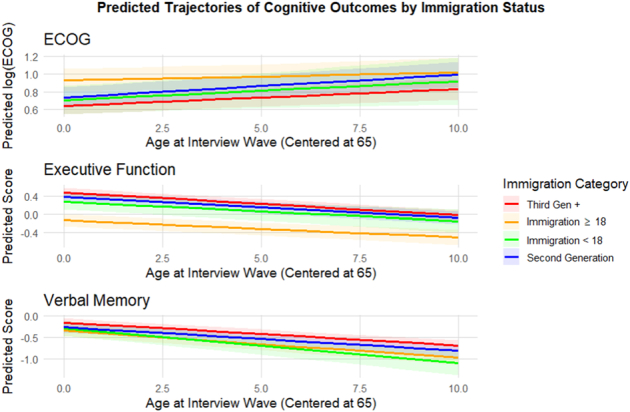
Results: Compared with third-generation participants, adulthood immigrants had worse VEM [(β = -0.19; 95% CI: -0.30, -0.08); EF (β = -0.61; -0.72, -0.50); and Ecog (β = 0.29; 0.19, 0.40)]; childhood immigrants had lower EF [β = -0.21 (-0.36, -0.05)]; and second-generation participants had worse VEM [β = -0.11 (-0.20, -0.02)], EF [β = -0.10 (-0.19, -0.01)], and Ecog [β = 0.10 (0.009, 0.18)]. Cognitive change did not differ by immigrant generation.
Conclusions: Individuals who immigrated in adulthood averaged worse cognitive scores and self-reported everyday cognition.


 求助内容:
求助内容: 应助结果提醒方式:

 京公网安备 11010802042870号


