
Bacterial Vesicles in Marine Ecosystems
IF 47.3
1区 综合性期刊
Q1 MULTIDISCIPLINARY SCIENCES
引用次数: 384
Abstract
Many heterotrophic bacteria are known to release extracellular vesicles, facilitating interactions between cells and their environment from a distance. Vesicle production has not been described in photoautotrophs, however, and the prevalence and characteristics of vesicles in natural ecosystems is unknown. Here, we report that cultures of Prochlorococcus, a numerically dominant marine cyanobacterium, continuously release lipid vesicles containing proteins, DNA, and RNA. We also show that vesicles carrying DNA from diverse bacteria are abundant in coastal and open-ocean seawater samples. Prochlorococcus vesicles can support the growth of heterotrophic bacterial cultures, which implicates these structures in marine carbon flux. The ability of vesicles to deliver diverse compounds in discrete packages adds another layer of complexity to the flow of information, energy, and biomolecules in marine microbial communities.
海洋生态系统中的细菌囊泡
众所周知,许多异养细菌会释放胞外囊泡,促进细胞与其环境之间的远距离互动。然而,在光自养型细菌中还没有关于囊泡产生的描述,自然生态系统中囊泡的普遍性和特征也不清楚。在这里,我们报告了一种在数量上占优势的海洋蓝藻--原绿球藻的培养物会不断释放出含有蛋白质、DNA 和 RNA 的脂质囊泡。我们还发现,在沿海和公海的海水样本中,含有多种细菌 DNA 的囊泡非常丰富。原绿球菌囊泡能支持异养细菌培养物的生长,这表明这些结构与海洋碳通量有关。囊泡能够以离散的包装传递各种化合物,这为海洋微生物群落中的信息、能量和生物分子流动增添了另一层复杂性。
本文章由计算机程序翻译,如有差异,请以英文原文为准。
求助全文
约1分钟内获得全文
求助全文
来源期刊
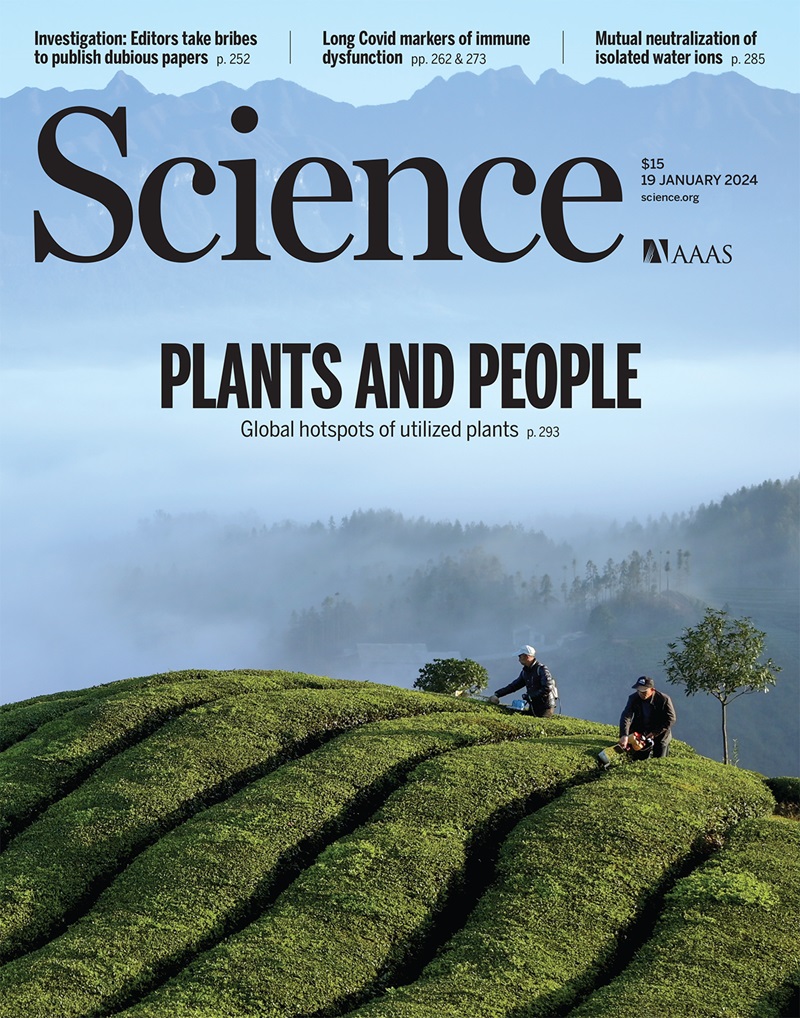
Science
综合性期刊-综合性期刊
CiteScore
61.10
自引率
0.90%
发文量
0
审稿时长
2.1 months
期刊介绍:
Science is a leading outlet for scientific news, commentary, and cutting-edge research. Through its print and online incarnations, Science reaches an estimated worldwide readership of more than one million. Science’s authorship is global too, and its articles consistently rank among the world's most cited research.
Science serves as a forum for discussion of important issues related to the advancement of science by publishing material on which a consensus has been reached as well as including the presentation of minority or conflicting points of view. Accordingly, all articles published in Science—including editorials, news and comment, and book reviews—are signed and reflect the individual views of the authors and not official points of view adopted by AAAS or the institutions with which the authors are affiliated.
Science seeks to publish those papers that are most influential in their fields or across fields and that will significantly advance scientific understanding. Selected papers should present novel and broadly important data, syntheses, or concepts. They should merit recognition by the wider scientific community and general public provided by publication in Science, beyond that provided by specialty journals. Science welcomes submissions from all fields of science and from any source. The editors are committed to the prompt evaluation and publication of submitted papers while upholding high standards that support reproducibility of published research. Science is published weekly; selected papers are published online ahead of print.
 求助内容:
 应助结果提醒方式:


 京公网安备 11010802042870号


