
Single-Cell ICP−MS Quantification of Intracellular Chromium and Cell-Surface TNFR2 for Assessing Cr(III/VI)-Induced Lung Epithelial Injury and COPD-Relevant Responses
IF 7.3
1区 化学
Q1 CHEMISTRY, ANALYTICAL
引用次数: 0
Abstract
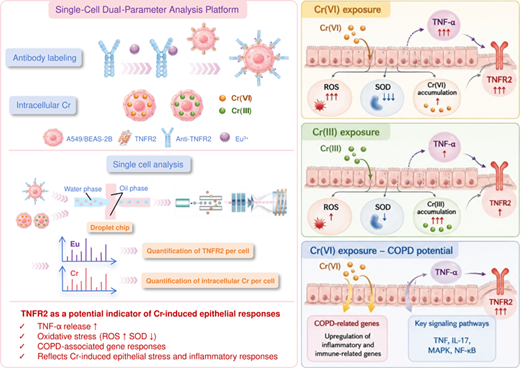
An integrated platform combining droplet microfluidics, lanthanide labeling, and inductively coupled plasma mass spectrometry (ICP−MS) was proposed to quantify intracellular heavy metal and cell-surface protein at single-cell resolution. The workflow performs parallel measurements on homologous single-cell subsets to establish statistical correlations between metal accumulation and functional protein responses. Using tumor necrosis factor receptor 2 (TNFR2) as a model protein, we investigated the effects of atmospheric particulate matter-associated heavy metals on human lung epithelial cells (BEAS-2B). Several heavy metals trigger TNFR2 upregulation, with Cr(VI) exerting the most pronounced effect. The Cr(VI)-induced increase in TNFR2 expression was associated with elevated TNF-α release, higher intracellular ROS, and reduced SOD activity but did not correlate directly with intracellular Cr accumulation, likely due to distinct cellular uptake mechanisms between Cr(III) and Cr(VI). High-concentration Cr(III) exposure, however, led to intracellular Cr enrichment and provoked inflammatory responses. Integration of differential gene expression, TNF-α release, and TNFR2 expression support TNFR2 as a potential indicator of metal-induced oxidative stress, epithelial injury, and COPD-relevant inflammatory responses. This single-cell dual-parameter approach provides a new strategy for linking metal uptake to functional protein responses in environmental toxicology.
单细胞ICP - MS定量细胞内铬和细胞表面TNFR2用于评估Cr(III/VI)诱导的肺上皮损伤和copd相关反应
提出了一种结合微滴微流体、镧系元素标记和电感耦合等离子体质谱(ICP - MS)的集成平台,以单细胞分辨率定量细胞内重金属和细胞表面蛋白。该工作流程对同源单细胞亚群进行平行测量,以建立金属积累与功能性蛋白质反应之间的统计相关性。以肿瘤坏死因子受体2 (TNFR2)为模型蛋白,研究大气颗粒物相关重金属对人肺上皮细胞(BEAS-2B)的影响。几种重金属会触发TNFR2上调,其中Cr(VI)的作用最为显著。Cr(VI)诱导的TNFR2表达增加与TNF-α释放升高、细胞内ROS升高和SOD活性降低有关,但与细胞内Cr积累没有直接关联,这可能是由于Cr(III)和Cr(VI)之间不同的细胞摄取机制。然而,高浓度的Cr(III)暴露导致细胞内Cr富集并引发炎症反应。差异基因表达、TNF-α释放和TNFR2表达的整合支持TNFR2作为金属诱导的氧化应激、上皮损伤和copd相关炎症反应的潜在指标。这种单细胞双参数方法为环境毒理学中金属摄取与功能蛋白反应的联系提供了新的策略。
本文章由计算机程序翻译,如有差异,请以英文原文为准。
求助全文
约1分钟内获得全文
求助全文
来源期刊
Analytical Chemistry
化学-分析化学
CiteScore
12.10
自引率
12.20%
发文量
1949
审稿时长
1.4 months
期刊介绍:
Analytical Chemistry, a peer-reviewed research journal, focuses on disseminating new and original knowledge across all branches of analytical chemistry. Fundamental articles may explore general principles of chemical measurement science and need not directly address existing or potential analytical methodology. They can be entirely theoretical or report experimental results. Contributions may cover various phases of analytical operations, including sampling, bioanalysis, electrochemistry, mass spectrometry, microscale and nanoscale systems, environmental analysis, separations, spectroscopy, chemical reactions and selectivity, instrumentation, imaging, surface analysis, and data processing. Papers discussing known analytical methods should present a significant, original application of the method, a notable improvement, or results on an important analyte.
 求助内容:
 应助结果提醒方式:


 京公网安备 11010802042870号


