Davide Momi, Zheng Wang, Mohammad P Oveisi, Kevin Kadak, Sorenza P Bastiaens, Jennifer I Lissemore, Yoshihiro Noda, Jonathan Downar, Fidel Vila Rodriguez, Rebecca Strafella, Zafiris J Daskalakis, Christoph Zrenner, Reza Zomorrodi, Camarin E Rolle, Manish Saggar, Nolan Williams, Corey J Keller, Daniel M Blumberger, Daphne Voineskos, John D Griffiths
{"title":"Excitation-Inhibition Balance and Fronto-Limbic Connectivity Distinguish TMS Treatment Outcomes in Refractory Depression.","authors":"Davide Momi, Zheng Wang, Mohammad P Oveisi, Kevin Kadak, Sorenza P Bastiaens, Jennifer I Lissemore, Yoshihiro Noda, Jonathan Downar, Fidel Vila Rodriguez, Rebecca Strafella, Zafiris J Daskalakis, Christoph Zrenner, Reza Zomorrodi, Camarin E Rolle, Manish Saggar, Nolan Williams, Corey J Keller, Daniel M Blumberger, Daphne Voineskos, John D Griffiths","doi":"10.1016/j.biopsych.2026.09.027","DOIUrl":null,"url":null,"abstract":"<p><strong>Background: </strong>Intermittent theta burst stimulation (iTBS) targeting the left dorsolateral prefrontal cortex (DLPFC) is effective for treatment-resistant depression, but outcomes remain variable. The neurophysiological mechanisms underlying response remain poorly understood, limiting precision neuromodulation.</p><p><strong>Methods: </strong>We combined transcranial magnetic stimulation with electroencephalography (TMS-EEG) and connectome-based Jansen-Rit neural mass modeling to investigate the mechanistic basis of treatment efficacy in 90 patients with treatment-resistant depression. Individualized whole-brain models were fitted to pre- and post-iTBS TMS-evoked potentials, yielding subject-specific estimates of synaptic connectivity, excitation-inhibition (E/I) balance, and cortical dynamics. Brain states were defined by singular value decomposition of the model's population activity, and partial least squares analysis with nested cross-validation identified the brain-state pattern distinguishing responders from non-responders.</p><p><strong>Results: </strong>We identified two neurophysiological signatures associated with treatment response. First, responders showed greater post-treatment reductions in 3-10 Hz oscillatory power, driven by shifts in E/I balance toward greater inhibitory control through reduced excitatory drive and increased inhibitory-to-pyramidal connectivity. Second, a pre-treatment brain state characterized by opposite-polarity dynamics between subgenual anterior cingulate cortex (sgACC) and left DLPFC distinguished responders from non-responders, consistent with prior fMRI findings on frontolimbic anticorrelation. Neural trajectory analysis further revealed greater dynamical reorganization and increased attractor stability in responders following treatment.</p><p><strong>Conclusions: </strong>These findings provide a neurophysiologically-informed framework linking iTBS treatment efficacy to specific changes in cortical E/I balance and frontolimbic circuit dynamics, pointing toward candidate markers that, with subject-specific structural connectivity and independent validation, may inform personalized neuromodulation approaches in treatment-resistant depression.</p>","PeriodicalId":8918,"journal":{"name":"Biological Psychiatry","volume":" ","pages":""},"PeriodicalIF":10.3000,"publicationDate":"2026-10-12","publicationTypes":"Journal Article","fieldsOfStudy":null,"isOpenAccess":false,"openAccessPdf":"","citationCount":"0","resultStr":null,"platform":"Semanticscholar","paperid":null,"PeriodicalName":"Biological Psychiatry","FirstCategoryId":"3","ListUrlMain":"https://doi.org/10.1016/j.biopsych.2026.09.027","RegionNum":1,"RegionCategory":"医学","ArticlePicture":[],"TitleCN":null,"AbstractTextCN":null,"PMCID":null,"EPubDate":"","PubModel":"","JCR":"Q1","JCRName":"NEUROSCIENCES","Score":null,"Total":0}
引用次数: 0
Abstract
Background: Intermittent theta burst stimulation (iTBS) targeting the left dorsolateral prefrontal cortex (DLPFC) is effective for treatment-resistant depression, but outcomes remain variable. The neurophysiological mechanisms underlying response remain poorly understood, limiting precision neuromodulation.
Methods: We combined transcranial magnetic stimulation with electroencephalography (TMS-EEG) and connectome-based Jansen-Rit neural mass modeling to investigate the mechanistic basis of treatment efficacy in 90 patients with treatment-resistant depression. Individualized whole-brain models were fitted to pre- and post-iTBS TMS-evoked potentials, yielding subject-specific estimates of synaptic connectivity, excitation-inhibition (E/I) balance, and cortical dynamics. Brain states were defined by singular value decomposition of the model's population activity, and partial least squares analysis with nested cross-validation identified the brain-state pattern distinguishing responders from non-responders.
Results: We identified two neurophysiological signatures associated with treatment response. First, responders showed greater post-treatment reductions in 3-10 Hz oscillatory power, driven by shifts in E/I balance toward greater inhibitory control through reduced excitatory drive and increased inhibitory-to-pyramidal connectivity. Second, a pre-treatment brain state characterized by opposite-polarity dynamics between subgenual anterior cingulate cortex (sgACC) and left DLPFC distinguished responders from non-responders, consistent with prior fMRI findings on frontolimbic anticorrelation. Neural trajectory analysis further revealed greater dynamical reorganization and increased attractor stability in responders following treatment.
Conclusions: These findings provide a neurophysiologically-informed framework linking iTBS treatment efficacy to specific changes in cortical E/I balance and frontolimbic circuit dynamics, pointing toward candidate markers that, with subject-specific structural connectivity and independent validation, may inform personalized neuromodulation approaches in treatment-resistant depression.
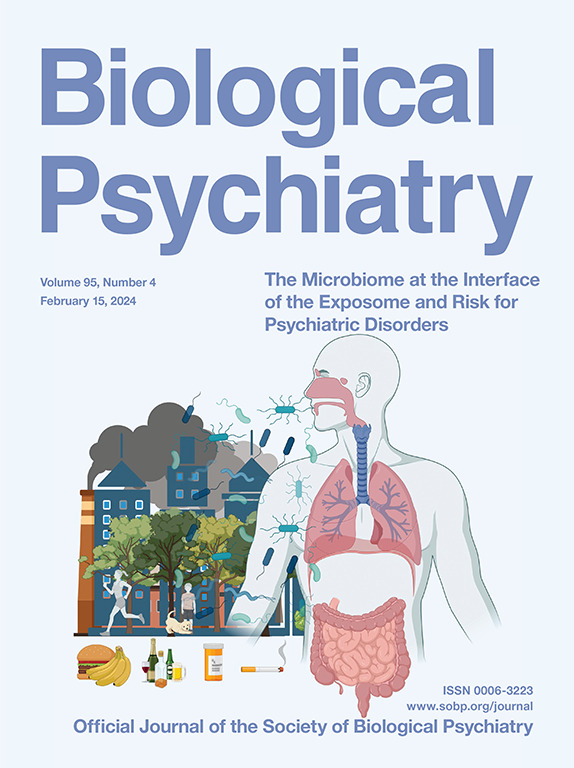
期刊介绍:
Biological Psychiatry is an official journal of the Society of Biological Psychiatry and was established in 1969. It is the first journal in the Biological Psychiatry family, which also includes Biological Psychiatry: Cognitive Neuroscience and Neuroimaging and Biological Psychiatry: Global Open Science. The Society's main goal is to promote excellence in scientific research and education in the fields related to the nature, causes, mechanisms, and treatments of disorders pertaining to thought, emotion, and behavior. To fulfill this mission, Biological Psychiatry publishes peer-reviewed, rapid-publication articles that present new findings from original basic, translational, and clinical mechanistic research, ultimately advancing our understanding of psychiatric disorders and their treatment. The journal also encourages the submission of reviews and commentaries on current research and topics of interest.

 求助内容:
 应助结果提醒方式:


 京公网安备 11010802042870号


