Sadi Ege Parim, Thomas E Hooper, Lewis R Owen, Derek C Sinclair
{"title":"Polymorphism, negative thermal expansion and electrical properties of SrNb<sub>2</sub>O<sub>6</sub>.","authors":"Sadi Ege Parim, Thomas E Hooper, Lewis R Owen, Derek C Sinclair","doi":"10.1039/d6tc01467d","DOIUrl":null,"url":null,"abstract":"<p><p>A combination of variable temperature X-ray diffraction, thermal analysis, and electrical measurements by fixed frequency dielectric spectroscopy, impedance spectroscopy, and electro-motive force measurements are used to establish the structure-electrical properties of SrNb<sub>2</sub>O<sub>6</sub> ceramics prepared by the conventional solid state reaction technique. A polymorphic phase transition from a monoclinic, m, (space group <i>P</i>2<sub>1</sub>/<i>c</i>) to an orthorhombic, o, (space group, <i>Pmcn</i> that is isomorphic with <i>Pnma</i>, CaTa<sub>2</sub>O<sub>6</sub>) cell occurs at ∼420 °C, accompanied by a negative thermal expansion effect (NTE) along the <i>a</i>-axis. The NTE in the monoclinic phase is driven primarily by a buckling of Nb<sub>2</sub>O<sub>10</sub> dimers linked by corners sharing anions along the <i>b</i>-axis combined with a switch in their canting arrangement along the <i>c</i>-axis across the m- to o-transition. SrNb<sub>2</sub>O<sub>6</sub> ceramics show no evidence of ferroelectricity; however, they display dielectric behaviour below ∼300 °C with m-SrNb<sub>2</sub>O<sub>6</sub> exhibiting a room temperature permittivity of ∼30 that approximately doubles on transformation to o-SrNb<sub>2</sub>O<sub>6</sub>. There is significant leakage conductivity associated with adsorption of moisture near room temperature and mixed oxide-ion and p-type electronic conductivity at >300 °C. Both of these space charge related mechanisms are possible origins of the anomalous behaviour in the dielectric spectroscopy measurements that give rise to the apparent ferroelectric behaviour and mask the intrinsic electrical properties of SrNb<sub>2</sub>O<sub>6</sub>.</p>","PeriodicalId":84,"journal":{"name":"Journal of Materials Chemistry C","volume":" ","pages":""},"PeriodicalIF":5.1000,"publicationDate":"2026-09-16","publicationTypes":"Journal Article","fieldsOfStudy":null,"isOpenAccess":false,"openAccessPdf":"https://www.ncbi.nlm.nih.gov/pmc/articles/PMC13637028/pdf/","citationCount":"0","resultStr":null,"platform":"Semanticscholar","paperid":null,"PeriodicalName":"Journal of Materials Chemistry C","FirstCategoryId":"1","ListUrlMain":"https://doi.org/10.1039/d6tc01467d","RegionNum":2,"RegionCategory":"材料科学","ArticlePicture":[],"TitleCN":null,"AbstractTextCN":null,"PMCID":null,"EPubDate":"","PubModel":"","JCR":"Q2","JCRName":"MATERIALS SCIENCE, MULTIDISCIPLINARY","Score":null,"Total":0}
引用次数: 0
Abstract
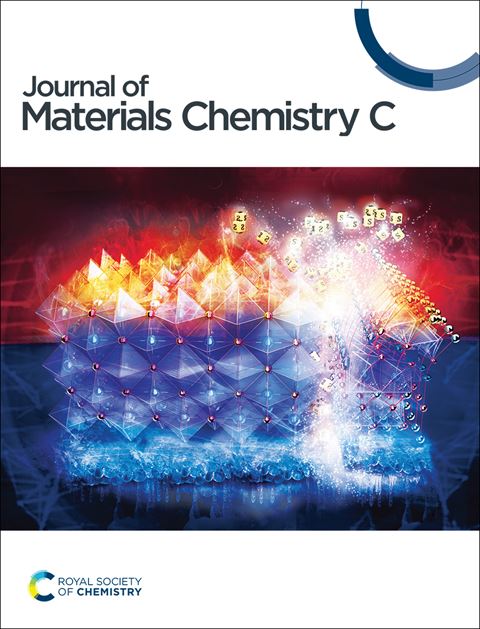
A combination of variable temperature X-ray diffraction, thermal analysis, and electrical measurements by fixed frequency dielectric spectroscopy, impedance spectroscopy, and electro-motive force measurements are used to establish the structure-electrical properties of SrNb2O6 ceramics prepared by the conventional solid state reaction technique. A polymorphic phase transition from a monoclinic, m, (space group P21/c) to an orthorhombic, o, (space group, Pmcn that is isomorphic with Pnma, CaTa2O6) cell occurs at ∼420 °C, accompanied by a negative thermal expansion effect (NTE) along the a-axis. The NTE in the monoclinic phase is driven primarily by a buckling of Nb2O10 dimers linked by corners sharing anions along the b-axis combined with a switch in their canting arrangement along the c-axis across the m- to o-transition. SrNb2O6 ceramics show no evidence of ferroelectricity; however, they display dielectric behaviour below ∼300 °C with m-SrNb2O6 exhibiting a room temperature permittivity of ∼30 that approximately doubles on transformation to o-SrNb2O6. There is significant leakage conductivity associated with adsorption of moisture near room temperature and mixed oxide-ion and p-type electronic conductivity at >300 °C. Both of these space charge related mechanisms are possible origins of the anomalous behaviour in the dielectric spectroscopy measurements that give rise to the apparent ferroelectric behaviour and mask the intrinsic electrical properties of SrNb2O6.
期刊介绍:
The Journal of Materials Chemistry is divided into three distinct sections, A, B, and C, each catering to specific applications of the materials under study:
Journal of Materials Chemistry A focuses primarily on materials intended for applications in energy and sustainability.
Journal of Materials Chemistry B specializes in materials designed for applications in biology and medicine.
Journal of Materials Chemistry C is dedicated to materials suitable for applications in optical, magnetic, and electronic devices.
Example topic areas within the scope of Journal of Materials Chemistry C are listed below. This list is neither exhaustive nor exclusive.
Bioelectronics
Conductors
Detectors
Dielectrics
Displays
Ferroelectrics
Lasers
LEDs
Lighting
Liquid crystals
Memory
Metamaterials
Multiferroics
Photonics
Photovoltaics
Semiconductors
Sensors
Single molecule conductors
Spintronics
Superconductors
Thermoelectrics
Topological insulators
Transistors

 求助内容:
 应助结果提醒方式:


 京公网安备 11010802042870号


