
Flow and Similar Attentional States in Autism and ADHD: A Scoping Review of Similarities and Differences
IF 9.5
1区 心理学
Q1 PSYCHOLOGY, MULTIDISCIPLINARY
引用次数: 0
Abstract
Flow is a state of optimal engagement. Autistic individuals and individuals with attention-deficit/hyperactivity disorder (ADHD) might have variations in flow-like experiences, such as hyperfocus, autistic inertia, and monotropism, that diverge from traditional or typical definitions. Following the Preferred Reporting Items for Systematic reviews and Meta-Analyses extension for Scoping Reviews (PRISMA-ScR) guidelines, we systematically reviewed 43 publications, including empirical studies, reviews, and other literature, to examine these constructs. Results showed that attentional experiences associated with neurodivergence overlap with, but also differ notably from, typical flow. Autistic inertia hinders task initiation and transitions, in contrast to flow’s seamless engagement. Monotropism involves rigid, directed focus and repetitive, tenacious engagement, whereas flow allows for flexible adaptations to challenges. Hyperfocus is like flow regarding intense concentration and immersion but is often involuntary, lacks clear goals, and is associated with emotional dysregulation. Although commonalities exist across these attentional experiences, the greatest overlap occurs within autistic inertia, monotropism, and hyperfocus. Attention in autistic and ADHD individuals might be more dynamic than previously believed, with potential for transitions between these experiences. This fluidity can enhance focus and productivity but may also lead to negative outcomes, such as overly rigid fixation or difficulty engaging with and disengaging from tasks. Clarifying these differences and overlaps can inform tailored interventions and supports, helping neurodivergent individuals manage focus, reduce task-related stress, and optimize productivity.自闭症和ADHD的心流和相似注意状态:相似性和差异的范围审查
心流是一种最佳参与状态。自闭症患者和患有注意力缺陷/多动障碍(ADHD)的患者可能会有不同于传统或典型定义的流样体验,如过度集中、自闭症惯性和单向性。根据系统评价的首选报告项目和范围评价的元分析扩展(PRISMA-ScR)指南,我们系统地回顾了43篇出版物,包括实证研究、综述和其他文献,以检验这些结构。结果表明,与神经分化相关的注意体验与典型的心流重叠,但也明显不同。与心流的无缝参与相反,自闭症惯性阻碍了任务的启动和过渡。单向性包括僵化的、定向的专注和重复的、顽强的参与,而心流则允许灵活地适应挑战。过度专注就像高度集中和沉浸的心流,但往往是无意识的,缺乏明确的目标,并与情绪失调有关。尽管这些注意力体验存在共性,但最大的重叠发生在自闭症惯性、单向性和过度聚焦。自闭症和多动症患者的注意力可能比以前认为的更有活力,在这些经历之间有可能发生转变。这种流动性可以提高注意力和效率,但也可能导致负面结果,比如过于僵化的固定或难以参与和脱离任务。澄清这些差异和重叠可以为量身定制的干预和支持提供信息,帮助神经分化个体管理注意力,减少任务相关压力,并优化生产力。
本文章由计算机程序翻译,如有差异,请以英文原文为准。
求助全文
约1分钟内获得全文
求助全文
来源期刊
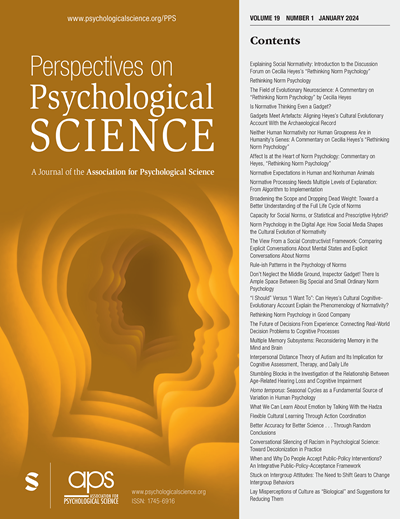
Perspectives on Psychological Science
PSYCHOLOGY, MULTIDISCIPLINARY-
CiteScore
22.70
自引率
4.00%
发文量
111
期刊介绍:
Perspectives on Psychological Science is a journal that publishes a diverse range of articles and reports in the field of psychology. The journal includes broad integrative reviews, overviews of research programs, meta-analyses, theoretical statements, book reviews, and articles on various topics such as the philosophy of science and opinion pieces about major issues in the field. It also features autobiographical reflections of senior members of the field, occasional humorous essays and sketches, and even has a section for invited and submitted articles.
The impact of the journal can be seen through the reverberation of a 2009 article on correlative analyses commonly used in neuroimaging studies, which still influences the field. Additionally, a recent special issue of Perspectives, featuring prominent researchers discussing the "Next Big Questions in Psychology," is shaping the future trajectory of the discipline.
Perspectives on Psychological Science provides metrics that showcase the performance of the journal. However, the Association for Psychological Science, of which the journal is a signatory of DORA, recommends against using journal-based metrics for assessing individual scientist contributions, such as for hiring, promotion, or funding decisions. Therefore, the metrics provided by Perspectives on Psychological Science should only be used by those interested in evaluating the journal itself.
 求助内容:
 应助结果提醒方式:


 京公网安备 11010802042870号


