
Atomistic Insights of Orbital Engineering in a-CuO Through First-Principles Study

IF 4.6 2区 工程技术 Q2 ENGINEERING, ELECTRICAL & ELECTRONIC
IEEE Electron Device Letters Pub Date : 2026-10-01 Epub Date: 2026-08-24 DOI:10.1109/LED.2026.3726776
M. Julie Therese;Vikash Mishra;Tejendra Dixit
{"title":"Atomistic Insights of Orbital Engineering in a-CuO Through First-Principles Study","authors":"M. Julie Therese;Vikash Mishra;Tejendra Dixit","doi":"10.1109/LED.2026.3726776","DOIUrl":null,"url":null,"abstract":"First-principles calculations were performed to investigate the structural, electronic, optical, and magnetic properties of amorphous CuO (a-CuO) through orbital engineering. The representative locally distorted CuO models were validated using the melt-quench molecular dynamics approach (MD), confirming the local structural rearrangements associated with amorphization. Partial density-of-states (PDOS) analysis reveals p-type behavior with Cu-3d states dominating the valence and conduction bands, accompanied by reduced t<sub>2g</sub>-e<sub>g</sub> crystal-field splitting. The reduced orbital splitting enhances Cu-3d/O-2p hybridization, leading to lower exciton binding energy extracted from the optical absorption spectra. Structural disorder also increases the magnetic moment and results in a threefold enhancement in carrier mobility. Furthermore, the Au/CuO/Au device is studied under both dark and illuminated conditions, where a-CuO demonstrates a better photocurrent density of 124.63 mA/cm<sup>2</sup> at 1 V as compared to c-CuO.","PeriodicalId":13198,"journal":{"name":"IEEE Electron Device Letters","volume":"47 10","pages":"2111-2114"},"PeriodicalIF":4.6000,"publicationDate":"2026-10-01","publicationTypes":"Journal Article","fieldsOfStudy":null,"isOpenAccess":false,"openAccessPdf":"","citationCount":"0","resultStr":null,"platform":"Semanticscholar","paperid":null,"PeriodicalName":"IEEE Electron Device Letters","FirstCategoryId":"5","ListUrlMain":"https://ieeexplore.ieee.org/document/11664393/","RegionNum":2,"RegionCategory":"工程技术","ArticlePicture":[],"TitleCN":null,"AbstractTextCN":null,"PMCID":null,"EPubDate":"2026/8/24 0:00:00","PubModel":"Epub","JCR":"Q2","JCRName":"ENGINEERING, ELECTRICAL & ELECTRONIC","Score":null,"Total":0}
引用次数: 0

Abstract

First-principles calculations were performed to investigate the structural, electronic, optical, and magnetic properties of amorphous CuO (a-CuO) through orbital engineering. The representative locally distorted CuO models were validated using the melt-quench molecular dynamics approach (MD), confirming the local structural rearrangements associated with amorphization. Partial density-of-states (PDOS) analysis reveals p-type behavior with Cu-3d states dominating the valence and conduction bands, accompanied by reduced t2g-eg crystal-field splitting. The reduced orbital splitting enhances Cu-3d/O-2p hybridization, leading to lower exciton binding energy extracted from the optical absorption spectra. Structural disorder also increases the magnetic moment and results in a threefold enhancement in carrier mobility. Furthermore, the Au/CuO/Au device is studied under both dark and illuminated conditions, where a-CuO demonstrates a better photocurrent density of 124.63 mA/cm2 at 1 V as compared to c-CuO.
基于第一性原理研究的a-CuO轨道工程的原子性洞察
通过轨道工程对非晶CuO (a-CuO)的结构、电子、光学和磁性进行了第一性原理计算。采用熔融-淬火分子动力学方法(MD)验证了具有代表性的局部扭曲CuO模型,证实了与非晶化相关的局部结构重排。偏态密度(PDOS)分析显示了p型行为,Cu-3d态主导价带和导带,并伴有t2g-eg晶体场分裂减少。减少的轨道分裂增强了Cu-3d/O-2p杂化,导致从光学吸收光谱中提取的激子结合能降低。结构紊乱也增加了磁矩,导致载流子迁移率提高了三倍。此外,在黑暗和光照条件下对Au/CuO/Au器件进行了研究,其中a-CuO在1 V时的光电流密度为124.63 mA/cm2,优于c-CuO。
本文章由计算机程序翻译,如有差异,请以英文原文为准。
求助全文
约1分钟内获得全文 求助全文
来源期刊
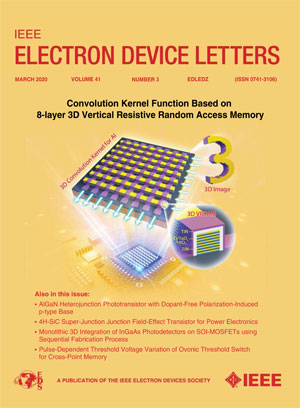
IEEE Electron Device Letters
IEEE Electron Device Letters 工程技术-工程:电子与电气
CiteScore
8.20
自引率
10.20%
发文量
551
审稿时长
1.4 months
期刊介绍: IEEE Electron Device Letters publishes original and significant contributions relating to the theory, modeling, design, performance and reliability of electron and ion integrated circuit devices and interconnects, involving insulators, metals, organic materials, micro-plasmas, semiconductors, quantum-effect structures, vacuum devices, and emerging materials with applications in bioelectronics, biomedical electronics, computation, communications, displays, microelectromechanics, imaging, micro-actuators, nanoelectronics, optoelectronics, photovoltaics, power ICs and micro-sensors.

×
引用
GB/T 7714-2015
复制
MLA
复制
APA
复制
导出至
BibTeX EndNote RefMan NoteFirst NoteExpress
×
提示
您的信息不完整,为了账户安全,请先补充。
现在去补充
×
提示
您因"违规操作"
具体请查看互助需知
我知道了
×
提示
确定
请完成安全验证×
copy
已复制链接
快去分享给好友吧!
我知道了
右上角分享
点击右上角分享
0
联系我们:info@booksci.cn Book学术提供免费学术资源搜索服务,方便国内外学者检索中英文文献。致力于提供最便捷和优质的服务体验。 Copyright © 2023 布克学术 All rights reserved.
京ICP备2023020795号-1
ghs 京公网安备 11010802042870号
Book学术文献互助
Book学术文献互助群
群 号:604180095
Book学术官方微信
小红书


