{"title":"The Responsibility-Power-Justice Nexus: A Framework for Reorienting Behavioral Science Toward Power and Justice.","authors":"Gulnaz Anjum, Mudassar Aziz","doi":"10.1177/17456916261468309","DOIUrl":null,"url":null,"abstract":"<p><p>Behavioral science has achieved remarkable policy influence, yet the problems it addresses, such as climate change, health inequality, and financial precarity, have worsened. We argue this is no coincidence. The field suffers from systematic power-blindness: it treats individuals as abstract decision makers while bracketing the structural forces that shape their behavioral possibilities. This article develops the responsibility-power-justice (RPJ) nexus framework as a corrective, advancing two foundational claims. First, power is not external to behavior but constitutive of it; every behavioral intervention embeds claims about who bears responsibility for problems and solutions. Second, justice is not a normative standard applied after behavioral analysis, but a causal mechanism operating within it: Tax compliance depends on perceived fairness, health behaviors reflect institutional trust, and cooperation requires beliefs about equitable burden-sharing. Across climate policy, public health, and economic governance, we demonstrate a consistent pattern: powerful actors reframe structural problems as individual failures, behavioral science supplies the intellectual tool kit, and interventions redistribute responsibility downward while leaving power structures intact. We trace this pattern to the field's roots in methodological individualism, its privileging of individual-level experiments, and its institutional entanglement with prevailing governance arrangements. We conclude by outlining what a justice-oriented behavioral science would require.</p>","PeriodicalId":19757,"journal":{"name":"Perspectives on Psychological Science","volume":" ","pages":"17456916261468309"},"PeriodicalIF":9.5000,"publicationDate":"2026-09-24","publicationTypes":"Journal Article","fieldsOfStudy":null,"isOpenAccess":false,"openAccessPdf":"","citationCount":"0","resultStr":null,"platform":"Semanticscholar","paperid":null,"PeriodicalName":"Perspectives on Psychological Science","FirstCategoryId":"102","ListUrlMain":"https://doi.org/10.1177/17456916261468309","RegionNum":1,"RegionCategory":"心理学","ArticlePicture":[],"TitleCN":null,"AbstractTextCN":null,"PMCID":null,"EPubDate":"","PubModel":"","JCR":"Q1","JCRName":"PSYCHOLOGY, MULTIDISCIPLINARY","Score":null,"Total":0}
引用次数: 0
Abstract
Behavioral science has achieved remarkable policy influence, yet the problems it addresses, such as climate change, health inequality, and financial precarity, have worsened. We argue this is no coincidence. The field suffers from systematic power-blindness: it treats individuals as abstract decision makers while bracketing the structural forces that shape their behavioral possibilities. This article develops the responsibility-power-justice (RPJ) nexus framework as a corrective, advancing two foundational claims. First, power is not external to behavior but constitutive of it; every behavioral intervention embeds claims about who bears responsibility for problems and solutions. Second, justice is not a normative standard applied after behavioral analysis, but a causal mechanism operating within it: Tax compliance depends on perceived fairness, health behaviors reflect institutional trust, and cooperation requires beliefs about equitable burden-sharing. Across climate policy, public health, and economic governance, we demonstrate a consistent pattern: powerful actors reframe structural problems as individual failures, behavioral science supplies the intellectual tool kit, and interventions redistribute responsibility downward while leaving power structures intact. We trace this pattern to the field's roots in methodological individualism, its privileging of individual-level experiments, and its institutional entanglement with prevailing governance arrangements. We conclude by outlining what a justice-oriented behavioral science would require.
期刊介绍:
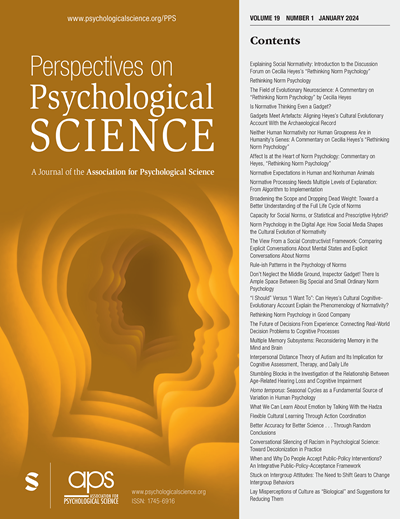
Perspectives on Psychological Science is a journal that publishes a diverse range of articles and reports in the field of psychology. The journal includes broad integrative reviews, overviews of research programs, meta-analyses, theoretical statements, book reviews, and articles on various topics such as the philosophy of science and opinion pieces about major issues in the field. It also features autobiographical reflections of senior members of the field, occasional humorous essays and sketches, and even has a section for invited and submitted articles.
The impact of the journal can be seen through the reverberation of a 2009 article on correlative analyses commonly used in neuroimaging studies, which still influences the field. Additionally, a recent special issue of Perspectives, featuring prominent researchers discussing the "Next Big Questions in Psychology," is shaping the future trajectory of the discipline.
Perspectives on Psychological Science provides metrics that showcase the performance of the journal. However, the Association for Psychological Science, of which the journal is a signatory of DORA, recommends against using journal-based metrics for assessing individual scientist contributions, such as for hiring, promotion, or funding decisions. Therefore, the metrics provided by Perspectives on Psychological Science should only be used by those interested in evaluating the journal itself.

 求助内容:
 应助结果提醒方式:


 京公网安备 11010802042870号


