Jamie Swaine, Cyprien Bone, Prakriti Kayastha, Matthew T Darby, Ewan Galloway, Keith T Butler
{"title":"Conditional generative models enable targeted exploration of MAX phase design space.","authors":"Jamie Swaine, Cyprien Bone, Prakriti Kayastha, Matthew T Darby, Ewan Galloway, Keith T Butler","doi":"10.1039/d6tc01390b","DOIUrl":null,"url":null,"abstract":"<p><p>MAX phases (M <sub><i>n</i>+1</sub>AX <sub><i>n</i></sub> ), precursors to MXenes, span a vast compositional space, motivating efficient computational screening for synthesisable candidates. We employ CrystaLLM-π, a large language model fine-tuned on 6179 double transition-metal MAX phases, and demonstrate its ability to generate novel structures consistent with known experimental trends. Using a conditioning vector with two dimensions (a statistically derived MXene derivative count and a surrogate for A-site binding energy), the model was able to target MXene-favourable regions of phase space for generation. Specific condition vectors double novel stable structure generation rates <i>versus</i> unconditioned baselines. Of ten compositionally novel candidates, five exhibit DFT-validated (<i>meta</i>)stability (<i>E</i> <sub>hull</sub> < 0.050 eV per atom). This work showcases the potential for autoregressive generative models to explore targeted materials' spaces, offering a scalable framework for accelerated discovery in compositionally complex systems.</p>","PeriodicalId":84,"journal":{"name":"Journal of Materials Chemistry C","volume":"14 35","pages":"16099-16110"},"PeriodicalIF":5.1000,"publicationDate":"2026-07-23","publicationTypes":"Journal Article","fieldsOfStudy":null,"isOpenAccess":false,"openAccessPdf":"https://www.ncbi.nlm.nih.gov/pmc/articles/PMC13584821/pdf/","citationCount":"0","resultStr":null,"platform":"Semanticscholar","paperid":null,"PeriodicalName":"Journal of Materials Chemistry C","FirstCategoryId":"1","ListUrlMain":"https://doi.org/10.1039/d6tc01390b","RegionNum":2,"RegionCategory":"材料科学","ArticlePicture":[],"TitleCN":null,"AbstractTextCN":null,"PMCID":null,"EPubDate":"2026/9/17 0:00:00","PubModel":"eCollection","JCR":"Q2","JCRName":"MATERIALS SCIENCE, MULTIDISCIPLINARY","Score":null,"Total":0}
引用次数: 0
Abstract
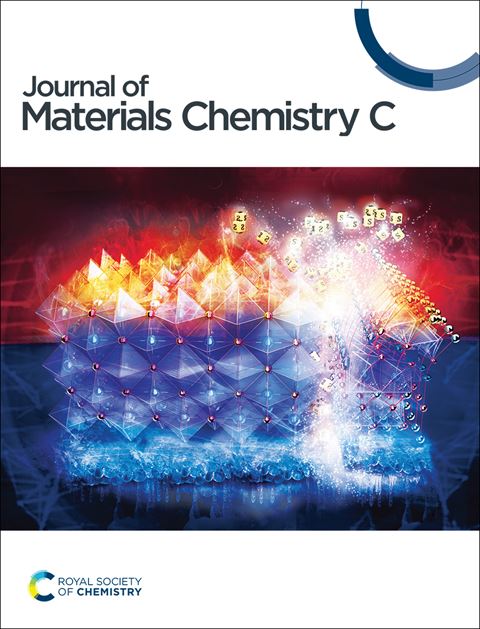
MAX phases (M n+1AX n ), precursors to MXenes, span a vast compositional space, motivating efficient computational screening for synthesisable candidates. We employ CrystaLLM-π, a large language model fine-tuned on 6179 double transition-metal MAX phases, and demonstrate its ability to generate novel structures consistent with known experimental trends. Using a conditioning vector with two dimensions (a statistically derived MXene derivative count and a surrogate for A-site binding energy), the model was able to target MXene-favourable regions of phase space for generation. Specific condition vectors double novel stable structure generation rates versus unconditioned baselines. Of ten compositionally novel candidates, five exhibit DFT-validated (meta)stability (Ehull < 0.050 eV per atom). This work showcases the potential for autoregressive generative models to explore targeted materials' spaces, offering a scalable framework for accelerated discovery in compositionally complex systems.
期刊介绍:
The Journal of Materials Chemistry is divided into three distinct sections, A, B, and C, each catering to specific applications of the materials under study:
Journal of Materials Chemistry A focuses primarily on materials intended for applications in energy and sustainability.
Journal of Materials Chemistry B specializes in materials designed for applications in biology and medicine.
Journal of Materials Chemistry C is dedicated to materials suitable for applications in optical, magnetic, and electronic devices.
Example topic areas within the scope of Journal of Materials Chemistry C are listed below. This list is neither exhaustive nor exclusive.
Bioelectronics
Conductors
Detectors
Dielectrics
Displays
Ferroelectrics
Lasers
LEDs
Lighting
Liquid crystals
Memory
Metamaterials
Multiferroics
Photonics
Photovoltaics
Semiconductors
Sensors
Single molecule conductors
Spintronics
Superconductors
Thermoelectrics
Topological insulators
Transistors

 求助内容:
 应助结果提醒方式:


 京公网安备 11010802042870号


