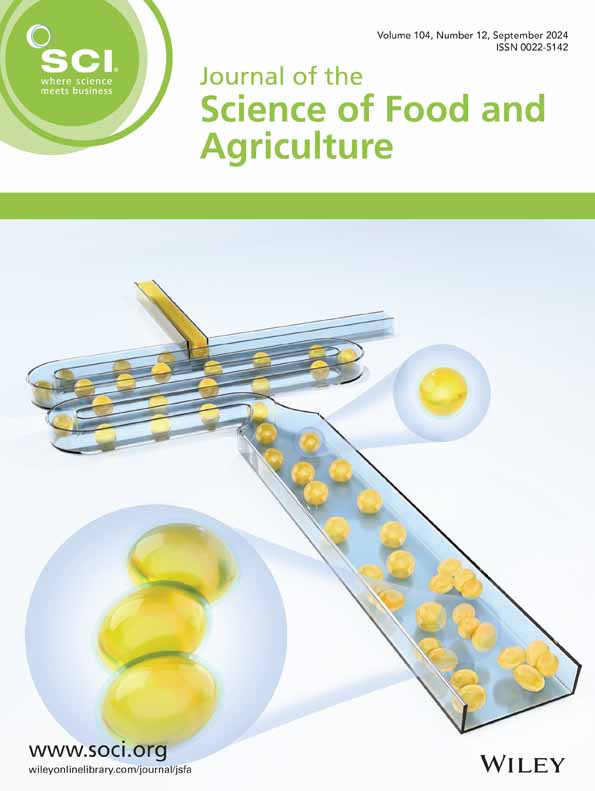
Impact of rutin-protein nanoparticles on extruded recombinant rice: structure, digestibility and in vitro fermentation.

IF 4 2区 农林科学 Q1 AGRICULTURE, MULTIDISCIPLINARY
Journal of the Science of Food and Agriculture Pub Date : 2026-11-01 Epub Date: 2026-07-14 DOI:10.1002/jsfa.70891
Zigao Chen, Yuteng Fu, Xiuting Hu, Shunjing Luo, Jiangping Ye, Chengmei Liu
{"title":"Impact of rutin-protein nanoparticles on extruded recombinant rice: structure, digestibility and in vitro fermentation.","authors":"Zigao Chen, Yuteng Fu, Xiuting Hu, Shunjing Luo, Jiangping Ye, Chengmei Liu","doi":"10.1002/jsfa.70891","DOIUrl":null,"url":null,"abstract":"<p><strong>Background: </strong>Rutin, a flavonol polyphenol, inhibits α-glucosidase activity and reduces starch digestibility, yet its application is limited by poor aqueous solubility, poor thermal stability, and low bioaccessibility. Rutin-protein nanoparticles have been shown to improve rutin stability. This study aimed to investigate how rutin-protein nanoparticles modulate the digestibility of extruded recombinant rice through multi-scale structural characterization, in vitro digestibility analysis, and in vitro fermentation evaluation.</p><p><strong>Results: </strong>Multi-scale structural analysis revealed that rutin was successfully incorporated into the recombinant rice matrix, interacting with starch chains through hydrogen bonding. This interaction promoted the transformation of starch crystallinity from A-type to A- + V-type. Additionally, the short-range order and the content of single and double helices increased. In vitro digestion experiments demonstrated that the bioaccessibility of rutin in the recombinant rice reached 92.49% after co-extrusion with rutin nanoparticles. The resistant starch content was significantly increased, while C<sub>∞</sub> (final digestion extent) and eGI (estimated glycemic index) value were significantly reduced. Moreover, in vitro fermentation results indicated that the recombinant rice with rutin nanoparticles contributed to reducing gas production and increasing the yields of propionate and butyrate.</p><p><strong>Conclusion: </strong>Rutin nanoparticles modulate starch digestibility through a dual mechanism involving the modification of starch structural domains and rutin bioaccessibility. This study provides a novel strategy and technical support for the development of low-glycemic-index functional staple foods. © 2026 Society of Chemical Industry.</p>","PeriodicalId":17725,"journal":{"name":"Journal of the Science of Food and Agriculture","volume":" ","pages":"8813-8823"},"PeriodicalIF":4.0000,"publicationDate":"2026-11-01","publicationTypes":"Journal Article","fieldsOfStudy":null,"isOpenAccess":false,"openAccessPdf":"","citationCount":"0","resultStr":null,"platform":"Semanticscholar","paperid":null,"PeriodicalName":"Journal of the Science of Food and Agriculture","FirstCategoryId":"97","ListUrlMain":"https://doi.org/10.1002/jsfa.70891","RegionNum":2,"RegionCategory":"农林科学","ArticlePicture":[],"TitleCN":null,"AbstractTextCN":null,"PMCID":null,"EPubDate":"2026/7/14 0:00:00","PubModel":"Epub","JCR":"Q1","JCRName":"AGRICULTURE, MULTIDISCIPLINARY","Score":null,"Total":0}
引用次数: 0

Abstract

Background: Rutin, a flavonol polyphenol, inhibits α-glucosidase activity and reduces starch digestibility, yet its application is limited by poor aqueous solubility, poor thermal stability, and low bioaccessibility. Rutin-protein nanoparticles have been shown to improve rutin stability. This study aimed to investigate how rutin-protein nanoparticles modulate the digestibility of extruded recombinant rice through multi-scale structural characterization, in vitro digestibility analysis, and in vitro fermentation evaluation.

Results: Multi-scale structural analysis revealed that rutin was successfully incorporated into the recombinant rice matrix, interacting with starch chains through hydrogen bonding. This interaction promoted the transformation of starch crystallinity from A-type to A- + V-type. Additionally, the short-range order and the content of single and double helices increased. In vitro digestion experiments demonstrated that the bioaccessibility of rutin in the recombinant rice reached 92.49% after co-extrusion with rutin nanoparticles. The resistant starch content was significantly increased, while C∞ (final digestion extent) and eGI (estimated glycemic index) value were significantly reduced. Moreover, in vitro fermentation results indicated that the recombinant rice with rutin nanoparticles contributed to reducing gas production and increasing the yields of propionate and butyrate.

Conclusion: Rutin nanoparticles modulate starch digestibility through a dual mechanism involving the modification of starch structural domains and rutin bioaccessibility. This study provides a novel strategy and technical support for the development of low-glycemic-index functional staple foods. © 2026 Society of Chemical Industry.

芦丁蛋白纳米颗粒对挤压重组米的影响:结构、消化率和体外发酵。
背景:芦丁是一种黄酮醇多酚,具有抑制α-葡萄糖苷酶活性和降低淀粉消化率的作用,但其水溶性差、热稳定性差、生物可及性低等限制了其应用。芦丁蛋白纳米颗粒已被证明可以提高芦丁的稳定性。本研究旨在通过多尺度结构表征、体外消化率分析和体外发酵评价来研究芦丁蛋白纳米颗粒如何调节膨化重组大米的消化率。结果:多尺度结构分析表明,芦丁成功融入重组水稻基质中,并通过氢键与淀粉链相互作用。这种相互作用促进了淀粉结晶度由A型向A- + v型转变。此外,单螺旋和双螺旋的近程阶数和含量增加。体外消化实验表明,与纳米颗粒共挤压后,重组水稻中芦丁的生物可达92.49%。抗性淀粉含量显著升高,最终消化程度C∞和血糖指数eGI值显著降低。此外,体外发酵结果表明,加入纳米颗粒芦丁的重组大米有助于减少产气量,提高丙酸和丁酸的产量。结论:芦丁纳米颗粒通过改变淀粉结构域和调节芦丁生物可及性的双重机制调节淀粉消化率。本研究为低血糖指数功能性主食的开发提供了新的策略和技术支持。©2026化学工业协会。
本文章由计算机程序翻译,如有差异,请以英文原文为准。
求助全文
约1分钟内获得全文 求助全文
来源期刊
CiteScore
8.10
自引率
4.90%
发文量
634
审稿时长
3.1 months
期刊介绍: The Journal of the Science of Food and Agriculture publishes peer-reviewed original research, reviews, mini-reviews, perspectives and spotlights in these areas, with particular emphasis on interdisciplinary studies at the agriculture/ food interface. Published for SCI by John Wiley & Sons Ltd. SCI (Society of Chemical Industry) is a unique international forum where science meets business on independent, impartial ground. Anyone can join and current Members include consumers, business people, environmentalists, industrialists, farmers, and researchers. The Society offers a chance to share information between sectors as diverse as food and agriculture, pharmaceuticals, biotechnology, materials, chemicals, environmental science and safety. As well as organising educational events, SCI awards a number of prestigious honours and scholarships each year, publishes peer-reviewed journals, and provides Members with news from their sectors in the respected magazine, Chemistry & Industry . Originally established in London in 1881 and in New York in 1894, SCI is a registered charity with Members in over 70 countries.

文献相关原料
原料信息
原料厂家
1
X-ray diffractometer
2
solid-state 13C CP/MAS NMR spectrometer
3
scanning electron microscope
4
twin-screw extruder FMHE36-24
5
GraphPad Prism
6
IBM SPSS Statistics
7
Broken rice
8
stereomicroscope
9
UV–visible spectrophotometer
11
Soy protein isolate
12
Porcine pancreas enzyme
13
Salivary amylase
14
FTIR spectrometer
15
Short-chain fatty acid standards
16
Pepsin
17
22
Amyloglucosidase
9032-08-0
¥15.00-¥49169.62
×
引用
GB/T 7714-2015
复制
MLA
复制
APA
复制
导出至
BibTeX EndNote RefMan NoteFirst NoteExpress
×
提示
您的信息不完整,为了账户安全,请先补充。
现在去补充
×
提示
您因"违规操作"
具体请查看互助需知
我知道了
×
提示
确定
请完成安全验证×
copy
已复制链接
快去分享给好友吧!
我知道了
右上角分享
点击右上角分享
0
联系我们:info@booksci.cn Book学术提供免费学术资源搜索服务,方便国内外学者检索中英文文献。致力于提供最便捷和优质的服务体验。 Copyright © 2023 布克学术 All rights reserved.
京ICP备2023020795号-1
ghs 京公网安备 11010802042870号
Book学术文献互助
Book学术文献互助群
群 号:604180095
Book学术官方微信
小红书