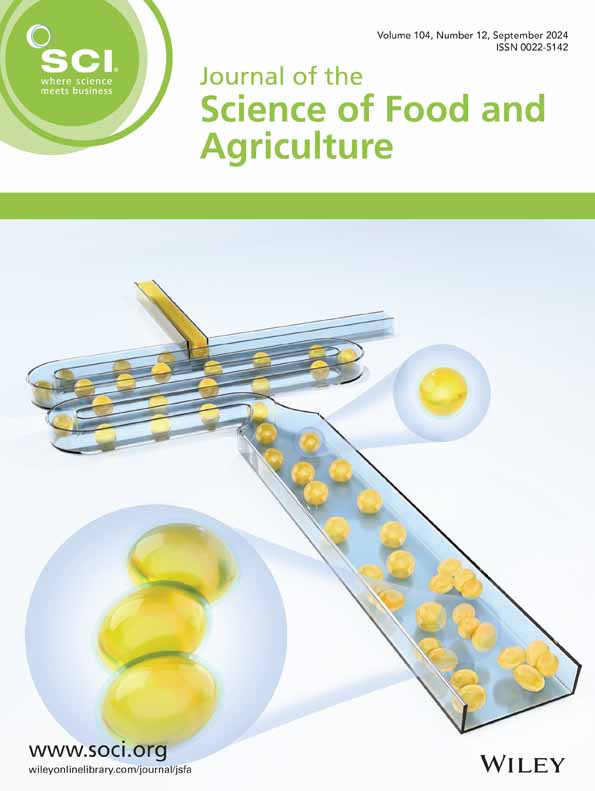
Development and application of novel acetylated starch-chitosan-oregano essential oil active extrudates for meat product microbiological preservation.

IF 4 2区 农林科学 Q1 AGRICULTURE, MULTIDISCIPLINARY
Journal of the Science of Food and Agriculture Pub Date : 2026-11-01 Epub Date: 2026-07-06 DOI:10.1002/jsfa.70877
Maury S Hernández, Leandro N Ludueña, Silvia K Flores
{"title":"Development and application of novel acetylated starch-chitosan-oregano essential oil active extrudates for meat product microbiological preservation.","authors":"Maury S Hernández, Leandro N Ludueña, Silvia K Flores","doi":"10.1002/jsfa.70877","DOIUrl":null,"url":null,"abstract":"<p><strong>Background: </strong>Developing biodegradable active packaging with improved mechanical and antimicrobial properties remains a key challenge in food preservation. This study evaluated the physical and antimicrobial performance of extruded sheets based on a base mixture of acetylated tapioca starch, glycerol and water (BMAS), chitosan (CH) and oregano essential oil (OEO).</p><p><strong>Methods: </strong>Extruded sheets with varying BMAS, CH and OEO proportions were formulated using a simplex centroid mixture design. Mechanical properties, water solubility, color and thermal behavior were analyzed. Sheets antimicrobial activity was tested in contact with a chicken meat-based food against external contamination by Escherichia coli, Listeria innocua, Enterococcus faecium, or Zygosaccharomyces bailii.</p><p><strong>Results: </strong>Two optimal formulations (g kg<sup>-1</sup>) were identified: central point (853.3 BMAS, 93.3 CH, 53.3 OEO) and S7 (840 BMAS, 80 CH, 80 OEO), both showing the highest stress at break (≈ 1.06 MPa), but maximum (105%) and minimal (26%) deformation, respectively. Water solubility was 40% for central point and 47% for S7. OEO increased mechanical resistance but reduced solubility compared to controls without oil. Acetylation improved tensile strength, solubility and whiteness, though slightly decreasing thermal stability. Regarding antimicrobial barrier action, the effectiveness was microorganism dependent: while Z. bailii was not detected along storage, Escherichia coli was more sensitive than L. innocua and Enterococcus faecium.</p><p><strong>Conclusion: </strong>The present findings indicate that the developed extrudates are promising candidates for biodegradable active food packaging. The retained availability of OEO effectively contributed to microbial spoilage control, with Z. bailii and Escherichia coli exhibiting greater susceptibility compared to L. innocua and Enterococcus faecium. © 2026 Society of Chemical Industry.</p>","PeriodicalId":17725,"journal":{"name":"Journal of the Science of Food and Agriculture","volume":" ","pages":"8604-8616"},"PeriodicalIF":4.0000,"publicationDate":"2026-11-01","publicationTypes":"Journal Article","fieldsOfStudy":null,"isOpenAccess":false,"openAccessPdf":"","citationCount":"0","resultStr":null,"platform":"Semanticscholar","paperid":null,"PeriodicalName":"Journal of the Science of Food and Agriculture","FirstCategoryId":"97","ListUrlMain":"https://doi.org/10.1002/jsfa.70877","RegionNum":2,"RegionCategory":"农林科学","ArticlePicture":[],"TitleCN":null,"AbstractTextCN":null,"PMCID":null,"EPubDate":"2026/7/6 0:00:00","PubModel":"Epub","JCR":"Q1","JCRName":"AGRICULTURE, MULTIDISCIPLINARY","Score":null,"Total":0}
引用次数: 0

Abstract

Background: Developing biodegradable active packaging with improved mechanical and antimicrobial properties remains a key challenge in food preservation. This study evaluated the physical and antimicrobial performance of extruded sheets based on a base mixture of acetylated tapioca starch, glycerol and water (BMAS), chitosan (CH) and oregano essential oil (OEO).

Methods: Extruded sheets with varying BMAS, CH and OEO proportions were formulated using a simplex centroid mixture design. Mechanical properties, water solubility, color and thermal behavior were analyzed. Sheets antimicrobial activity was tested in contact with a chicken meat-based food against external contamination by Escherichia coli, Listeria innocua, Enterococcus faecium, or Zygosaccharomyces bailii.

Results: Two optimal formulations (g kg-1) were identified: central point (853.3 BMAS, 93.3 CH, 53.3 OEO) and S7 (840 BMAS, 80 CH, 80 OEO), both showing the highest stress at break (≈ 1.06 MPa), but maximum (105%) and minimal (26%) deformation, respectively. Water solubility was 40% for central point and 47% for S7. OEO increased mechanical resistance but reduced solubility compared to controls without oil. Acetylation improved tensile strength, solubility and whiteness, though slightly decreasing thermal stability. Regarding antimicrobial barrier action, the effectiveness was microorganism dependent: while Z. bailii was not detected along storage, Escherichia coli was more sensitive than L. innocua and Enterococcus faecium.

Conclusion: The present findings indicate that the developed extrudates are promising candidates for biodegradable active food packaging. The retained availability of OEO effectively contributed to microbial spoilage control, with Z. bailii and Escherichia coli exhibiting greater susceptibility compared to L. innocua and Enterococcus faecium. © 2026 Society of Chemical Industry.

新型乙酰化淀粉-壳聚糖-牛至油活性挤出剂的研制与应用。
背景:开发具有更好的机械性能和抗菌性能的生物可降解活性包装仍然是食品保鲜的关键挑战。本研究考察了乙酰化木薯淀粉、甘油和水(BMAS)、壳聚糖(CH)和牛至油(OEO)混合基料制成的挤压片的物理性能和抗菌性能。方法:采用单形质心混合设计制备不同BMAS、CH和OEO配比的挤压片材。分析了材料的力学性能、水溶性、颜色和热性能。在与鸡肉为基础的食品接触时,测试了床单对大肠杆菌、无性李斯特菌、屎肠球菌或白耳酵母等外部污染的抗菌活性。结果:确定了两种最佳配方(g kg-1):中心点(853.3 BMAS, 93.3 CH, 53.3 OEO)和S7 (840 BMAS, 80 CH, 80 OEO),均表现出最高的断裂应力(≈1.06 MPa),但变形最大(105%)和最小(26%)。溶解度中心点为40%,S7为47%。与无油对照相比,OEO增加了机械阻力,但降低了溶解度。乙酰化提高了抗拉强度、溶解度和白度,但稍微降低了热稳定性。在抗菌屏障作用方面,其效果与微生物有关:贮藏过程中未检出百氏弧菌,而大肠杆菌对百氏弧菌的敏感性高于无菌乳杆菌和屎肠球菌。结论:所制备的挤出物是生物可降解活性食品包装的理想材料。保留OEO的有效性有效地促进了微生物腐败控制,与L. innocua和屎肠球菌相比,Z. bailii和大肠杆菌表现出更强的易感性。©2026化学工业协会。
本文章由计算机程序翻译,如有差异,请以英文原文为准。
求助全文
约1分钟内获得全文 求助全文
来源期刊
CiteScore
8.10
自引率
4.90%
发文量
634
审稿时长
3.1 months
期刊介绍: The Journal of the Science of Food and Agriculture publishes peer-reviewed original research, reviews, mini-reviews, perspectives and spotlights in these areas, with particular emphasis on interdisciplinary studies at the agriculture/ food interface. Published for SCI by John Wiley & Sons Ltd. SCI (Society of Chemical Industry) is a unique international forum where science meets business on independent, impartial ground. Anyone can join and current Members include consumers, business people, environmentalists, industrialists, farmers, and researchers. The Society offers a chance to share information between sectors as diverse as food and agriculture, pharmaceuticals, biotechnology, materials, chemicals, environmental science and safety. As well as organising educational events, SCI awards a number of prestigious honours and scholarships each year, publishes peer-reviewed journals, and provides Members with news from their sectors in the respected magazine, Chemistry & Industry . Originally established in London in 1881 and in New York in 1894, SCI is a registered charity with Members in over 70 countries.

×
引用
GB/T 7714-2015
复制
MLA
复制
APA
复制
导出至
BibTeX EndNote RefMan NoteFirst NoteExpress
×
提示
您的信息不完整,为了账户安全,请先补充。
现在去补充
×
提示
您因"违规操作"
具体请查看互助需知
我知道了
×
提示
确定
请完成安全验证×
copy
已复制链接
快去分享给好友吧!
我知道了
右上角分享
点击右上角分享
0
联系我们:info@booksci.cn Book学术提供免费学术资源搜索服务,方便国内外学者检索中英文文献。致力于提供最便捷和优质的服务体验。 Copyright © 2023 布克学术 All rights reserved.
京ICP备2023020795号-1
ghs 京公网安备 11010802042870号
Book学术文献互助
Book学术文献互助群
群 号:604180095
Book学术官方微信
小红书