Wei Wang, Siqi Wang, Yan Wang, Di Rong, Ruize Yuan, Zaiqian Yu and Shiwei Wang
{"title":"TiO2-driven enhancement of electrochromic performance of polymer electrolytes: insights and mechanisms","authors":"Wei Wang, Siqi Wang, Yan Wang, Di Rong, Ruize Yuan, Zaiqian Yu and Shiwei Wang","doi":"10.1039/D6TC00134C","DOIUrl":null,"url":null,"abstract":"<p >In recent years, electrochromic laminated glass has been widely used in automobiles and buildings due to its comfort and energy efficiency; however, its promotion is limited due to its complex structure. Herein, a TiO<small><sub>2</sub></small> enhanced conductive polyvinyl butyral (PVB) film has been constructed by a blending process. Its ionic conductivity can reach as high as 9.6 × 10<small><sup>−4</sup></small> S cm<small><sup>−1</sup></small>, which is attributed to the higher number of lithium ion transport channels in the composite film. Also, a corresponding electrochromic device (ECD) with a FTO/WO<small><sub>3</sub></small>/PVB/NiO/FTO structure and dimensions of 10 × 10 cm<small><sup>2</sup></small> was assembled <em>via</em> a hot press process, and the enhancement in electrochromic performance was systematically evaluated. The tensile strength reached 34.6 MPa, the elongation at break reached 141%, and the adhesive strength was 5.5 MPa, which is equivalent to an automotive grade PVB film. Drop ball tests show that, for a 190 cm drop height with a 30 g mass, the device loses only 1.2% of its mass, which confirms its excellent safety. The device not only exhibited a fast response time of 4 s at a low voltage of ±3 V, but also demonstrated excellent electrochemical stability and cycling reversibility over 10 000 CV cycles. This work clarifies the coupling relationship between ion transport and device color change, demonstrating the potential application value in ECDs. Subsequent research can further integrate interfacial engineering strategies to advance the integration and application of CPE in practical devices.</p>","PeriodicalId":84,"journal":{"name":"Journal of Materials Chemistry C","volume":" 23","pages":" 10315-10322"},"PeriodicalIF":5.1000,"publicationDate":"2026-04-23","publicationTypes":"Journal Article","fieldsOfStudy":null,"isOpenAccess":false,"openAccessPdf":"","citationCount":"0","resultStr":null,"platform":"Semanticscholar","paperid":null,"PeriodicalName":"Journal of Materials Chemistry C","FirstCategoryId":"1","ListUrlMain":"https://pubs.rsc.org/en/content/articlelanding/2026/tc/d6tc00134c","RegionNum":2,"RegionCategory":"材料科学","ArticlePicture":[],"TitleCN":null,"AbstractTextCN":null,"PMCID":null,"EPubDate":"","PubModel":"","JCR":"Q2","JCRName":"MATERIALS SCIENCE, MULTIDISCIPLINARY","Score":null,"Total":0}
引用次数: 0
Abstract
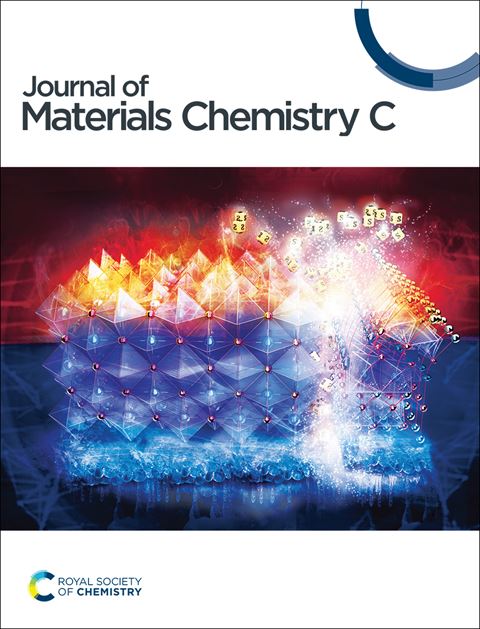
In recent years, electrochromic laminated glass has been widely used in automobiles and buildings due to its comfort and energy efficiency; however, its promotion is limited due to its complex structure. Herein, a TiO2 enhanced conductive polyvinyl butyral (PVB) film has been constructed by a blending process. Its ionic conductivity can reach as high as 9.6 × 10⁻⁴ S cm−1, which is attributed to the higher number of lithium ion transport channels in the composite film. Also, a corresponding electrochromic device (ECD) with a FTO/WO3/PVB/NiO/FTO structure and dimensions of 10 × 10 cm2 was assembled via a hot press process, and the enhancement in electrochromic performance was systematically evaluated. The tensile strength reached 34.6 MPa, the elongation at break reached 141%, and the adhesive strength was 5.5 MPa, which is equivalent to an automotive grade PVB film. Drop ball tests show that, for a 190 cm drop height with a 30 g mass, the device loses only 1.2% of its mass, which confirms its excellent safety. The device not only exhibited a fast response time of 4 s at a low voltage of ±3 V, but also demonstrated excellent electrochemical stability and cycling reversibility over 10 000 CV cycles. This work clarifies the coupling relationship between ion transport and device color change, demonstrating the potential application value in ECDs. Subsequent research can further integrate interfacial engineering strategies to advance the integration and application of CPE in practical devices.
期刊介绍:
The Journal of Materials Chemistry is divided into three distinct sections, A, B, and C, each catering to specific applications of the materials under study:
Journal of Materials Chemistry A focuses primarily on materials intended for applications in energy and sustainability.
Journal of Materials Chemistry B specializes in materials designed for applications in biology and medicine.
Journal of Materials Chemistry C is dedicated to materials suitable for applications in optical, magnetic, and electronic devices.
Example topic areas within the scope of Journal of Materials Chemistry C are listed below. This list is neither exhaustive nor exclusive.
Bioelectronics
Conductors
Detectors
Dielectrics
Displays
Ferroelectrics
Lasers
LEDs
Lighting
Liquid crystals
Memory
Metamaterials
Multiferroics
Photonics
Photovoltaics
Semiconductors
Sensors
Single molecule conductors
Spintronics
Superconductors
Thermoelectrics
Topological insulators
Transistors


 求助内容:
 应助结果提醒方式:


 京公网安备 11010802042870号


