Yixuan Li, Yaxin Zhao, Yiren Chen, Rongxue Zhou, Yi Wang, Ziyuan Huang, Ying Li, Ke Jiang, Xiaojuan Sun, Weili Yu and Dabing Li
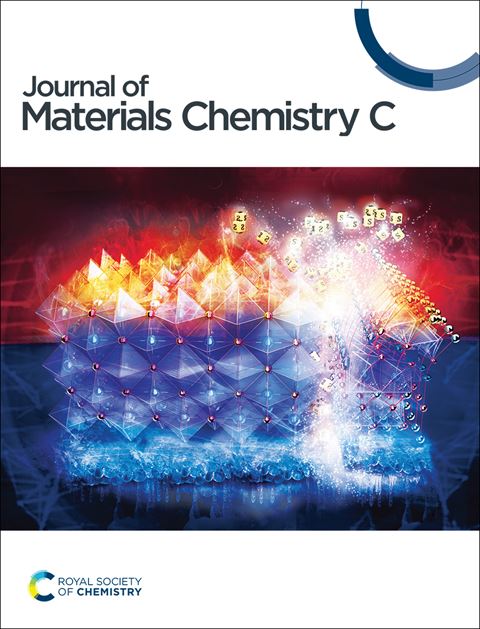
{"title":"Broad-spectrum (UV-vis-Nir) high-performance photodetector based on perovskite/quantum dot tandem heterostructure","authors":"Yixuan Li, Yaxin Zhao, Yiren Chen, Rongxue Zhou, Yi Wang, Ziyuan Huang, Ying Li, Ke Jiang, Xiaojuan Sun, Weili Yu and Dabing Li","doi":"10.1039/D6TC00776G","DOIUrl":null,"url":null,"abstract":"<p >Organic–inorganic hybrid perovskite materials demonstrate significant potential in photodetection due to their outstanding optoelectronic properties. However, their inherent structural characteristics result in limited light response in the ultraviolet and near-infrared bands (>800 nm), severely limiting their applications in multiband imaging, optical communications, and biomedical detection. This study extended the spectral response range of devices from the ultraviolet to the short-wave infrared region (1000–1600 nm) by constructing a heterojunction structure between PbS colloidal quantum dots (CQDs) and FA<small><sub>0.9</sub></small>Cs<small><sub>0.1</sub></small>PbI<small><sub>3</sub></small> perovskite (PSK) thin films. The results indicate that a Type-II band alignment at the PbS/perovskite heterojunction interface promotes efficient separation and transport of photo-generated carriers. The fabricated ITO/SnO<small><sub>2</sub></small>/PbS/FA<small><sub>0.9</sub></small>Cs<small><sub>0.1</sub></small>PbI<small><sub>3</sub></small>/Au device achieved responsivities of 82.5 mA W<small><sup>−1</sup></small> at 280 nm (UV), 319.3 mA W<small><sup>−1</sup></small> at 520 nm (visible), and 63.3 mA W<small><sup>−1</sup></small> at 1550 nm (near-IR), with specific detectivities (<em>D</em>*) of 4.3 × 10<small><sup>10</sup></small>, 1.7 × 10<small><sup>11</sup></small>, and 3.3 × 10<small><sup>12</sup></small>, respectively. This heterojunction detector exhibits fast response characteristics (rise/fall time: 160 ms/80 ms) under a 0.6 V bias. This study provides a novel material system and device design strategy for developing high-performance, low-cost multiband photodetectors.</p>","PeriodicalId":84,"journal":{"name":"Journal of Materials Chemistry C","volume":" 22","pages":" 9459-9466"},"PeriodicalIF":5.1000,"publicationDate":"2026-06-03","publicationTypes":"Journal Article","fieldsOfStudy":null,"isOpenAccess":false,"openAccessPdf":"","citationCount":"0","resultStr":null,"platform":"Semanticscholar","paperid":null,"PeriodicalName":"Journal of Materials Chemistry C","FirstCategoryId":"1","ListUrlMain":"https://pubs.rsc.org/en/content/articlelanding/2026/tc/d6tc00776g","RegionNum":2,"RegionCategory":"材料科学","ArticlePicture":[],"TitleCN":null,"AbstractTextCN":null,"PMCID":null,"EPubDate":"","PubModel":"","JCR":"Q2","JCRName":"MATERIALS SCIENCE, MULTIDISCIPLINARY","Score":null,"Total":0}
引用次数: 0
Abstract
Organic–inorganic hybrid perovskite materials demonstrate significant potential in photodetection due to their outstanding optoelectronic properties. However, their inherent structural characteristics result in limited light response in the ultraviolet and near-infrared bands (>800 nm), severely limiting their applications in multiband imaging, optical communications, and biomedical detection. This study extended the spectral response range of devices from the ultraviolet to the short-wave infrared region (1000–1600 nm) by constructing a heterojunction structure between PbS colloidal quantum dots (CQDs) and FA0.9Cs0.1PbI3 perovskite (PSK) thin films. The results indicate that a Type-II band alignment at the PbS/perovskite heterojunction interface promotes efficient separation and transport of photo-generated carriers. The fabricated ITO/SnO2/PbS/FA0.9Cs0.1PbI3/Au device achieved responsivities of 82.5 mA W−1 at 280 nm (UV), 319.3 mA W−1 at 520 nm (visible), and 63.3 mA W−1 at 1550 nm (near-IR), with specific detectivities (D*) of 4.3 × 10¹⁰, 1.7 × 10¹¹, and 3.3 × 10¹², respectively. This heterojunction detector exhibits fast response characteristics (rise/fall time: 160 ms/80 ms) under a 0.6 V bias. This study provides a novel material system and device design strategy for developing high-performance, low-cost multiband photodetectors.
有机-无机杂化钙钛矿材料由于其优异的光电性能,在光探测领域显示出巨大的潜力。然而,其固有的结构特性导致其在紫外和近红外波段(>800 nm)的光响应有限,严重限制了其在多波段成像、光通信和生物医学检测方面的应用。本研究通过构建PbS胶体量子点(CQDs)与FA0.9Cs0.1PbI3钙钛矿(PSK)薄膜之间的异质结结构,将器件的光谱响应范围从紫外扩展到短波红外区域(1000-1600 nm)。结果表明,在PbS/钙钛矿异质结界面处的ii型带对准促进了光生载流子的有效分离和输运。所制备的ITO/SnO2/PbS/FA0.9Cs0.1PbI3/Au器件在280 nm(紫外)、520 nm(可见光)和1550 nm(近红外)的响应度分别为82.5 mA W - 1、319.3 mA W - 1和63.3 mA W - 1,比检出率(D*)分别为4.3 × 10¹⁰、1.7 × 10¹¹和3.3 × 10¹²。该异质结检测器在0.6 V偏置下具有快速响应特性(上升/下降时间:160 ms/80 ms)。本研究为开发高性能、低成本的多波段光电探测器提供了一种新的材料体系和器件设计策略。
期刊介绍:
The Journal of Materials Chemistry is divided into three distinct sections, A, B, and C, each catering to specific applications of the materials under study:
Journal of Materials Chemistry A focuses primarily on materials intended for applications in energy and sustainability.
Journal of Materials Chemistry B specializes in materials designed for applications in biology and medicine.
Journal of Materials Chemistry C is dedicated to materials suitable for applications in optical, magnetic, and electronic devices.
Example topic areas within the scope of Journal of Materials Chemistry C are listed below. This list is neither exhaustive nor exclusive.
Bioelectronics
Conductors
Detectors
Dielectrics
Displays
Ferroelectrics
Lasers
LEDs
Lighting
Liquid crystals
Memory
Metamaterials
Multiferroics
Photonics
Photovoltaics
Semiconductors
Sensors
Single molecule conductors
Spintronics
Superconductors
Thermoelectrics
Topological insulators
Transistors


 求助内容:
 应助结果提醒方式:


 京公网安备 11010802042870号


