
Modulation of intestinal mucosal immunity in human microbiota-associated rat by 2′-Fucosyllactose and Lacto-N-neotetraose
IF 7.3
1区 农林科学
Q1 FOOD SCIENCE & TECHNOLOGY
引用次数: 0
Abstract
The objective of this study was to investigate the role of human milk oligosaccharides, specifically 2′-Fucosyllactose and Lacto-N-neotetraose, in the immunomodulation of the intestinal mucosa in human microbiota-associated rats. Evidence from studies suggests that 2′-FL and LNnT significantly alleviate damage induced by LPS in the intestines, resulting in a notable increase in DAI scores. Furthermore, 2′-FL and LNnT have been shown to enhance the function of the intestinal barrier and improve the immunity of the intestinal mucosa. This beneficial effect is achieved by increasing the mRNA expression of proteins such as MUC2, Claudin-1, Claudin-2, and ZO-1 in the intestinal tract, while simultaneously promoting a decrease in serum D-Lactate and DAO levels. 2′-FL and LNnT may also play a significant role in ameliorating intestinal immune damage. This is accomplished by suppressing the secretion of pro-inflammatory cytokines while simultaneously augmenting the production of anti-inflammatory cytokines. Furthermore, 2′-FL and LNnT are capable of modulating the cellular immune homeostasis of essential immune cells, including CD4+/CD8+, Th1/Th2, and Th17/Treg. The findings of this study also revealed that human milk oligosaccharides can ameliorate intestinal dysbiosis triggered by LPS. This includes increasing the abundance of Muribaculaceae and Roseburia, decreasing the abundance of Escherichia-Shigella and Alloprevotella. Furthermore, we conducted a more detailed investigation into the levels of major short-chain fatty acids in the feces of rats and found that 2'-FL and LNnT significantly increased the concentrations of acetate, propionate, and butyrate in the feces of LPS-treated rats. In summary, human milk oligosaccharides demonstrate a significant improvement in intestinal mucosal immunity by refining the structure of the intestinal microbiota, enhancing the functions of the intestinal barrier, and coordinating immune responses.2′-焦酰基乳糖和n -新四糖对人微生物群相关大鼠肠道黏膜免疫的调节作用
本研究的目的是研究人乳低聚糖,特别是2 ' -聚焦乳糖和n -新四糖在人类微生物群相关大鼠肠道黏膜免疫调节中的作用。研究证据表明,2′-FL和LNnT可显著减轻LPS对肠道的损伤,导致DAI评分显著升高。此外,2 ' -FL和LNnT已被证明可以增强肠道屏障功能,提高肠道黏膜的免疫力。这种有益效果是通过增加肠道MUC2、Claudin-1、Claudin-2和ZO-1等蛋白的mRNA表达,同时促进血清d -乳酸和DAO水平的降低来实现的。2 ' -FL和LNnT也可能在改善肠道免疫损伤中发挥重要作用。这是通过抑制促炎细胞因子的分泌,同时增加抗炎细胞因子的产生来实现的。此外,2 ' -FL和LNnT能够调节必需免疫细胞的细胞免疫稳态,包括CD4+/CD8+、Th1/Th2和Th17/Treg。本研究结果还表明,人乳低聚糖可改善LPS引起的肠道生态失调。这包括增加Muribaculaceae和Roseburia的丰度,减少Escherichia-Shigella和Alloprevotella的丰度。此外,我们对大鼠粪便中主要短链脂肪酸的水平进行了更详细的调查,发现2'-FL和LNnT显著增加了lps处理大鼠粪便中醋酸盐、丙酸盐和丁酸盐的浓度。综上所述,人乳低聚糖通过改善肠道菌群结构、增强肠道屏障功能和协调免疫反应,显著改善肠道黏膜免疫。
本文章由计算机程序翻译,如有差异,请以英文原文为准。
求助全文
约1分钟内获得全文
求助全文
来源期刊
Food Science and Human Wellness
Agricultural and Biological Sciences-Food Science
CiteScore
8.30
自引率
5.70%
发文量
80
审稿时长
28 days
期刊介绍:
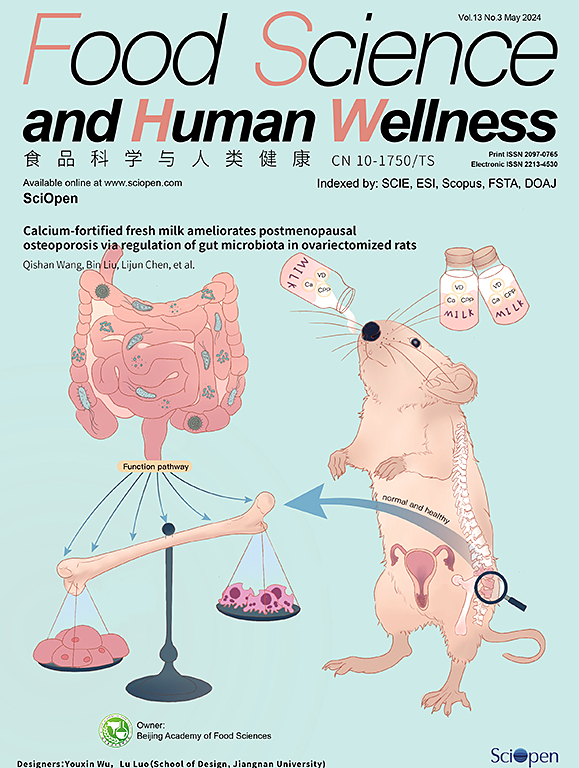
Food Science and Human Wellness is an international peer-reviewed journal that provides a forum for the dissemination of the latest scientific results in food science, nutriology, immunology and cross-field research. Articles must present information that is novel, has high impact and interest, and is of high scientific quality. By their effort, it has been developed to promote the public awareness on diet, advocate healthy diet, reduce the harm caused by unreasonable dietary habit, and directs healthy food development for food industrial producers.
 求助内容:
 应助结果提醒方式:


 京公网安备 11010802042870号


