
Sandwich-Type SERS Aptasensor Based on Aptamer-functionalized Magnetic Capture Probe and AuNPs@MIL-101 Signal Enhancement Probe for Ultrasensitive Detection of Bifidobacterium bifidum
IF 7.3
1区 农林科学
Q1 FOOD SCIENCE & TECHNOLOGY
引用次数: 0
Abstract
Rapid and on-site detection of Bifidobacterium bifidum (B. bifidum) throughout the food manufacturing process serves as an essential sentinel for assessing product quality and healthy potency. Herein, we introduce a sandwich-type surface-enhanced Raman scattering (SERS) aptasensor for B. bifidum quantification, which integrates aptamer-functionalized magnetic beads (Apt-Fe3O4) for target-specific capture and aptamer-modified gold nanoparticles/metal-organic framework composites (Apt-AuNPs@MIL-101) for SERS-based signal amplification. Experimental results revealed a strong linear correlation between the intensity of the characteristic Raman peak and the logarithmic of the B. bifidum concentrations within the range of 2.0 × 101 to 2.0 × 10⁶ CFU/mL, and the limit of detection was as low as 2.5 CFU/mL. In addition to superior sensitivity, the proposed approach demonstrated exceptional specificity against non-target bacterial strains, particularly in multi-strain coexistent systems. The method further demonstrated great potential in analysis of B. bifidum in commercial samples, showing high consistency with the results obtained from the classic qPCR method. The study established an innovative analytical platform for rapid and on-site probiotic assessment, highlighting its applicability in probiotic food products’ quality control and evaluation.基于适配体功能化磁捕获探针和AuNPs@MIL-101信号增强探针的三明治型SERS超灵敏两歧双歧杆菌检测
在整个食品生产过程中快速和现场检测两歧双歧杆菌(双歧杆菌)是评估产品质量和健康效力的重要哨兵。在此,我们介绍一个夹层表面增强喇曼散射(ser) aptasensor bifidum量化,集aptamer-functionalized磁珠(Apt-Fe3O4)有针对性的捕捉和aptamer-modified金纳米粒子/有机框架复合材料(apt - aunps@mil - 101) SERS-based信号放大。实验结果表明,在2.0 × 101 ~ 2.0 × 10⁶ CFU/mL范围内,两歧双歧杆菌浓度的对数与特征拉曼峰强度呈较强的线性相关,检出限低至2.5 CFU/mL。除了优越的灵敏度外,该方法对非目标细菌菌株具有特殊的特异性,特别是在多菌株共存的系统中。该方法在两歧双歧杆菌的商业样品分析中显示出很大的潜力,与经典qPCR方法的结果高度一致。本研究建立了一种创新的益生菌快速现场评价分析平台,突出了其在益生菌食品质量控制与评价中的适用性。
本文章由计算机程序翻译,如有差异,请以英文原文为准。
求助全文
约1分钟内获得全文
求助全文
来源期刊
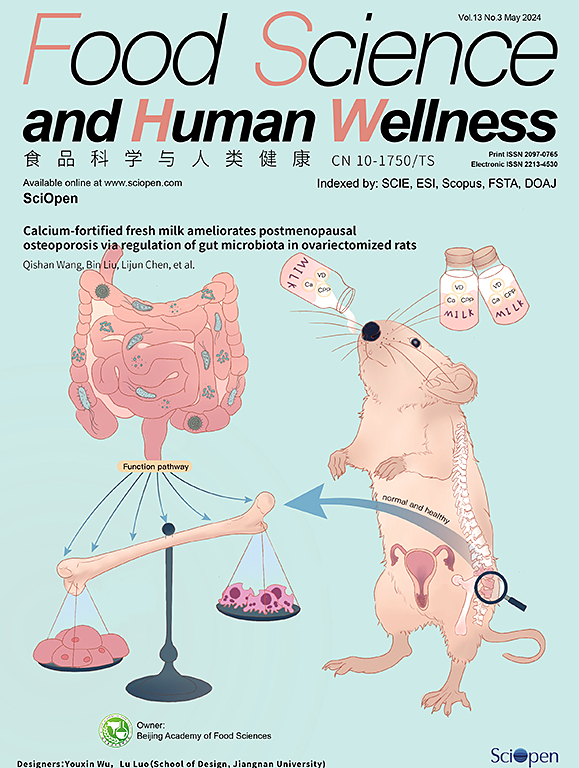
Food Science and Human Wellness
Agricultural and Biological Sciences-Food Science
CiteScore
8.30
自引率
5.70%
发文量
80
审稿时长
28 days
期刊介绍:
Food Science and Human Wellness is an international peer-reviewed journal that provides a forum for the dissemination of the latest scientific results in food science, nutriology, immunology and cross-field research. Articles must present information that is novel, has high impact and interest, and is of high scientific quality. By their effort, it has been developed to promote the public awareness on diet, advocate healthy diet, reduce the harm caused by unreasonable dietary habit, and directs healthy food development for food industrial producers.
 求助内容:
 应助结果提醒方式:


 京公网安备 11010802042870号


