
Data Mining of Key Quality Components from NATCM- Registered BPH Prescriptions, Their Quantification and Activity Optimization
IF 1.5
4区 医学
Q4 CHEMISTRY, MEDICINAL
引用次数: 0
Abstract
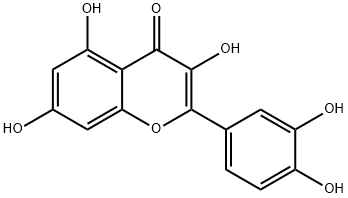
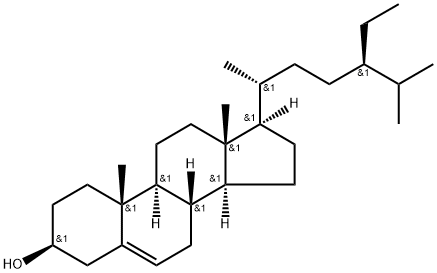
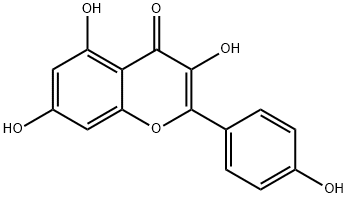
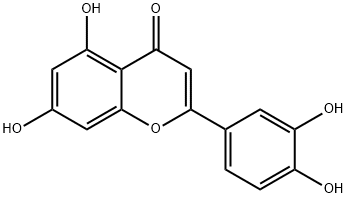
Background: Benign prostatic hyperplasia (BPH) is prevalent in elderly males. Although 28 Traditional Chinese Medicine (TCM) prescriptions are approved for BPH, their key quality components and mechanisms remain unclear. Methods: Network pharmacology and molecular docking analyzed 28 prescriptions to identify components. High-performance liquid chromatography (HPLC) quantified these components. Optimized component ratios were validated in BPH cell lines, assessing hormone (PSA, DHT, E2) and inflammatory biomarkers (NO, NOS). Results: Analysis identified 75 active compounds. Twenty-six prescriptions shared a mechanism targeting proteins (eg, TP53, AKT1). Quercetin, luteolin, kaempferol, and β-sitosterol showed stable binding to targets in 17 prescriptions; their contents were quantified across 26 prescriptions. An optimized combination (quercetin: 81 µM, luteolin: 46 µM, kaempferol: 129 µM, β-sitosterol: 82 µM; molar ratio 1:0.6:1.6:1 relative to β-sitosterol) significantly inhibited BPH cell growth by 89.6%. It reduced PSA, DHT, E2 and increased NO, NOS levels. Conclusion: The quercetin, luteolin, kaempferol, and β-sitosterol are key quality components for BPH treatment. Incorporating them at the experimentally determined ratio within safe limits significantly enhances efficacy. Consequently, these findings provide practical insights for refining TCM quality standards, identifying key quality markers, and facilitating the development of new BPH-specific TCM treatments. Future in vivo studies and clinical trials are required to confirm the therapeutic efficacy and safety of this optimized combination.NATCM注册BPH处方中关键质量成分的数据挖掘、量化及活性优化
背景:良性前列腺增生(BPH)在老年男性中普遍存在。虽然有28种中药处方被批准用于治疗BPH,但其关键质量成分和机制尚不清楚。方法:网络药理学与分子对接对28张处方进行成分鉴定。高效液相色谱(HPLC)对这些成分进行了定量分析。优化后的成分比例在BPH细胞系中进行验证,评估激素(PSA、DHT、E2)和炎症生物标志物(NO、NOS)。结果:经分析鉴定出75种有效成分。26种处方共享一种靶向蛋白质(如TP53、AKT1)的机制。槲皮素、木犀草素、山奈酚、β-谷甾醇与靶点的结合稳定;在26个处方中对其含量进行量化。槲皮素:81µM,木犀草素:46µM,山奈酚:129µM, β-谷甾醇:82µM,与β-谷甾醇的摩尔比为1:0.6:1.6:1,优化后的组合对BPH细胞生长的抑制率为89.6%。降低PSA、DHT、E2,提高NO、NOS水平。结论:槲皮素、木犀草素、山奈酚和β-谷甾醇是治疗BPH的关键品质成分。在安全限度内按实验确定的比例加入它们可显著提高疗效。因此,这些发现为完善中医药质量标准、确定关键质量标记以及促进新的bph特异性中医药治疗的开发提供了实用的见解。需要进一步的体内研究和临床试验来证实这种优化组合的治疗效果和安全性。
本文章由计算机程序翻译,如有差异,请以英文原文为准。
求助全文
约1分钟内获得全文
求助全文
来源期刊
Natural Product Communications
工程技术-食品科技
CiteScore
3.10
自引率
11.10%
发文量
254
审稿时长
2.7 months
期刊介绍:
Natural Product Communications is a peer reviewed, open access journal studying all aspects of natural products, including isolation, characterization, spectroscopic properties, biological activities, synthesis, structure-activity, biotransformation, biosynthesis, tissue culture and fermentation. It covers the full breadth of chemistry, biochemistry, biotechnology, pharmacology, and chemical ecology of natural products.
Natural Product Communications is a peer reviewed, open access journal studying all aspects of natural products, including isolation, characterization, spectroscopic properties, biological activities, synthesis, structure-activity, biotransformation, biosynthesis, tissue culture and fermentation. It covers the full breadth of chemistry, biochemistry, biotechnology, pharmacology, and chemical ecology of natural products.
Natural Product Communications is a peer reviewed, open access journal studying all aspects of natural products, including isolation, characterization, spectroscopic properties, biological activities, synthesis, structure-activity, biotransformation, biosynthesis, tissue culture and fermentation. It covers the full breadth of chemistry, biochemistry, biotechnology, pharmacology, and chemical ecology of natural products.
文献相关原料
原料信息
原料厂家
 求助内容:
求助内容: 应助结果提醒方式:

 京公网安备 11010802042870号


