Jie Yang, Jian Wu, Zhaoguang Zhu, Mingshuo Cao, Enrique Herrera-Viedma
{"title":"Maximum-Return-Driven Consensus Framework With Internal-External Compensation in Undirected Collaboration Network.","authors":"Jie Yang, Jian Wu, Zhaoguang Zhu, Mingshuo Cao, Enrique Herrera-Viedma","doi":"10.1109/TCYB.2026.3688527","DOIUrl":null,"url":null,"abstract":"<p><p>In group decision-making (GDM) involving decision-makers (DMs) with heterogeneous interests and responsibilities, such as transboundary watershed governance, consensus formation is fundamentally return-driven. This study develops a directionally asymmetric maximum-return consensus model (MRCM) with nonnegative return constraints, which shifts from a moderator-cost perspective to an individual-return perspective. To this end, a feasibility diagnosis approach integrating the minimum-slack feasibility checking model (MSFCM) and the relaxed MRCM is proposed to determine whether the MRCM is feasible. When it is not feasible, it further reveals whether the infeasibility originates from individual- or collective-level return deficits. Based on the diagnosis results, a twofold adaptive consensus framework is further developed: 1)internal compensation-driven feedback is applied when individual return deficits coexist with a nonnegative total cooperative return, reallocating surplus via an asymmetric Nash bargaining game (ANBG) without modifying the relaxed consensus outcome and 2)external compensation-driven feedback is activated when the total cooperative return is negative, with the moderator providing the minimum compensation to ensure consensus with nonnegative returns. The novelty of this work lies in developing a unified return-driven consensus mechanism governed by feasibility diagnosis by refining the new return formulation and compensation scheme. A numerical study based on the Dongjiang River Basin demonstrates that the proposed framework adaptively selects compensation strategies and effectively enhances consensus feasibility and stability.</p>","PeriodicalId":13112,"journal":{"name":"IEEE Transactions on Cybernetics","volume":"PP ","pages":""},"PeriodicalIF":10.5000,"publicationDate":"2026-05-05","publicationTypes":"Journal Article","fieldsOfStudy":null,"isOpenAccess":false,"openAccessPdf":"","citationCount":"0","resultStr":null,"platform":"Semanticscholar","paperid":null,"PeriodicalName":"IEEE Transactions on Cybernetics","FirstCategoryId":"94","ListUrlMain":"https://doi.org/10.1109/TCYB.2026.3688527","RegionNum":1,"RegionCategory":"计算机科学","ArticlePicture":[],"TitleCN":null,"AbstractTextCN":null,"PMCID":null,"EPubDate":"","PubModel":"","JCR":"Q1","JCRName":"AUTOMATION & CONTROL SYSTEMS","Score":null,"Total":0}
引用次数: 0
Abstract
In group decision-making (GDM) involving decision-makers (DMs) with heterogeneous interests and responsibilities, such as transboundary watershed governance, consensus formation is fundamentally return-driven. This study develops a directionally asymmetric maximum-return consensus model (MRCM) with nonnegative return constraints, which shifts from a moderator-cost perspective to an individual-return perspective. To this end, a feasibility diagnosis approach integrating the minimum-slack feasibility checking model (MSFCM) and the relaxed MRCM is proposed to determine whether the MRCM is feasible. When it is not feasible, it further reveals whether the infeasibility originates from individual- or collective-level return deficits. Based on the diagnosis results, a twofold adaptive consensus framework is further developed: 1)internal compensation-driven feedback is applied when individual return deficits coexist with a nonnegative total cooperative return, reallocating surplus via an asymmetric Nash bargaining game (ANBG) without modifying the relaxed consensus outcome and 2)external compensation-driven feedback is activated when the total cooperative return is negative, with the moderator providing the minimum compensation to ensure consensus with nonnegative returns. The novelty of this work lies in developing a unified return-driven consensus mechanism governed by feasibility diagnosis by refining the new return formulation and compensation scheme. A numerical study based on the Dongjiang River Basin demonstrates that the proposed framework adaptively selects compensation strategies and effectively enhances consensus feasibility and stability.
期刊介绍:
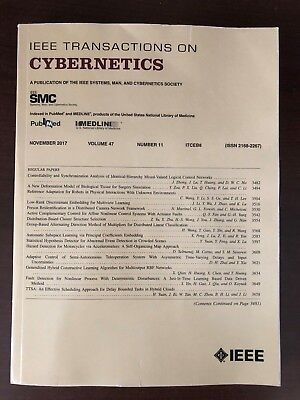
The scope of the IEEE Transactions on Cybernetics includes computational approaches to the field of cybernetics. Specifically, the transactions welcomes papers on communication and control across machines or machine, human, and organizations. The scope includes such areas as computational intelligence, computer vision, neural networks, genetic algorithms, machine learning, fuzzy systems, cognitive systems, decision making, and robotics, to the extent that they contribute to the theme of cybernetics or demonstrate an application of cybernetics principles.

 求助内容:
求助内容: 应助结果提醒方式:

 京公网安备 11010802042870号


