Isolation, structural characterization, and immunostimulatory activity of a polysaccharide from the stem of Trapa acornis Nakano on RAW264.7 macrophages
Bin Zhang, Xueping Zhang, Lei Liu, Xin Zhong, Yiting Lyu, Ke Xu, Ran Zhang, Xiaowen Shi
{"title":"Isolation, structural characterization, and immunostimulatory activity of a polysaccharide from the stem of Trapa acornis Nakano on RAW264.7 macrophages","authors":"Bin Zhang, Xueping Zhang, Lei Liu, Xin Zhong, Yiting Lyu, Ke Xu, Ran Zhang, Xiaowen Shi","doi":"10.1186/s40538-026-00935-x","DOIUrl":null,"url":null,"abstract":"<div><h3>Background</h3><p><i>Trapa acornis</i> Nakano, also known as “Nan-hu-ling” (NHL), is an important agricultural crop whose fruits are commonly consumed as food, while its stems are usually discarded as agricultural by-products.</p><h3>Methods and results</h3><p>In the current investigation, a homogeneous polysaccharide (NHLP) with a weight-average molecular weight (Mw) of 62.0 kDa was isolated from the stem of NHL. Monosaccharide composition analysis revealed that NHLP was primarily composed of Gal (24.4%), Glc (18.9%), GalA (16.8%), Xyl (12.1%), and Rha (7.7%). Methylation analysis indicated that NHLP mainly contained residues of 4-Gal<i>p</i>A, 4-Glc<i>p</i>, 4-Gal<i>p</i>, 4-Xyl<i>p</i>, 3,6-Gal<i>p</i>, t-Ara<i>f</i>, t-Gal<i>p</i>, and t-Rha<i>p</i>. The linkage patterns of these residues were structurally resolved using one- and two-dimensional nuclear magnetic resonance (NMR) spectroscopy. In vitro assays demonstrated that NHLP stimulated RAW264.7 cells to produce nitric oxide (NO) in a dose-dependent manner, promoted the release of proinflammatory cytokines including interleukin-6 (IL-6), interleukin-1β (IL-1β), and tumor necrosis factor-α (TNF-α), and upregulated transcriptional profiles of genes involved in inflammatory responses (IL-6, IL-1β, TNF-α, COX-2, iNOS, and IκBα) and proteins (iNOS, COX-2, IL-1β, and TNF-α).</p><h3>Conclusions</h3><p>This study clarified the proposed structure of the polysaccharide derived from <i>T. acornis</i> stem and its macrophage-activating effects, providing supportive evidence for its potential application in immune activation.</p><h3>Graphical abstract</h3><div><figure><div><div><picture><source><img></source></picture><span>The alternative text for this image may have been generated using AI.</span></div></div></figure></div></div>","PeriodicalId":512,"journal":{"name":"Chemical and Biological Technologies in Agriculture","volume":"13 1","pages":""},"PeriodicalIF":5.2000,"publicationDate":"2026-03-27","publicationTypes":"Journal Article","fieldsOfStudy":null,"isOpenAccess":false,"openAccessPdf":"https://link.springer.com/content/pdf/10.1186/s40538-026-00935-x.pdf","citationCount":"0","resultStr":null,"platform":"Semanticscholar","paperid":null,"PeriodicalName":"Chemical and Biological Technologies in Agriculture","FirstCategoryId":"97","ListUrlMain":"https://link.springer.com/article/10.1186/s40538-026-00935-x","RegionNum":2,"RegionCategory":"农林科学","ArticlePicture":[],"TitleCN":null,"AbstractTextCN":null,"PMCID":null,"EPubDate":"2026/5/7 0:00:00","PubModel":"Epub","JCR":"Q1","JCRName":"AGRICULTURE, MULTIDISCIPLINARY","Score":null,"Total":0}
引用次数: 0
Abstract
Background
Trapa acornis Nakano, also known as “Nan-hu-ling” (NHL), is an important agricultural crop whose fruits are commonly consumed as food, while its stems are usually discarded as agricultural by-products.
Methods and results
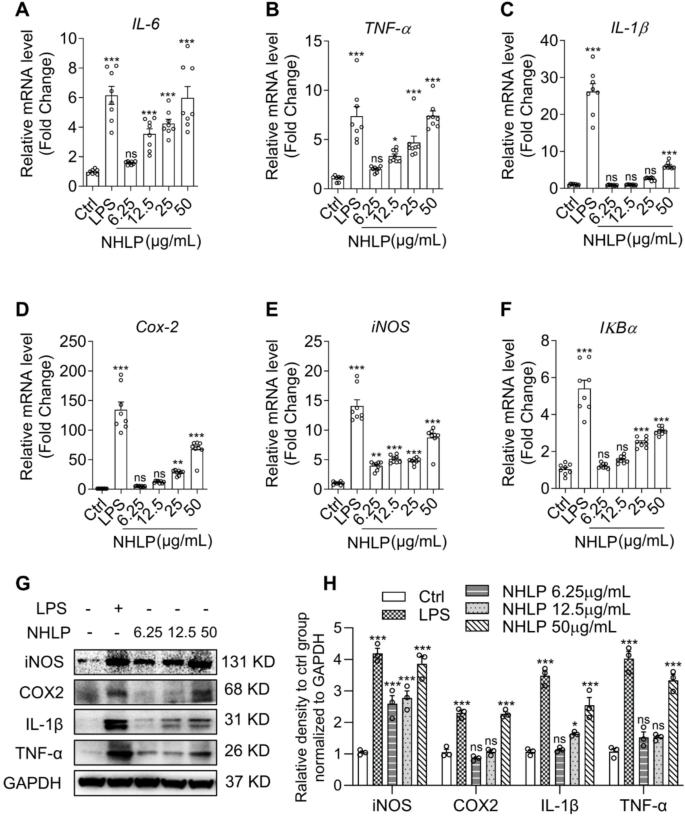
In the current investigation, a homogeneous polysaccharide (NHLP) with a weight-average molecular weight (Mw) of 62.0 kDa was isolated from the stem of NHL. Monosaccharide composition analysis revealed that NHLP was primarily composed of Gal (24.4%), Glc (18.9%), GalA (16.8%), Xyl (12.1%), and Rha (7.7%). Methylation analysis indicated that NHLP mainly contained residues of 4-GalpA, 4-Glcp, 4-Galp, 4-Xylp, 3,6-Galp, t-Araf, t-Galp, and t-Rhap. The linkage patterns of these residues were structurally resolved using one- and two-dimensional nuclear magnetic resonance (NMR) spectroscopy. In vitro assays demonstrated that NHLP stimulated RAW264.7 cells to produce nitric oxide (NO) in a dose-dependent manner, promoted the release of proinflammatory cytokines including interleukin-6 (IL-6), interleukin-1β (IL-1β), and tumor necrosis factor-α (TNF-α), and upregulated transcriptional profiles of genes involved in inflammatory responses (IL-6, IL-1β, TNF-α, COX-2, iNOS, and IκBα) and proteins (iNOS, COX-2, IL-1β, and TNF-α).
Conclusions
This study clarified the proposed structure of the polysaccharide derived from T. acornis stem and its macrophage-activating effects, providing supportive evidence for its potential application in immune activation.
Graphical abstract
The alternative text for this image may have been generated using AI.
期刊介绍:
Chemical and Biological Technologies in Agriculture is an international, interdisciplinary, peer-reviewed forum for the advancement and application to all fields of agriculture of modern chemical, biochemical and molecular technologies. The scope of this journal includes chemical and biochemical processes aimed to increase sustainable agricultural and food production, the evaluation of quality and origin of raw primary products and their transformation into foods and chemicals, as well as environmental monitoring and remediation. Of special interest are the effects of chemical and biochemical technologies, also at the nano and supramolecular scale, on the relationships between soil, plants, microorganisms and their environment, with the help of modern bioinformatics. Another special focus is the use of modern bioorganic and biological chemistry to develop new technologies for plant nutrition and bio-stimulation, advancement of biorefineries from biomasses, safe and traceable food products, carbon storage in soil and plants and restoration of contaminated soils to agriculture.
This journal presents the first opportunity to bring together researchers from a wide number of disciplines within the agricultural chemical and biological sciences, from both industry and academia. The principle aim of Chemical and Biological Technologies in Agriculture is to allow the exchange of the most advanced chemical and biochemical knowledge to develop technologies which address one of the most pressing challenges of our times - sustaining a growing world population.
Chemical and Biological Technologies in Agriculture publishes original research articles, short letters and invited reviews. Articles from scientists in industry, academia as well as private research institutes, non-governmental and environmental organizations are encouraged.

 求助内容:
求助内容: 应助结果提醒方式:

 京公网安备 11010802042870号


