
Assessing the effect of treated wastewater used in combination with inorganic nutrients on the quality and nutritional attributes of tomato (Solanum lycopersicum L.)
IF 4.2
2区 农林科学
Q1 HORTICULTURE
Scientia Horticulturae
Pub Date : 2026-04-15
Epub Date: 2026-05-06
DOI:10.1016/j.scienta.2026.114869
引用次数: 0
Abstract
Addressing nutrient variability in wastewater through fertilizer supplementation has proven to enhance hydroponic crop growth, reduce fertilizer use, and ensure efficient wastewater reuse. However, the effect of such practice on crop quality and nutritional attributes remains unexplored. A study was conducted in a greenhouse to investigate the effect of wastewater supplementation on the quality and nutritional attributes of tomatoes (Solanum lycopersicum L. cv. Star. 9001). The experiment was laid out in a completely randomized design (CRD). The treatments included anaerobic filter effluent (AF), AF supplemented with 50% of the recommended application rate of hydroponic fertilizer mix (CHFM50), and 100% application rate of the hydroponic fertilizer mix dissolved in tap water (CHFMT). Data was collected on crop quality, fruit nutrient content, and physicochemical attributes. Results showed significant differences (p < 0.05) among the crop quality traits evaluated. The CHFM50 and CHFMT recorded higher and comparable fruit nutrient content, better crop quality (color index, firmness, and size), and physicochemical attributes (total soluble solids, total phenolic content, ascorbic acid content, and BrimA). In contrast, the AF-treated plants recorded lower values for the evaluated traits. This study demonstrates that the sole reuse of wastewater for crop fertigation results in suboptimal tomato quality and nutritional attributes. However, half the recommended rate of commercial hydroponic fertilizer mix (CHFM50) can sufficiently supplement AF without compromising crop quality, nutrient content, and physicochemical properties. This approach can reduce the dependency on commercial fertilizers, lower the demand for freshwater use, and contribute to safe wastewater reuse in non-circulating hydroponic systems.
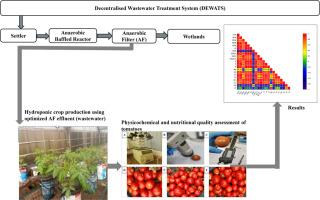
评价处理废水与无机营养物配合使用对番茄品质和营养属性的影响
通过补充肥料来解决废水中的养分变化问题已被证明可以促进水培作物的生长,减少肥料的使用,并确保废水的有效再利用。然而,这种做法对作物品质和营养属性的影响仍未得到探索。在温室条件下,研究了污水处理对番茄品质和营养特性的影响。明星。9001)。实验采用完全随机设计(CRD)。厌氧过滤出水(AF)、AF中添加50%推荐施用量的水培混肥(CHFM50)和100%推荐施用量的水培混肥(CHFMT)。收集了作物品质、果实营养成分和理化性状的数据。结果表明,评价的作物品质性状之间存在显著差异(p < 0.05)。CHFM50和CHFMT的果实营养成分含量较高且相当,作物品质(颜色指数、硬度和大小)和理化性状(总可溶性固形物、总酚含量、抗坏血酸含量和BrimA)也较好。相比之下,af处理的植株的评价性状值较低。该研究表明,单一的废水回用作物施肥导致番茄品质和营养属性不理想。然而,一半的推荐量的商业水培肥料混合(CHFM50)可以充分补充AF,而不影响作物品质、营养含量和理化性质。这种方法可以减少对商业肥料的依赖,降低对淡水使用的需求,并有助于在非循环水培系统中安全再利用废水。
本文章由计算机程序翻译,如有差异,请以英文原文为准。
求助全文
约1分钟内获得全文
求助全文
来源期刊
Scientia Horticulturae
农林科学-园艺
CiteScore
8.60
自引率
4.70%
发文量
796
审稿时长
47 days
期刊介绍:
Scientia Horticulturae is an international journal publishing research related to horticultural crops. Articles in the journal deal with open or protected production of vegetables, fruits, edible fungi and ornamentals under temperate, subtropical and tropical conditions. Papers in related areas (biochemistry, micropropagation, soil science, plant breeding, plant physiology, phytopathology, etc.) are considered, if they contain information of direct significance to horticulture. Papers on the technical aspects of horticulture (engineering, crop processing, storage, transport etc.) are accepted for publication only if they relate directly to the living product. In the case of plantation crops, those yielding a product that may be used fresh (e.g. tropical vegetables, citrus, bananas, and other fruits) will be considered, while those papers describing the processing of the product (e.g. rubber, tobacco, and quinine) will not. The scope of the journal includes all horticultural crops but does not include speciality crops such as, medicinal crops or forestry crops, such as bamboo. Basic molecular studies without any direct application in horticulture will not be considered for this journal.
 求助内容:
求助内容: 应助结果提醒方式:

 京公网安备 11010802042870号


