
Model-Free Magnetic Servoing for Pose Control of Capsule Robots

IF 11.1 1区 计算机科学 Q1 ROBOTICS
IEEE Transactions on Robotics Pub Date : 2026-01-01 Epub Date: 2026-04-27 DOI:10.1109/TRO.2026.3688064
Chang Liu;Xiaoyang Wu;Jiaole Wang;Shuang Song
{"title":"Model-Free Magnetic Servoing for Pose Control of Capsule Robots","authors":"Chang Liu;Xiaoyang Wu;Jiaole Wang;Shuang Song","doi":"10.1109/TRO.2026.3688064","DOIUrl":null,"url":null,"abstract":"This article proposes a model-free magnetic servoing technique for closed-loop pose control of capsule robots. The system employs an internal permanent magnet (IPM) inside the capsule and an external permanent magnet (EPM) manipulated by a robotic arm. Control feedback is directly derived from magnetic field measurements (via a sensor array) and optical tracking of the EPM’s pose. To enable model-free control, we develop a feature extraction method that condenses the IPM’s magnetic sensor data into a compact representation. Based on this magnetic feature, we derive a Jacobian matrix that directly maps the feature space to the robotic arm’s joint configuration space. To adaptively handle system nonlinearities, the Jacobian matrix is iteratively updated using an unscented Kalman filter, bypassing the need for an explicit dynamic model. Experimental results demonstrate the effectiveness of our approach, with average tracking errors of 0.62 mm in position and 0.75<inline-formula><tex-math>$^{\\circ }$</tex-math></inline-formula> in orientation during simultaneous pose control tasks.","PeriodicalId":50388,"journal":{"name":"IEEE Transactions on Robotics","volume":"42 ","pages":"2127-2145"},"PeriodicalIF":11.1000,"publicationDate":"2026-01-01","publicationTypes":"Journal Article","fieldsOfStudy":null,"isOpenAccess":false,"openAccessPdf":"","citationCount":"0","resultStr":null,"platform":"Semanticscholar","paperid":null,"PeriodicalName":"IEEE Transactions on Robotics","FirstCategoryId":"94","ListUrlMain":"https://ieeexplore.ieee.org/document/11495418/","RegionNum":1,"RegionCategory":"计算机科学","ArticlePicture":[],"TitleCN":null,"AbstractTextCN":null,"PMCID":null,"EPubDate":"2026/4/27 0:00:00","PubModel":"Epub","JCR":"Q1","JCRName":"ROBOTICS","Score":null,"Total":0}
引用次数: 0

Abstract

This article proposes a model-free magnetic servoing technique for closed-loop pose control of capsule robots. The system employs an internal permanent magnet (IPM) inside the capsule and an external permanent magnet (EPM) manipulated by a robotic arm. Control feedback is directly derived from magnetic field measurements (via a sensor array) and optical tracking of the EPM’s pose. To enable model-free control, we develop a feature extraction method that condenses the IPM’s magnetic sensor data into a compact representation. Based on this magnetic feature, we derive a Jacobian matrix that directly maps the feature space to the robotic arm’s joint configuration space. To adaptively handle system nonlinearities, the Jacobian matrix is iteratively updated using an unscented Kalman filter, bypassing the need for an explicit dynamic model. Experimental results demonstrate the effectiveness of our approach, with average tracking errors of 0.62 mm in position and 0.75$^{\circ }$ in orientation during simultaneous pose control tasks.
无模型磁伺服胶囊机器人位姿控制
提出了一种用于胶囊机器人姿态闭环控制的无模型磁伺服技术。该系统在胶囊内部使用一个内部永磁体(IPM)和一个由机械臂操纵的外部永磁体(EPM)。控制反馈直接来源于磁场测量(通过传感器阵列)和EPM姿态的光学跟踪。为了实现无模型控制,我们开发了一种特征提取方法,将IPM的磁传感器数据压缩成紧凑的表示。基于该磁性特征,导出了将特征空间直接映射到机械臂关节位形空间的雅可比矩阵。为了自适应处理系统非线性,雅可比矩阵使用无气味卡尔曼滤波器迭代更新,绕过了对显式动态模型的需要。实验结果证明了该方法的有效性,在同步姿态控制任务中,位置的平均跟踪误差为0.62 mm,方向的平均跟踪误差为0.75$^{\circ}$。
本文章由计算机程序翻译,如有差异,请以英文原文为准。
求助全文
约1分钟内获得全文 求助全文
来源期刊
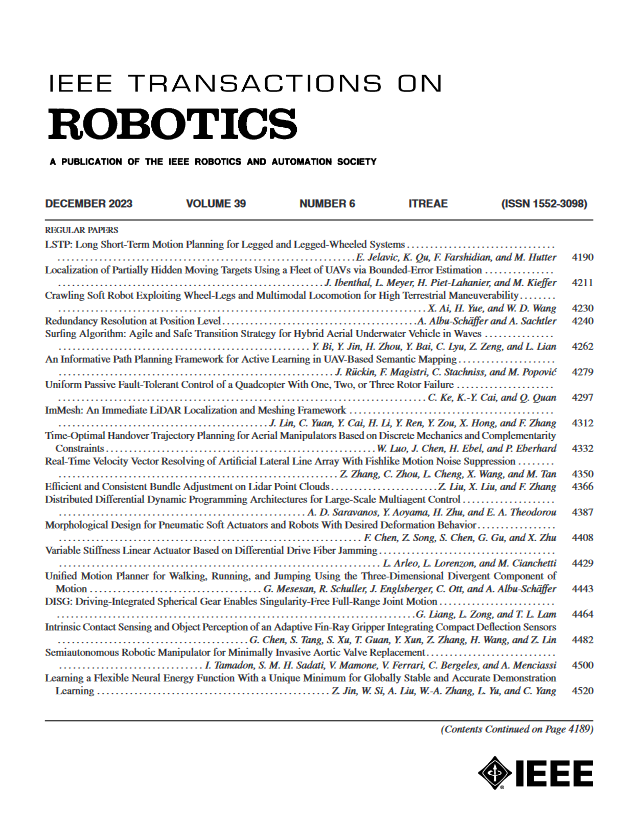
IEEE Transactions on Robotics
IEEE Transactions on Robotics 工程技术-机器人学
CiteScore
14.90
自引率
5.10%
发文量
259
审稿时长
6.0 months
期刊介绍: The IEEE Transactions on Robotics (T-RO) is dedicated to publishing fundamental papers covering all facets of robotics, drawing on interdisciplinary approaches from computer science, control systems, electrical engineering, mathematics, mechanical engineering, and beyond. From industrial applications to service and personal assistants, surgical operations to space, underwater, and remote exploration, robots and intelligent machines play pivotal roles across various domains, including entertainment, safety, search and rescue, military applications, agriculture, and intelligent vehicles. Special emphasis is placed on intelligent machines and systems designed for unstructured environments, where a significant portion of the environment remains unknown and beyond direct sensing or control.

×
引用
GB/T 7714-2015
复制
MLA
复制
APA
复制
导出至
BibTeX EndNote RefMan NoteFirst NoteExpress
×
提示
您的信息不完整,为了账户安全,请先补充。
现在去补充
×
提示
您因"违规操作"
具体请查看互助需知
我知道了
×
提示
确定
请完成安全验证×
copy
已复制链接
快去分享给好友吧!
我知道了
右上角分享
点击右上角分享
0
联系我们:info@booksci.cn Book学术提供免费学术资源搜索服务,方便国内外学者检索中英文文献。致力于提供最便捷和优质的服务体验。 Copyright © 2023 布克学术 All rights reserved.
京ICP备2023020795号-1
ghs 京公网安备 11010802042870号
Book学术文献互助
Book学术文献互助群
群 号:604180095
Book学术官方微信
小红书


