
Database and deep-learning scalability of anharmonic phonon properties by automated brute-force first-principles calculations
IF 11.9
1区 材料科学
Q1 CHEMISTRY, PHYSICAL
引用次数: 0
Abstract
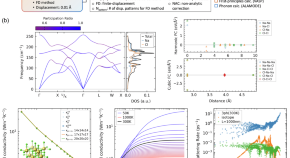
Understanding the anharmonic phonon properties of crystal compounds—such as phonon lifetimes and thermal conductivities—is essential for investigating and optimizing their thermal transport behaviors. These properties also impact optical, electronic, and magnetic characteristics through interactions between phonons and other quasiparticles and fields. In this study, we develop an automated first-principles workflow to calculate anharmonic phonon properties and build a comprehensive database encompassing more than 6500 inorganic compounds. Utilizing this dataset, we train a graph neural network model to predict thermal conductivity values and spectra from structural parameters, demonstrating a scaling law in which prediction accuracy improves with increasing training data size. High-throughput screening with the model enables the identification of materials exhibiting extreme thermal conductivities—both high and low. The resulting database offers valuable insights into the anharmonic behavior of phonons, thereby accelerating the design and development of advanced functional materials.
非调和声子特性的数据库和深度学习可扩展性,自动化蛮力第一原理计算
了解晶体化合物的非谐波声子特性,如声子寿命和导热性,对于研究和优化它们的热输运行为至关重要。这些特性还通过声子与其他准粒子和场之间的相互作用影响光学、电子和磁特性。在这项研究中,我们开发了一个自动化的第一性原理工作流程来计算非谐波声子的性质,并建立了一个包含6500多种无机化合物的综合数据库。利用该数据集,我们训练了一个图神经网络模型来预测结构参数的导热系数值和光谱,证明了预测精度随着训练数据大小的增加而提高的标度规律。使用该模型进行高通量筛选,可以识别具有极端导热性的材料,无论是高导热性还是低导热性。由此产生的数据库为声子的非谐波行为提供了有价值的见解,从而加速了先进功能材料的设计和开发。
本文章由计算机程序翻译,如有差异,请以英文原文为准。
求助全文
约1分钟内获得全文
求助全文
来源期刊
npj Computational Materials
Mathematics-Modeling and Simulation
CiteScore
15.30
自引率
5.20%
发文量
229
审稿时长
6 weeks
期刊介绍:
npj Computational Materials is a high-quality open access journal from Nature Research that publishes research papers applying computational approaches for the design of new materials and enhancing our understanding of existing ones. The journal also welcomes papers on new computational techniques and the refinement of current approaches that support these aims, as well as experimental papers that complement computational findings.
Some key features of npj Computational Materials include a 2-year impact factor of 12.241 (2021), article downloads of 1,138,590 (2021), and a fast turnaround time of 11 days from submission to the first editorial decision. The journal is indexed in various databases and services, including Chemical Abstracts Service (ACS), Astrophysics Data System (ADS), Current Contents/Physical, Chemical and Earth Sciences, Journal Citation Reports/Science Edition, SCOPUS, EI Compendex, INSPEC, Google Scholar, SCImago, DOAJ, CNKI, and Science Citation Index Expanded (SCIE), among others.
 求助内容:
求助内容: 应助结果提醒方式:

 京公网安备 11010802042870号


