
Optimization of modified atmosphere packaging for shelf-life extension of freeze-dried kimchi starter culture
IF 6.2
Q1 AGRICULTURE, MULTIDISCIPLINARY
引用次数: 0
Abstract
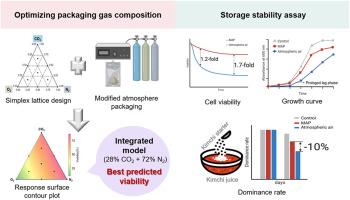
Ensuring the long-term stability of freeze-dried lactic acid bacteria (LAB) starters is vital for improving the efficiency of fermented food production and reducing storage- and distribution-associated costs in the food supply chain. This study aimed to enhance the storage stability of a kimchi starter by optimizing the gas composition of modified atmosphere packaging (MAP), a sustainable preservation approach applied to diverse agricultural and food products. A simplex lattice design was employed to evaluate the effects of CO2, O2, and N2 ratios on the viability of Latilactobacillus curvatus WiKim0094 under accelerated shelf-life test conditions (37 °C and 55 °C for 10–20 days, representing ambient and stressed storage, respectively). Reduced O2 and elevated CO2 and N2 concentrations were found to significantly improve cell survival. Inactivation kinetics were modeled to estimate the half-life of Lb. curvatus WiKim0094 under different packaging atmospheres. The optimized MAP condition (28% CO2 + 72% N2) extended the half-life to 74.9 days, over fivefold longer than that under atmospheric air (13.4 days), demonstrating enhanced stability. Growth profiling in MRS medium and validation in kimchi juice showed that MAP-stored powders retained rapid growth initiation and high dominance (71% at day 7), whereas air-stored cultures showed 30% slower growth and approximately 10% lower dominance. Overall, these findings highlight MAP as a practical and scalable preservation technology for maintaining the viability and activity of starter cultures, thus supporting sustainable cold-chain management and improved quality of fermented foods in the agri-food industry.
改良气调包装延长冻干泡菜发酵剂保质期的研究
确保冻干乳酸菌(LAB)发酵剂的长期稳定性对于提高发酵食品生产效率和降低食品供应链中与储存和分销相关的成本至关重要。本研究旨在通过优化气调包装(MAP)的气体组成来提高泡菜发酵剂的储存稳定性,这是一种适用于多种农产品和食品的可持续保鲜方法。采用单纯形晶格设计,在加速保质期试验条件下(分别为室温和应力储存,37°C和55°C, 10-20天),评估CO2、O2和N2配比对弯曲乳酸杆菌WiKim0094活力的影响。O2浓度降低、CO2和N2浓度升高可显著提高细胞存活率。采用失活动力学模型估计了Lb. curvatus WiKim0094在不同包装气氛下的半衰期。优化后的MAP条件(28% CO2 + 72% N2)将半衰期延长至74.9天,比大气条件下的半衰期(13.4天)长5倍以上,稳定性增强。MRS培养基中的生长分析和泡菜汁中的验证表明,map储存的粉末保持了快速的生长起始和高优势(第7天71%),而空气储存的粉末生长速度慢30%,优势度低约10%。总的来说,这些发现突出了MAP作为一种实用和可扩展的保存技术,可以保持发酵剂的活力和活性,从而支持可持续冷链管理和提高农业食品工业发酵食品的质量。
本文章由计算机程序翻译,如有差异,请以英文原文为准。
求助全文
约1分钟内获得全文
求助全文
来源期刊

Journal of Agriculture and Food Research
Multiple-
CiteScore
5.40
自引率
2.60%
发文量
193
审稿时长
69 days
 求助内容:
求助内容: 应助结果提醒方式:

 京公网安备 11010802042870号


