Alessandra Andréa Pereira Nicolau, Rebeca Salvador-Reyes, Maria Teresa Pedrosa Silva Clerici, Bruno Martins Dala-Paula
{"title":"Functional Potential of Peruvian Fava Bean Flours in Bread: Antioxidant Activity and Phenolic Bioaccessibility.","authors":"Alessandra Andréa Pereira Nicolau, Rebeca Salvador-Reyes, Maria Teresa Pedrosa Silva Clerici, Bruno Martins Dala-Paula","doi":"10.1007/s11130-026-01487-z","DOIUrl":null,"url":null,"abstract":"<p><p>Plant-based foods are increasingly valued for their health-promoting and sustainable attributes. Among legumes, fava bean (Vicia faba L.) is notable for its nutritional density and bioactive compounds. This study evaluated the effect of partially substituting wheat flour with raw flours from three Peruvian cultivars (Verde, Quelcao, and Peruanita) on antioxidant potential and phenolic bioaccessibility in bread. Six bread formulations were prepared by replacing 10 and 20% of wheat flour with fava bean flours, alongside a control (100% wheat flour). Antioxidant activity was assessed using ABTS•⁺ and DPPH assays, while total phenolic content (TPC) and total flavonoid content (TFC) were measured spectrophotometrically. Phenolic bioaccessibility and antioxidant activity were further examined through in vitro gastrointestinal digestion following the INFOGEST protocol. Compared with the control, fava bean flours showed significantly higher antioxidant potential (ABTS 26.13 µmol TE/g; DPPH 0.90 µmol TE/g), TPC (1.61 mg GAE/g), and TFC (0.80 mg CE/g), with Peruanita achieving the highest values. Partial substitution enhanced the antioxidant properties of breads, particularly at 20%. After digestion, both breads and flours exhibited greater antioxidant potential and phenolic bioaccessibility, suggesting the release of bound compounds. Partial substitution of wheat flour with Peruvian fava bean flours improves bread’s nutritional and functional properties by enhancing antioxidant potential and phenolic bioaccessibility. These results underscore the value of underutilized Andean legumes as sustainable ingredients for developing functional bakery products with added health benefits.</p>","PeriodicalId":20092,"journal":{"name":"Plant Foods for Human Nutrition","volume":"81 2","pages":""},"PeriodicalIF":3.6000,"publicationDate":"2026-03-21","publicationTypes":"Journal Article","fieldsOfStudy":null,"isOpenAccess":false,"openAccessPdf":"https://www.ncbi.nlm.nih.gov/pmc/articles/PMC13005775/pdf/","citationCount":"0","resultStr":null,"platform":"Semanticscholar","paperid":null,"PeriodicalName":"Plant Foods for Human Nutrition","FirstCategoryId":"97","ListUrlMain":"https://doi.org/10.1007/s11130-026-01487-z","RegionNum":2,"RegionCategory":"农林科学","ArticlePicture":[],"TitleCN":null,"AbstractTextCN":null,"PMCID":null,"EPubDate":"","PubModel":"","JCR":"Q2","JCRName":"CHEMISTRY, APPLIED","Score":null,"Total":0}
引用次数: 0
Abstract
Plant-based foods are increasingly valued for their health-promoting and sustainable attributes. Among legumes, fava bean (Vicia faba L.) is notable for its nutritional density and bioactive compounds. This study evaluated the effect of partially substituting wheat flour with raw flours from three Peruvian cultivars (Verde, Quelcao, and Peruanita) on antioxidant potential and phenolic bioaccessibility in bread. Six bread formulations were prepared by replacing 10 and 20% of wheat flour with fava bean flours, alongside a control (100% wheat flour). Antioxidant activity was assessed using ABTS•⁺ and DPPH assays, while total phenolic content (TPC) and total flavonoid content (TFC) were measured spectrophotometrically. Phenolic bioaccessibility and antioxidant activity were further examined through in vitro gastrointestinal digestion following the INFOGEST protocol. Compared with the control, fava bean flours showed significantly higher antioxidant potential (ABTS 26.13 µmol TE/g; DPPH 0.90 µmol TE/g), TPC (1.61 mg GAE/g), and TFC (0.80 mg CE/g), with Peruanita achieving the highest values. Partial substitution enhanced the antioxidant properties of breads, particularly at 20%. After digestion, both breads and flours exhibited greater antioxidant potential and phenolic bioaccessibility, suggesting the release of bound compounds. Partial substitution of wheat flour with Peruvian fava bean flours improves bread’s nutritional and functional properties by enhancing antioxidant potential and phenolic bioaccessibility. These results underscore the value of underutilized Andean legumes as sustainable ingredients for developing functional bakery products with added health benefits.
期刊介绍:
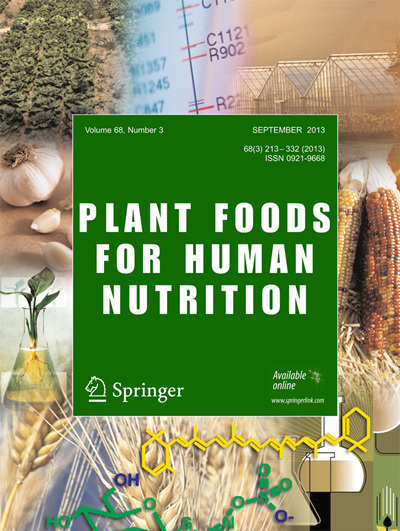
Plant Foods for Human Nutrition (previously Qualitas Plantarum) is an international journal that publishes reports of original research and critical reviews concerned with the improvement and evaluation of the nutritional quality of plant foods for humans, as they are influenced by:
- Biotechnology (all fields, including molecular biology and genetic engineering)
- Food science and technology
- Functional, nutraceutical or pharma foods
- Other nutrients and non-nutrients inherent in plant foods


 求助内容:
 应助结果提醒方式:


 京公网安备 11010802042870号


