
All-Solution-Processed Perovskite Light-Emitting Transistors Enabled by a Fully Organic Architecture
IF 5.3
2区 材料科学
Q2 MATERIALS SCIENCE, MULTIDISCIPLINARY
引用次数: 0
Abstract
CsPbBr3 perovskite nanocrystals (Pe-NCs) are promising solution-processable emitters for light-emitting devices due to their high brightness, color purity, and photoluminescence quantum yield. However, their integration into more advanced device architectures such as organic light-emitting transistors (OLETs) remains limited by the lack of fully solution-processable platforms that support uniform and compact Pe-NCs emissive layers (EMLs). In this work, we report fully solution-processed Pe-NCs-based LETs (Pe-LETs) using CsPbBr3 nanocrystals as the emitter. The realization of such a device is enabled by the development of a fully organic LET platform that incorporates: (i) a tailored bilayer gate dielectric of polyvinyl alcohol (PVA) and CyTOP, (ii) a solvent-resistant p-type polymer semiconductor, poly[2,5-(2-octyldodecyl)-3,6-diketopyrrolopyrrole-alt-5,5-(2,5-di(thien-2yl)thieno[3,2-b]thiophene)] (DPP-DTT), and (iii) a nanocomposite EML of Pe-NCs dispersed in a poly(9-vinylcarbazole) and 1,3-bis[2-(4-tert-butylphenyl)1,3,4-oxadiazo-5-yl]benzene (PVK:OXD-7) matrix. Morphological and photophysical characterization, including confocal laser scanning microscopy, drives the optimization of solvent and processing conditions for uniform film formation. Benchmark device substructures are also used to fine-tune the organic platform for effective EML integration. The resulting Pe-LETs exhibit a narrow emission at 509 nm (full width at half maximum, FWHM = 19.2 nm), demonstrating excellent color purity suitable for displays and sensing. A maximum external quantum efficiency of 4.17 × 10⁻³ % is achieved, comparable to state-of-the-art values for inorganic-based LETs.
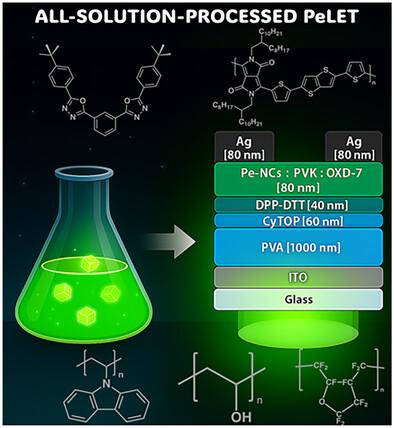
全有机结构实现全溶液处理钙钛矿发光晶体管
CsPbBr3钙钛矿纳米晶体(Pe-NCs)具有高亮度、高色纯度和光致发光量子产率等优点,是一种很有前途的溶液可加工发光材料。然而,由于缺乏支持统一和紧凑的pe - nc发射层(eml)的完全解决方案可处理平台,它们与更先进的器件架构(如有机发光晶体管(olet))的集成仍然受到限制。在这项工作中,我们报告了使用CsPbBr3纳米晶体作为发射器的完全溶液处理的Pe-NCs-based let (Pe-LETs)。这种装置的实现是通过开发一个完全有机的LET平台实现的,该平台包含:(i)聚乙烯醇(PVA)和CyTOP的自定义双层栅极电介质,(ii)耐溶剂p型聚合物半导体,聚[2,5-(2-辛基十二烷基)-3,6-二酮基吡咯-醛-5,5-(2,5-二(噻吩-2)基)噻吩[3,2-b]噻吩](DPP-DTT),以及(iii)分散在聚(9-乙烯基carbazole)和1,3-双[2-(4-叔丁基苯基)1,3,4-恶二氮唑-5-基]苯(PVK:OXD-7)基体中的pe - nc纳米复合EML。形态学和光物理表征,包括共聚焦激光扫描显微镜,驱动溶剂和均匀薄膜形成的加工条件的优化。基准器件子结构也用于微调有机平台,以实现有效的EML集成。所得到的pe - let在509 nm处表现出窄发射(全宽度为最大值的一半,FWHM = 19.2 nm),具有适合显示和传感的优异颜色纯度。最大外量子效率为4.17 × 10⁻³%,与无机let的最新值相当。
本文章由计算机程序翻译,如有差异,请以英文原文为准。
求助全文
约1分钟内获得全文
求助全文
来源期刊
Advanced Electronic Materials
NANOSCIENCE & NANOTECHNOLOGYMATERIALS SCIE-MATERIALS SCIENCE, MULTIDISCIPLINARY
CiteScore
11.00
自引率
3.20%
发文量
433
期刊介绍:
Advanced Electronic Materials is an interdisciplinary forum for peer-reviewed, high-quality, high-impact research in the fields of materials science, physics, and engineering of electronic and magnetic materials. It includes research on physics and physical properties of electronic and magnetic materials, spintronics, electronics, device physics and engineering, micro- and nano-electromechanical systems, and organic electronics, in addition to fundamental research.
 求助内容:
求助内容: 应助结果提醒方式:

 京公网安备 11010802042870号


