
Creating and maintaining digital third places: Orchestrating interaction ritual chains at a distance
IF 10.2
1区 管理学
Q1 BUSINESS
引用次数: 0
Abstract
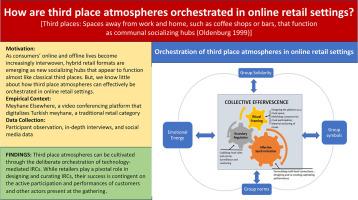
With online and offline lives increasingly intertwined, hybrid retail spaces are emerging as new social hubs akin to classical third places. Third places refer to spaces apart from work and home, such as cafes and bars, that provide opportunities for social interaction. While prior research has primarily conceptualized third places as physical establishments, it also acknowledges that online environments, such as multiplayer gaming platforms or chatrooms, can fulfil similar functions. Yet, despite the recognized social-supportive role of retail venues, relatively little is known about how third place atmospheres can effectively be orchestrated in online retail settings. This study addresses this gap through an ethnographic investigation of a digital platform that recreates a physical third place online, enabling consumers to gather for long hours, consuming, conversing, and socializing. We find that, in online retail settings, third place atmospheres can be cultivated through the deliberate orchestration of technology-mediated interaction ritual chains. Through three interconnected processes – ritual framing, boundary regulation, and affective synchronization – that unfold before, during, and after the gatherings, the online setting transforms into a digital third place. Both retailers and consumers play pivotal roles in this transformation. Drawing on these findings, we offer several theoretical contributions and managerial recommendations.
创建和维护数字第三场所:远距离协调互动仪式链
随着线上和线下生活日益交织在一起,混合零售空间正在成为类似于传统第三场所的新型社交中心。第三空间指的是工作和家庭之外的空间,如咖啡馆和酒吧,提供社交互动的机会。虽然之前的研究主要将第三场所定义为实体场所,但它也承认在线环境,如多人游戏平台或聊天室,可以实现类似的功能。然而,尽管零售场所具有公认的社会支持作用,但人们对如何有效地在在线零售环境中营造第三名氛围知之甚少。这项研究通过对数字平台的人种学调查来解决这一差距,该平台在网上重建了一个实体的第三场所,使消费者能够长时间聚集在一起,消费,交谈和社交。我们发现,在在线零售环境中,可以通过精心编排技术介导的互动仪式链来培养第三方氛围。通过三个相互关联的过程——仪式框架、边界调节和情感同步——在聚会之前、期间和之后展开,在线环境转变为数字第三空间。零售商和消费者在这一转变中都扮演着关键角色。根据这些发现,我们提出了一些理论贡献和管理建议。
本文章由计算机程序翻译,如有差异,请以英文原文为准。
求助全文
约1分钟内获得全文
求助全文
来源期刊
Journal of Retailing
BUSINESS-
CiteScore
15.90
自引率
6.00%
发文量
54
审稿时长
67 days
期刊介绍:
The focus of The Journal of Retailing is to advance knowledge and its practical application in the field of retailing. This includes various aspects such as retail management, evolution, and current theories. The journal covers both products and services in retail, supply chains and distribution channels that serve retailers, relationships between retailers and supply chain members, and direct marketing as well as emerging electronic markets for households. Articles published in the journal may take an economic or behavioral approach, but all are based on rigorous analysis and a deep understanding of relevant theories and existing literature. Empirical research follows the scientific method, employing modern sampling procedures and statistical analysis.
 求助内容:
求助内容: 应助结果提醒方式:

 京公网安备 11010802042870号


