
Mitigating Interferences in 5G O-RAN HetNets Through ML-Driven xAPP to Enhance Users’ QoS
IF 5.7
2区 计算机科学
Q1 COMPUTER SCIENCE, INFORMATION SYSTEMS
IEEE Transactions on Network and Service Management
Pub Date : 2026-02-24
DOI:10.1109/TNSM.2026.3667462
引用次数: 0
Abstract
In today’s rapidly evolving telecommunications landscape, the demand for seamless connectivity and top-tier network performance has reached unprecedented levels. Traditional cellular systems, while valiant in their service, now struggle under the weight of spiraling data demands, spectrum scarcity, and power inefficiency. The era of ultra-dense mobile networks, with Heterogeneous Networks (HetNets) at the forefront, ushers in improved throughput, spectral efficiency, and energy management. To tackle these challenges, this paper introduces MLCIMO (Machine Learning-enhanced Classification for Interference Management and Offloading) into 5G HetNets. MLCIMO employs a multi-binary classification strategy to categorize users based on interference types and levels. It also introduces an offloading scheme tailored to user service priorities, enhancing the user quality of experience, while conserving energy. It seamlessly aligns with the evolving needs of the HetNets, addressing some of the issues introduced by small cell deployments. Simulation results show that MLCIMO achieves the highest throughput, shortest delay, and lowest packet loss ratio in comparison with alternative approaches. In a comprehensive analysis, the varying degrees of interference encountered by users under different schemes are unveiled, further establishing MLCIMO’s distinguished position in mitigating interference.利用机器学习驱动的xAPP减少5G O-RAN网络中的干扰,提高用户的QoS
在当今快速发展的电信环境中,对无缝连接和顶级网络性能的需求达到了前所未有的水平。传统的蜂窝系统虽然在服务方面表现英勇,但现在却在不断上升的数据需求、频谱稀缺和电力效率低下的重压下挣扎。以异构网络(HetNets)为前沿的超密集移动网络时代,将带来更高的吞吐量、频谱效率和能源管理。为了应对这些挑战,本文将MLCIMO(机器学习增强的干扰管理和卸载分类)引入5G HetNets。MLCIMO采用多二元分类策略,根据干扰类型和程度对用户进行分类。它还引入了针对用户服务优先级量身定制的卸载方案,在提高用户体验质量的同时节约能源。它无缝地配合了HetNets不断发展的需求,解决了小型蜂窝部署带来的一些问题。仿真结果表明,与其他方法相比,MLCIMO具有最高的吞吐量、最短的延迟和最低的丢包率。综合分析,揭示了不同方案下用户遇到的不同程度的干扰,进一步确立了MLCIMO在缓解干扰方面的卓越地位。
本文章由计算机程序翻译,如有差异,请以英文原文为准。
求助全文
约1分钟内获得全文
求助全文
来源期刊
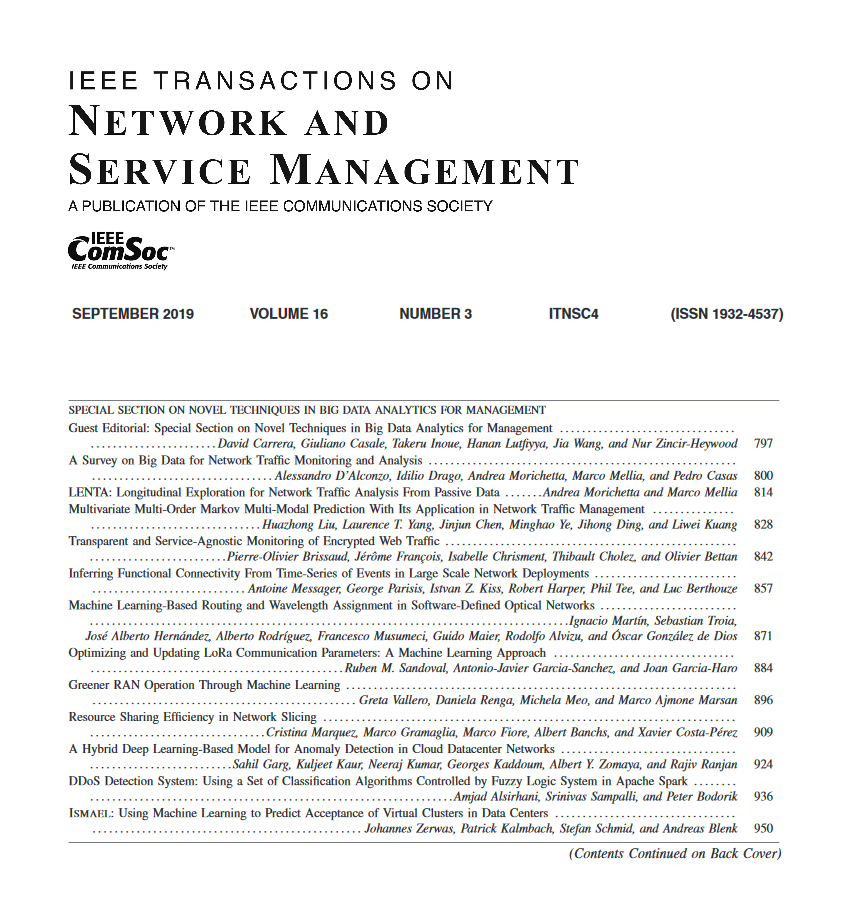
IEEE Transactions on Network and Service Management
Computer Science-Computer Networks and Communications
CiteScore
9.30
自引率
15.10%
发文量
325
期刊介绍:
IEEE Transactions on Network and Service Management will publish (online only) peerreviewed archival quality papers that advance the state-of-the-art and practical applications of network and service management. Theoretical research contributions (presenting new concepts and techniques) and applied contributions (reporting on experiences and experiments with actual systems) will be encouraged. These transactions will focus on the key technical issues related to: Management Models, Architectures and Frameworks; Service Provisioning, Reliability and Quality Assurance; Management Functions; Enabling Technologies; Information and Communication Models; Policies; Applications and Case Studies; Emerging Technologies and Standards.
 求助内容:
求助内容: 应助结果提醒方式:

 京公网安备 11010802042870号


