
Dynamic Migration in Digital Twin-Enabled Industrial Internet: A Stochastic Network Calculus Approach
IF 5.7
2区 计算机科学
Q1 COMPUTER SCIENCE, INFORMATION SYSTEMS
IEEE Transactions on Network and Service Management
Pub Date : 2026-02-16
DOI:10.1109/TNSM.2026.3665033
引用次数: 0
Abstract
Digital Twin (DT) technology serves as a critical enabler in Cyber-Physical-Social Systems (CPSS), especially within Industry 5.0’s human-centric manufacturing paradigm. However, the computational intensity of processing real-time data in DT systems often leads to resource saturation and performance degradation at computation nodes. Dynamic service migration of digital twins by offloading computation-intensive tasks to resource-rich nodes to offer a promising solution, yet introduces challenges in preserving service quality during migration. Key issues include high delay, data inconsistency, service interruptions, and limited bandwidth compromising system stability. To address these challenges, this paper proposes a dynamic migration scheduling strategy for digital twins based on a Lyapunov optimization framework. Our approach integrates Stochastic Network Calculus (SNC) for Quality of Service (QoS) quantification and a persistent queue mechanism for reliability assurance. Theoretical analysis and extensive simulations demonstrate that the proposed algorithm achieves near-optimal performance with provable bounds, effectively minimizing migration-induced delay while maintaining service reliability. The results confirm that our framework consistently outperforms existing solutions in managing service migration within industrial internet systems.数字双机工业互联网的动态迁移:随机网络演算方法
数字孪生(DT)技术是网络-物理-社会系统(CPSS)的关键推动者,特别是在工业5.0以人为中心的制造范式中。然而,在DT系统中,处理实时数据的计算强度往往导致计算节点的资源饱和和性能下降。通过将计算密集型任务卸载到资源丰富的节点来实现数字孪生的动态服务迁移,提供了一个有前途的解决方案,但在迁移过程中引入了保持服务质量的挑战。关键问题包括高延迟、数据不一致、服务中断和影响系统稳定性的有限带宽。为了解决这些问题,本文提出了一种基于Lyapunov优化框架的数字孪生动态迁移调度策略。我们的方法集成了用于服务质量(QoS)量化的随机网络演算(SNC)和用于可靠性保证的持久队列机制。理论分析和大量仿真结果表明,该算法在可证明边界下实现了近乎最优的性能,在保持服务可靠性的同时有效地减少了迁移引起的延迟。结果证实,我们的框架在管理工业互联网系统内的服务迁移方面始终优于现有的解决方案。
本文章由计算机程序翻译,如有差异,请以英文原文为准。
求助全文
约1分钟内获得全文
求助全文
来源期刊
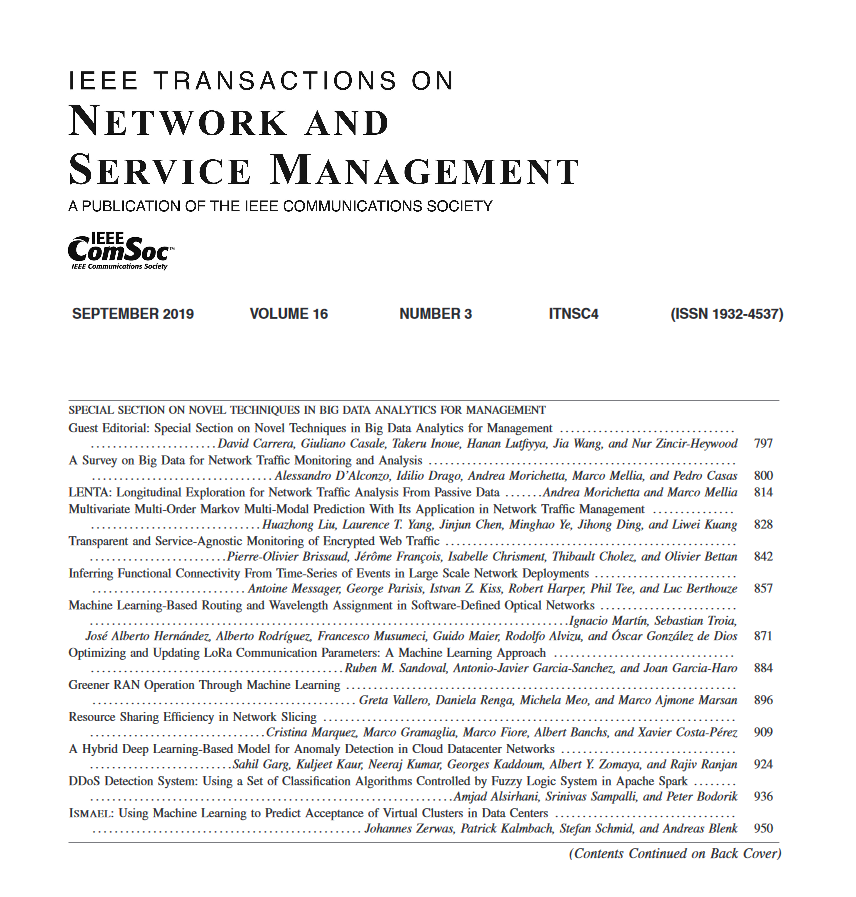
IEEE Transactions on Network and Service Management
Computer Science-Computer Networks and Communications
CiteScore
9.30
自引率
15.10%
发文量
325
期刊介绍:
IEEE Transactions on Network and Service Management will publish (online only) peerreviewed archival quality papers that advance the state-of-the-art and practical applications of network and service management. Theoretical research contributions (presenting new concepts and techniques) and applied contributions (reporting on experiences and experiments with actual systems) will be encouraged. These transactions will focus on the key technical issues related to: Management Models, Architectures and Frameworks; Service Provisioning, Reliability and Quality Assurance; Management Functions; Enabling Technologies; Information and Communication Models; Policies; Applications and Case Studies; Emerging Technologies and Standards.
 求助内容:
 应助结果提醒方式:


 京公网安备 11010802042870号


