
End-to-End Deterministic Network Slicing: A Profit-Driven Optimization Framework With Domain-Specific Algorithms
IF 5.7
2区 计算机科学
Q1 COMPUTER SCIENCE, INFORMATION SYSTEMS
IEEE Transactions on Network and Service Management
Pub Date : 2026-02-25
DOI:10.1109/TNSM.2026.3667996
引用次数: 0
Abstract
With the rapid evolution of 5G/6G networks, deterministic services such as the Industrial Internet, vehicular communications, and immersive applications impose stringent end-to-end (E2E) latency guarantees. Efficient resource allocation for E2E network slicing (NS) is therefore required to simultaneously satisfy strict latency constraints and improve overall resource efficiency. However, orchestrating cross-domain and multidimensional resources across the radio access network (RAN) and core network (CN) remains challenging due to strong coupling and scalability issues. To address this problem, this paper develops a profit-driven optimization framework for static E2E NS, which jointly accounts for deterministic service guarantees and system profitability. On the RAN side, a hybrid genetic algorithm (HGA) is developed to preserve the global exploration capability of genetic algorithms, while incorporating a gradient-guided resource scaling (GGRS) operator to refine elite solutions and improve solution quality. On the CN side, we design a capacity-aware workload balancing algorithm (CA-WLB). For each candidate path, CA-WLB couples capacity adaptive virtual network function (VNF) placement with demand responsive CPU allocation to jointly optimize latency and resource consumption, and then selects the path that yields the maximum profit. Extensive simulations across a wide range of scenarios demonstrate that the proposed framework consistently outperforms conventional heuristic and meta-heuristic approaches, while achieving performance close to high-complexity optimization benchmarks with significantly reduced computational overhead.端到端确定性网络切片:具有特定领域算法的利润驱动优化框架
随着5G/6G网络的快速发展,工业互联网、车载通信和沉浸式应用等确定性服务要求严格的端到端(E2E)延迟保证。因此,端到端网络切片(NS)需要有效的资源分配,同时满足严格的延迟约束,提高整体资源效率。然而,由于强耦合和可扩展性问题,跨无线接入网(RAN)和核心网(CN)协调跨域和多维资源仍然具有挑战性。为了解决这一问题,本文开发了一个利润驱动的静态端到端网络优化框架,该框架共同考虑了确定性服务保证和系统盈利能力。在RAN方面,开发了一种混合遗传算法(HGA)来保留遗传算法的全局勘探能力,同时结合梯度引导资源缩放(GGRS)算子来细化精英解并提高解质量。在CN端,我们设计了一个容量感知的工作负载平衡算法(CA-WLB)。对于每个候选路径,CA-WLB将容量自适应虚拟网络功能(VNF)配置与需求响应型CPU分配相结合,共同优化延迟和资源消耗,然后选择利润最大的路径。在各种场景中的广泛模拟表明,所提出的框架始终优于传统的启发式和元启发式方法,同时在显著降低计算开销的情况下实现接近高复杂性优化基准的性能。
本文章由计算机程序翻译,如有差异,请以英文原文为准。
求助全文
约1分钟内获得全文
求助全文
来源期刊
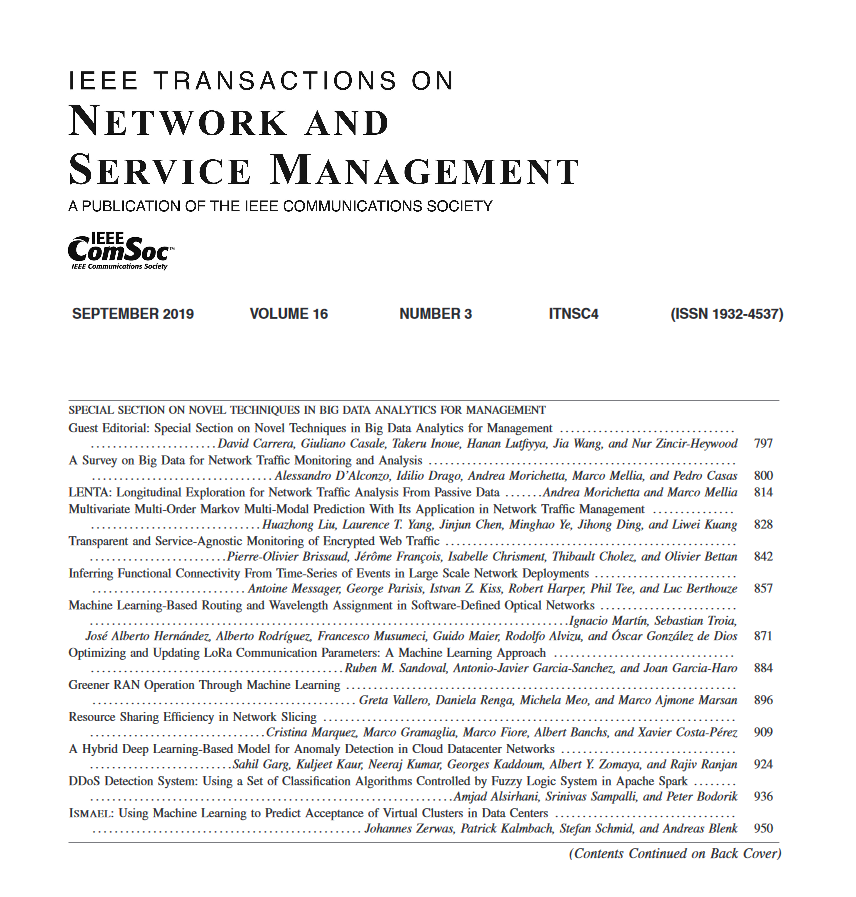
IEEE Transactions on Network and Service Management
Computer Science-Computer Networks and Communications
CiteScore
9.30
自引率
15.10%
发文量
325
期刊介绍:
IEEE Transactions on Network and Service Management will publish (online only) peerreviewed archival quality papers that advance the state-of-the-art and practical applications of network and service management. Theoretical research contributions (presenting new concepts and techniques) and applied contributions (reporting on experiences and experiments with actual systems) will be encouraged. These transactions will focus on the key technical issues related to: Management Models, Architectures and Frameworks; Service Provisioning, Reliability and Quality Assurance; Management Functions; Enabling Technologies; Information and Communication Models; Policies; Applications and Case Studies; Emerging Technologies and Standards.
 求助内容:
 应助结果提醒方式:


 京公网安备 11010802042870号


