
Dynamic Normalization TD3-Based Task Offloading for UAV-Assisted Collaborative Computing
IF 5.7
2区 计算机科学
Q1 COMPUTER SCIENCE, INFORMATION SYSTEMS
IEEE Transactions on Network and Service Management
Pub Date : 2026-02-24
DOI:10.1109/TNSM.2026.3667404
引用次数: 0
Abstract
To meet the computational requirements of computation-intensive and delay-sensitive applications, we construct an Unmanned Aerial Vehicle (UAV)-assisted three-layer collaborative computing framework that integrates local, edge, and cloud computing resources. However, in dynamic UAV-assisted environments, some existing approaches lack adaptability and struggle to effectively balance delay and energy consumption. To address these challenges, we formulate a joint optimization problem that minimizes the weighted sum of delay and energy consumption, where adaptive weight factors are dynamically adjusted according to system state variations. Due to the non-convex and high-dimensional nature of our proposed problem, traditional optimization methods are generally inadequate. Hence, the problem is modeled as a Markov Decision Process (MDP), and a normalization-based reward function is designed to eliminate the dimensional imbalance between delay and energy consumption. A Dynamic Normalization Twin Delayed Deep Deterministic Policy Gradient (DN-TD3) algorithm is then proposed, which incorporates mechanisms of adaptive exploration and critic-driven policy updates to enhance convergence stability and reduce sensitivity to hyperparameters. Simulation results demonstrate that the proposed DN-TD3 algorithm outperforms benchmark schemes in terms of system cost reduction, convergence speed, and overall stability.基于动态归一化td3的无人机辅助协同计算任务分流
为满足计算密集型和延迟敏感型应用的计算需求,构建了集成本地、边缘和云计算资源的无人机辅助三层协同计算框架。然而,在动态的无人机辅助环境下,现有的一些方法缺乏适应性,难以有效地平衡延迟和能耗。为了解决这些挑战,我们制定了一个联合优化问题,最小化延迟和能量消耗的加权和,其中自适应权重因子根据系统状态变化动态调整。由于我们所提出的问题的非凸性和高维性,传统的优化方法通常是不够的。因此,将该问题建模为马尔可夫决策过程(MDP),并设计基于归一化的奖励函数来消除延迟和能耗之间的维度不平衡。提出了一种动态归一化双延迟深度确定性策略梯度(DN-TD3)算法,该算法结合了自适应探索和关键驱动策略更新机制,提高了收敛稳定性,降低了对超参数的敏感性。仿真结果表明,提出的DN-TD3算法在降低系统成本、收敛速度和整体稳定性方面优于基准方案。
本文章由计算机程序翻译,如有差异,请以英文原文为准。
求助全文
约1分钟内获得全文
求助全文
来源期刊
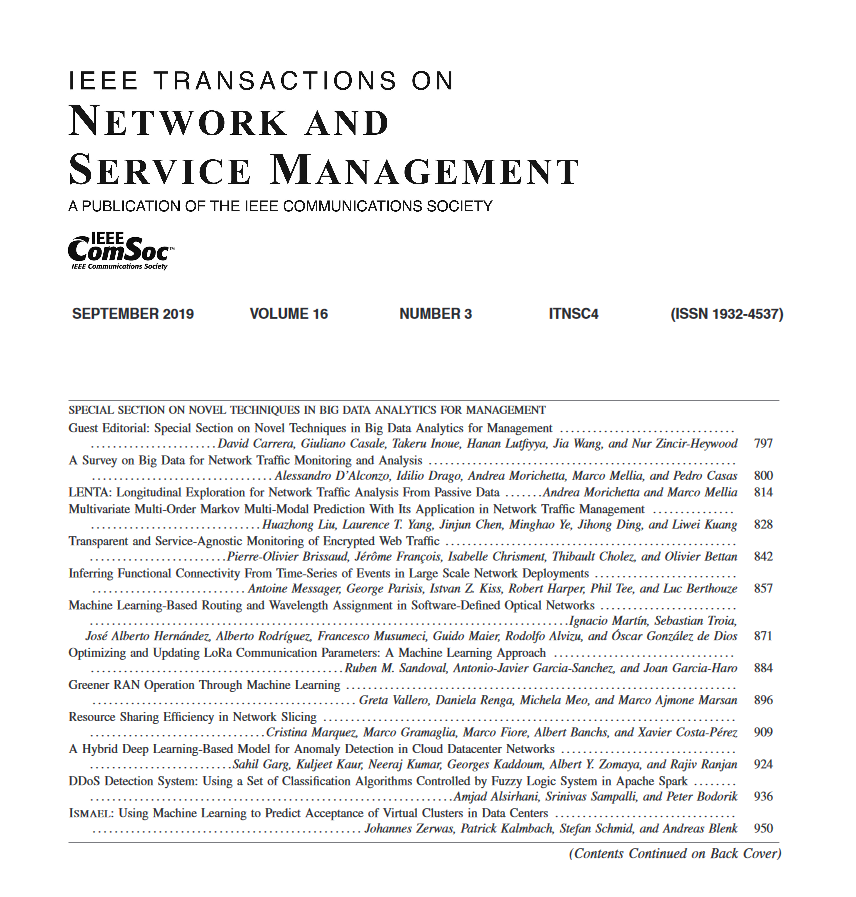
IEEE Transactions on Network and Service Management
Computer Science-Computer Networks and Communications
CiteScore
9.30
自引率
15.10%
发文量
325
期刊介绍:
IEEE Transactions on Network and Service Management will publish (online only) peerreviewed archival quality papers that advance the state-of-the-art and practical applications of network and service management. Theoretical research contributions (presenting new concepts and techniques) and applied contributions (reporting on experiences and experiments with actual systems) will be encouraged. These transactions will focus on the key technical issues related to: Management Models, Architectures and Frameworks; Service Provisioning, Reliability and Quality Assurance; Management Functions; Enabling Technologies; Information and Communication Models; Policies; Applications and Case Studies; Emerging Technologies and Standards.
 求助内容:
 应助结果提醒方式:


 京公网安备 11010802042870号


