
Privacy-Preserving and Collusion-Resistant Data Query Scheme for Vehicular Platoons
IF 5.7
2区 计算机科学
Q1 COMPUTER SCIENCE, INFORMATION SYSTEMS
IEEE Transactions on Network and Service Management
Pub Date : 2026-02-27
DOI:10.1109/TNSM.2026.3669013
引用次数: 0
Abstract
Data queries play a crucial role in the vehicular platoon, enabling vehicles to obtain traffic information about surrounding road conditions and personalized entertainment information services. However, data query requests from vehicles may expose the vehicle owner’s personal attributes and habits. Although several schemes can address these issues, they are incapable of countering collusion attacks between the coordinating vehicle and roadside units (RSUs). To solve this problem, in this paper we propose a privacy-preserving and collusion-resistant data query scheme, named PCDQ. Specifically, PCDQ uses the Paillier encryption and Chinese Remainder Theorem to protect the query privacy of vehicle owners, allowing the RSU to recover individual data query requests without associating them with the original vehicles. Next, the parameter update mechanism in PCDQ prevents the coordinating vehicle from obtaining the corresponding mapping information between vehicles and query parameters, thereby resisting collusion attacks between the coordinating vehicle and RSUs. In addition, identity-based signcryption is used to ensure secure parameter distribution among vehicles, and the batch verification enables efficient authentication of query requests. Detailed security proofs and analysis demonstrate that PCDQ satisfies multiple security properties, including resistance to collusion attacks and replay attacks, unlinkability, confidentiality, and authentication and data integrity. Experimental results show that, compared to existing solutions, PCDQ performs better in terms of computation overhead, communication overhead, and network performance.车辆队列的隐私保护和抗合谋数据查询方案
数据查询在车辆排中发挥着至关重要的作用,使车辆能够获取周围路况的交通信息和个性化的娱乐信息服务。但是,来自车辆的数据查询请求可能会暴露车主的个人属性和习惯。虽然有几种方案可以解决这些问题,但它们无法对抗协调车辆和路边单元(rsu)之间的合谋攻击。为了解决这一问题,本文提出了一种保护隐私和抗合谋的数据查询方案PCDQ。具体来说,PCDQ使用Paillier加密和中国剩余定理来保护车主的查询隐私,允许RSU恢复单个数据查询请求,而不将其与原始车辆关联。其次,PCDQ中的参数更新机制防止协调车辆获取车辆之间对应的映射信息和查询参数,从而抵抗协调车辆与rsu之间的合谋攻击。此外,采用基于身份的签名加密技术,保证了参数在车辆间的安全分布;采用批量验证技术,实现了查询请求的高效认证。详细的安全性证明和分析表明,PCDQ满足多种安全属性,包括抗串通攻击和重放攻击、不可链接性、机密性、认证和数据完整性。实验结果表明,与现有的解决方案相比,PCDQ在计算开销、通信开销和网络性能方面都有更好的表现。
本文章由计算机程序翻译,如有差异,请以英文原文为准。
求助全文
约1分钟内获得全文
求助全文
来源期刊
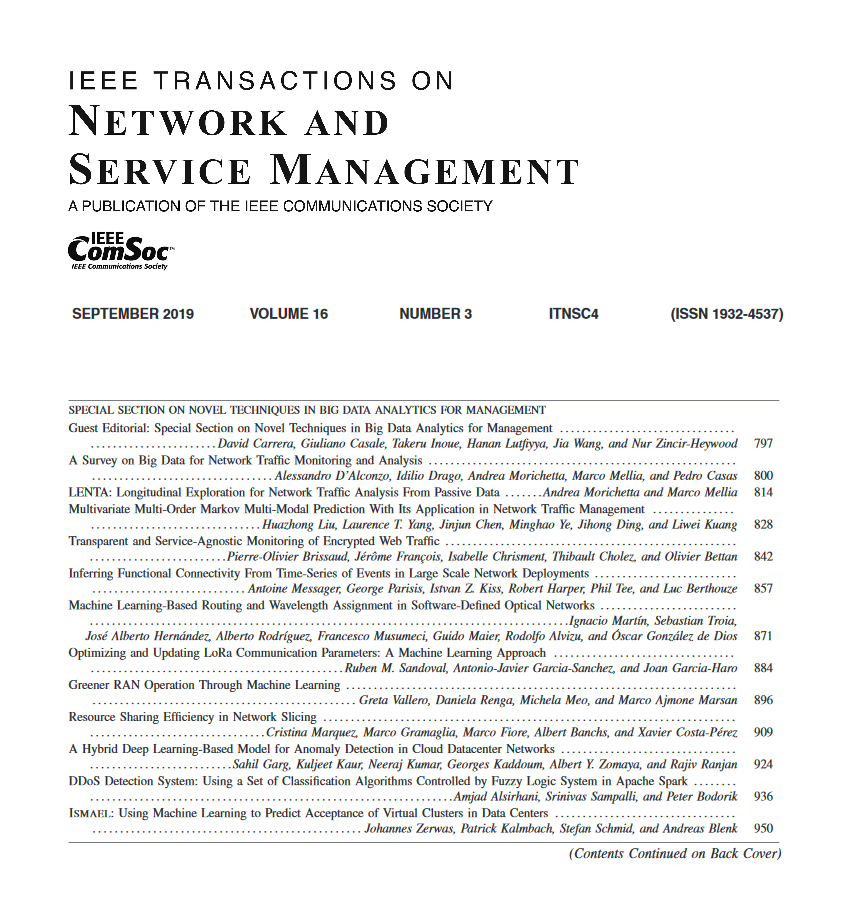
IEEE Transactions on Network and Service Management
Computer Science-Computer Networks and Communications
CiteScore
9.30
自引率
15.10%
发文量
325
期刊介绍:
IEEE Transactions on Network and Service Management will publish (online only) peerreviewed archival quality papers that advance the state-of-the-art and practical applications of network and service management. Theoretical research contributions (presenting new concepts and techniques) and applied contributions (reporting on experiences and experiments with actual systems) will be encouraged. These transactions will focus on the key technical issues related to: Management Models, Architectures and Frameworks; Service Provisioning, Reliability and Quality Assurance; Management Functions; Enabling Technologies; Information and Communication Models; Policies; Applications and Case Studies; Emerging Technologies and Standards.
 求助内容:
求助内容: 应助结果提醒方式:

 京公网安备 11010802042870号


