
Dietary supplements of algal polysaccharides promote ellagic acid biotransformation targeted on gut bacteria
IF 7.3
1区 农林科学
Q1 FOOD SCIENCE & TECHNOLOGY
引用次数: 0
Abstract
Ellagic acid (EA) could be converted into urolithins to exert health-promoting effects by intestinal flora, but the biotransformation capacity varied among individuals. Strategies targeted on gut microflora modulation could be a novel method to obtain more urolithins beyond the inter-individual variability. The study aimed at investigating the impacts of four algal polysaccharides (APs) supplements on EA biotransformation. Results showed that simple APs supplements would increase certain urolithin productions, and APs-EA solid dispersions supplement improved urolithins contents from 4.25 μmol to 6.16-6.79 μmol. The enhancement was related to the proliferation of the EA-metabolic-related bacteria like Gordonibacter, Faecalibacterium, Sutterella, Dialister, Enterocloster and etc. and increasing the bioaccessibility of EA to the bacteria. Furthermore, mono-/co-culture fermentation further verified that Gordonibacter urolithinfaciens was greatly proliferated by simple APs and EA solid dispersions supplements. EA/UPP 1-1 showed the best performances in urolithins productions, and the total urolithins contents increased by 3.78 times compared to control EA group. These results showed dietary supplements could improve biotransformation ability by influencing the EA-metabolic-related bacteria and the access to substrates.膳食中添加藻多糖可促进鞣花酸对肠道细菌的生物转化
鞣花酸可通过肠道菌群转化为尿石素,发挥促进健康的作用,但个体转化能力存在差异。针对肠道菌群调节的策略可能是一种超越个体间差异获得更多尿石素的新方法。本研究旨在探讨4种海藻多糖(ap)添加物对EA生物转化的影响。结果表明,单纯添加APs可提高尿石素产量,添加APs- ea固体分散体可使尿石素含量从4.25 μmol提高到6.16 ~ 6.79 μmol。这种增强与Gordonibacter、Faecalibacterium、Sutterella、Dialister、Enterocloster等EA代谢相关细菌的增殖以及EA对这些细菌的生物可及性增加有关。此外,单/共培养发酵进一步证实,添加简单的APs和EA固体分散体可显著增殖尿石素酵母菌。EA/UPP 1-1在产尿石素方面表现最佳,总尿石素含量较对照EA组提高了3.78倍。这些结果表明,膳食补充剂可以通过影响ea代谢相关细菌和对底物的获取来提高生物转化能力。
本文章由计算机程序翻译,如有差异,请以英文原文为准。
求助全文
约1分钟内获得全文
求助全文
来源期刊
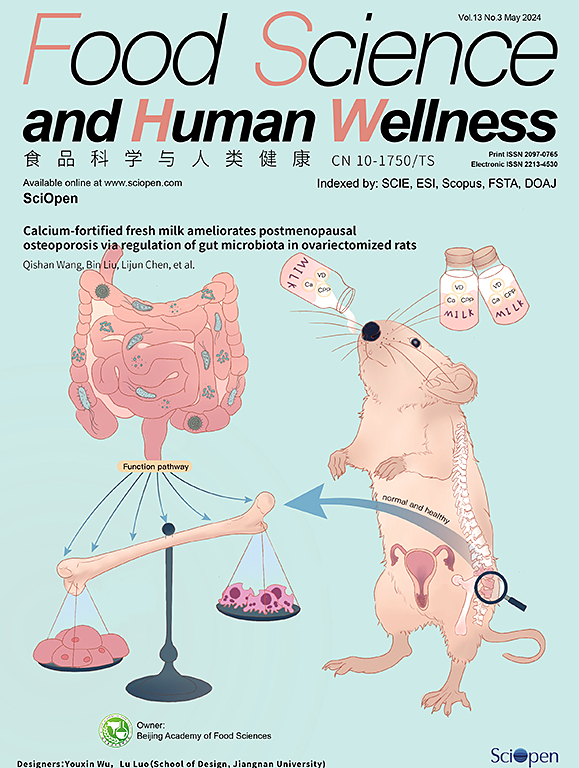
Food Science and Human Wellness
Agricultural and Biological Sciences-Food Science
CiteScore
8.30
自引率
5.70%
发文量
80
审稿时长
28 days
期刊介绍:
Food Science and Human Wellness is an international peer-reviewed journal that provides a forum for the dissemination of the latest scientific results in food science, nutriology, immunology and cross-field research. Articles must present information that is novel, has high impact and interest, and is of high scientific quality. By their effort, it has been developed to promote the public awareness on diet, advocate healthy diet, reduce the harm caused by unreasonable dietary habit, and directs healthy food development for food industrial producers.
文献相关原料
原料信息
原料厂家



 求助内容:
 应助结果提醒方式:


 京公网安备 11010802042870号


