
Dynamic Parallel Task Offloading and Sustainable On-Board Computing for Delay-Energy Optimization LEO Networks
IF 5.7
2区 计算机科学
Q1 COMPUTER SCIENCE, INFORMATION SYSTEMS
IEEE Transactions on Network and Service Management
Pub Date : 2026-02-17
DOI:10.1109/TNSM.2026.3665512
引用次数: 0
Abstract
Task offloading among low-earth orbit (LEO) satellites with on-board computing (OBC) is important for real-time applications. However, OBC is constrained by the battery capacity of LEO, which fluctuates with orbital dynamics and available solar power. This paper addresses the problem of energy sustainability and timeliness in LEO-OBC systems by proposing a sustainable OBC-LEO framework that combines parallel offloading strategies with dynamic energy management. This problem is formulated as a Markov decision process aiming to minimize the overall delay while satisfying the LEO satellite energy constraints and achieving a high task success rate. To balance immediate computational demands and long-term energy stability, a Lyapunov optimization-based dynamic parallel offloading (LODPO) algorithm is designed to make decisions dynamically within each time slot, integrated with subtask allocation based on a low-cost (SABLC) algorithm that dynamically adjusts task allocations. Finally, simulation results demonstrate that the LODPO framework achieves a significant reduction in execution delay, incurring only 34.0% of the delay cost of binary offloading. Most critically, it ensures exceptional reliability, with a task drop rate that is only 8.5% of that seen in binary offloading and 12.0% of that in the DQN-based approach. This ensures high responsiveness and dependability for mission-critical, delay-sensitive applications.时延能量优化LEO网络的动态并行任务卸载与可持续星载计算
具有星载计算(OBC)的低地球轨道(LEO)卫星任务卸载对于实时应用非常重要。然而,OBC受到LEO电池容量的限制,电池容量随着轨道动力学和可用太阳能的变化而波动。本文通过提出一种结合并行卸载策略和动态能源管理的可持续OBC-LEO框架,解决了LEO-OBC系统的能源可持续性和及时性问题。该问题被表述为一个马尔可夫决策过程,其目标是在满足低轨道卫星能量约束的同时最小化总体延迟,并获得较高的任务成功率。为了平衡即时计算需求和长期能量稳定性,设计了一种基于Lyapunov优化的动态并行卸载(LODPO)算法,该算法在每个时隙内动态决策,并结合基于低成本(SABLC)算法的子任务分配,动态调整任务分配。最后,仿真结果表明,LODPO框架显著降低了执行延迟,其延迟成本仅为二进制卸载延迟成本的34.0%。最关键的是,它确保了卓越的可靠性,其任务丢失率仅为二进制卸载的8.5%和基于dqn的方法的12.0%。这确保了任务关键型、延迟敏感型应用程序的高响应性和可靠性。
本文章由计算机程序翻译,如有差异,请以英文原文为准。
求助全文
约1分钟内获得全文
求助全文
来源期刊
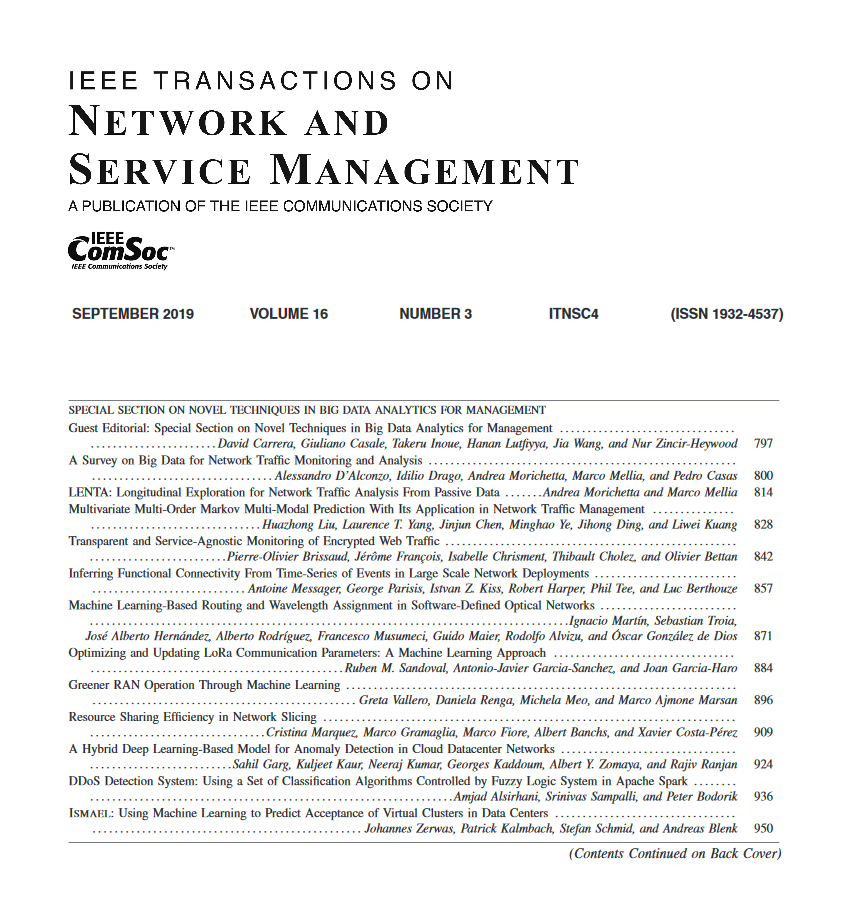
IEEE Transactions on Network and Service Management
Computer Science-Computer Networks and Communications
CiteScore
9.30
自引率
15.10%
发文量
325
期刊介绍:
IEEE Transactions on Network and Service Management will publish (online only) peerreviewed archival quality papers that advance the state-of-the-art and practical applications of network and service management. Theoretical research contributions (presenting new concepts and techniques) and applied contributions (reporting on experiences and experiments with actual systems) will be encouraged. These transactions will focus on the key technical issues related to: Management Models, Architectures and Frameworks; Service Provisioning, Reliability and Quality Assurance; Management Functions; Enabling Technologies; Information and Communication Models; Policies; Applications and Case Studies; Emerging Technologies and Standards.
 求助内容:
求助内容: 应助结果提醒方式:

 京公网安备 11010802042870号


