
Optimizing thermal comfort in highly automated vehicles: An AI-Based HVAC management approach with radiant panels for winter conditions

IF 7.1 2区 工程技术 Q1 CONSTRUCTION & BUILDING TECHNOLOGY
Energy and Buildings Pub Date : 2026-04-15 Epub Date: 2026-02-05 DOI:10.1016/j.enbuild.2026.117113
Manuel Kipp, Ruya Wang, Klaus Bengler
{"title":"Optimizing thermal comfort in highly automated vehicles: An AI-Based HVAC management approach with radiant panels for winter conditions","authors":"Manuel Kipp,&nbsp;Ruya Wang,&nbsp;Klaus Bengler","doi":"10.1016/j.enbuild.2026.117113","DOIUrl":null,"url":null,"abstract":"<div><div>This paper presents an AI-based model for optimizing heating, ventilation, and air conditioning (HVAC) settings to improve thermal comfort in electric vehicles under winter conditions and to estimate the associated power consumption. Unlike conventional HVAC systems that primarily rely on convective heating, the investigated concept combines convective airflow with nine radiant heating panels to enhance comfort and energy efficiency. Equivalent temperature (ET) was employed as an objective thermal comfort metric, and an XGBoost (Extreme Gradient Boosting) model was trained to predict ET for 16 body regions, achieving a high accuracy (coefficient of determination <span><math><mrow><msup><mi>R</mi><mn>2</mn></msup><mo>=</mo><mn>0.96</mn></mrow></math></span>). A Random Forest model was applied to relate fan speed and damper settings to mass flow. Validation experiments confirmed that the optimized HVAC settings maintained thermal comfort, with at least 50% of local body regions and 100% of upper and lower body averages within the neutral comfort zone. The approach demonstrated potential power savings of up to 240 W compared to convection-dominant strategies. These findings highlight the potential of combining AI with hybrid HVAC concepts to improve passenger comfort and reduce energy consumption in future automated electric vehicles.</div></div>","PeriodicalId":11641,"journal":{"name":"Energy and Buildings","volume":"357 ","pages":"Article 117113"},"PeriodicalIF":7.1000,"publicationDate":"2026-04-15","publicationTypes":"Journal Article","fieldsOfStudy":null,"isOpenAccess":false,"openAccessPdf":"","citationCount":"0","resultStr":null,"platform":"Semanticscholar","paperid":null,"PeriodicalName":"Energy and Buildings","FirstCategoryId":"5","ListUrlMain":"https://www.sciencedirect.com/science/article/pii/S0378778826001738","RegionNum":2,"RegionCategory":"工程技术","ArticlePicture":[],"TitleCN":null,"AbstractTextCN":null,"PMCID":null,"EPubDate":"2026/2/5 0:00:00","PubModel":"Epub","JCR":"Q1","JCRName":"CONSTRUCTION & BUILDING TECHNOLOGY","Score":null,"Total":0}
引用次数: 0

Abstract

This paper presents an AI-based model for optimizing heating, ventilation, and air conditioning (HVAC) settings to improve thermal comfort in electric vehicles under winter conditions and to estimate the associated power consumption. Unlike conventional HVAC systems that primarily rely on convective heating, the investigated concept combines convective airflow with nine radiant heating panels to enhance comfort and energy efficiency. Equivalent temperature (ET) was employed as an objective thermal comfort metric, and an XGBoost (Extreme Gradient Boosting) model was trained to predict ET for 16 body regions, achieving a high accuracy (coefficient of determination R2=0.96). A Random Forest model was applied to relate fan speed and damper settings to mass flow. Validation experiments confirmed that the optimized HVAC settings maintained thermal comfort, with at least 50% of local body regions and 100% of upper and lower body averages within the neutral comfort zone. The approach demonstrated potential power savings of up to 240 W compared to convection-dominant strategies. These findings highlight the potential of combining AI with hybrid HVAC concepts to improve passenger comfort and reduce energy consumption in future automated electric vehicles.
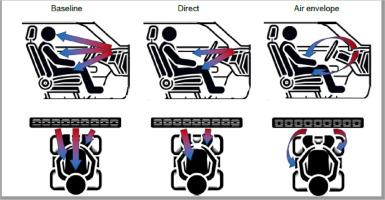
Abstract Image

优化高度自动化车辆的热舒适性:冬季条件下基于人工智能的辐射板HVAC管理方法
本文提出了一种基于人工智能的模型,用于优化供暖、通风和空调(HVAC)设置,以改善冬季条件下电动汽车的热舒适性,并估算相关的功耗。与主要依赖对流加热的传统暖通空调系统不同,研究的概念将对流气流与九个辐射加热板结合起来,以提高舒适度和能源效率。采用等效温度(ET)作为客观热舒适指标,并训练XGBoost (Extreme Gradient Boosting)模型预测16个身体区域的ET,准确度较高(决定系数R2=0.96)。采用随机森林模型将风扇转速和阻尼器设置与质量流量联系起来。验证实验证实,优化后的暖通空调设置保持了热舒适,至少50%的局部身体区域和100%的上半身和下半身平均处于中性舒适区。与对流占优策略相比,该方法可节省高达240 W的潜在功率。这些发现强调了将人工智能与混合暖通空调概念相结合的潜力,以提高未来自动驾驶电动汽车的乘客舒适度并降低能耗。
本文章由计算机程序翻译,如有差异,请以英文原文为准。
求助全文
约1分钟内获得全文 求助全文
来源期刊
Energy and Buildings
Energy and Buildings 工程技术-工程:土木
CiteScore
12.70
自引率
11.90%
发文量
863
审稿时长
38 days
期刊介绍: An international journal devoted to investigations of energy use and efficiency in buildings Energy and Buildings is an international journal publishing articles with explicit links to energy use in buildings. The aim is to present new research results, and new proven practice aimed at reducing the energy needs of a building and improving indoor environment quality.

×
引用
GB/T 7714-2015
复制
MLA
复制
APA
复制
导出至
BibTeX EndNote RefMan NoteFirst NoteExpress
×
提示
您的信息不完整,为了账户安全,请先补充。
现在去补充
×
提示
您因"违规操作"
具体请查看互助需知
我知道了
×
提示
确定
请完成安全验证×
copy
已复制链接
快去分享给好友吧!
我知道了
右上角分享
点击右上角分享
0
联系我们:info@booksci.cn Book学术提供免费学术资源搜索服务,方便国内外学者检索中英文文献。致力于提供最便捷和优质的服务体验。 Copyright © 2023 布克学术 All rights reserved.
京ICP备2023020795号-1
ghs 京公网安备 11010802042870号
Book学术文献互助
Book学术文献互助群
群 号:604180095
Book学术官方微信
小红书


