Abdulrahman Saeed AbuDahish, Mohamed Suwareldahab Sati, Ali Hassan A Alnasser, Jaffar A Al-Tawfiq
{"title":"Epidemiology of HIV in the Eastern Province of Saudi Arabia: A 10-year Retrospective Analysis.","authors":"Abdulrahman Saeed AbuDahish, Mohamed Suwareldahab Sati, Ali Hassan A Alnasser, Jaffar A Al-Tawfiq","doi":"10.4103/sjmms.sjmms_264_25","DOIUrl":null,"url":null,"abstract":"<p><strong>Background: </strong>HIV transmission trends and risk factors have not been specifically reported from the Eastern Province of Saudi Arabia.</p><p><strong>Objective: </strong>To report epidemiological trends of HIV/AIDS in the Eastern Province of Saudi Arabia over a 10-year period.</p><p><strong>Materials and methods: </strong>This retrospective study included all cases of HIV/AIDS in the registry of Department of Infectious Diseases of the Public Health Authority in the Eastern Province, Ministry of Health, Saudi Arabia, between January 01, 2014, and December 31, 2023.</p><p><strong>Results: </strong>A total of 1633 new cases of HIV infections were reported in the Eastern Province of Saudi Arabia between 2014 and 2023. Most patients were males (87.1%), aged 30-44 years (49.8%), and Saudis (60.5%). There was a year-on-year increase in the number of cases each year, except in 2016 and 2020. Overall, there was a >2.5-fold increase in the number of cases between 2014 and 2023; there was a 42% increase in the number of cases between 2021 and 2023. The most common source of HIV transmission was heterosexual contact (70.8%). Other modes of transmission, such as injection drug use, homosexual contact, and vertical transmission, were low.</p><p><strong>Conclusion: </strong>The steady rise in the number of HIV cases reported in the Eastern Province of Saudi Arabia indicates the need for developing stronger surveillance, testing, and prevention programs.</p>","PeriodicalId":21442,"journal":{"name":"Saudi Journal of Medicine & Medical Sciences","volume":"14 1","pages":"43-47"},"PeriodicalIF":1.5000,"publicationDate":"2026-01-19","publicationTypes":"Journal Article","fieldsOfStudy":null,"isOpenAccess":false,"openAccessPdf":"https://www.ncbi.nlm.nih.gov/pmc/articles/PMC12890237/pdf/","citationCount":"0","resultStr":null,"platform":"Semanticscholar","paperid":null,"PeriodicalName":"Saudi Journal of Medicine & Medical Sciences","FirstCategoryId":"1085","ListUrlMain":"https://doi.org/10.4103/sjmms.sjmms_264_25","RegionNum":0,"RegionCategory":null,"ArticlePicture":[],"TitleCN":null,"AbstractTextCN":null,"PMCID":null,"EPubDate":"2026/1/1 0:00:00","PubModel":"eCollection","JCR":"Q2","JCRName":"MEDICINE, GENERAL & INTERNAL","Score":null,"Total":0}
引用次数: 0
Abstract
Background: HIV transmission trends and risk factors have not been specifically reported from the Eastern Province of Saudi Arabia.
Objective: To report epidemiological trends of HIV/AIDS in the Eastern Province of Saudi Arabia over a 10-year period.
Materials and methods: This retrospective study included all cases of HIV/AIDS in the registry of Department of Infectious Diseases of the Public Health Authority in the Eastern Province, Ministry of Health, Saudi Arabia, between January 01, 2014, and December 31, 2023.
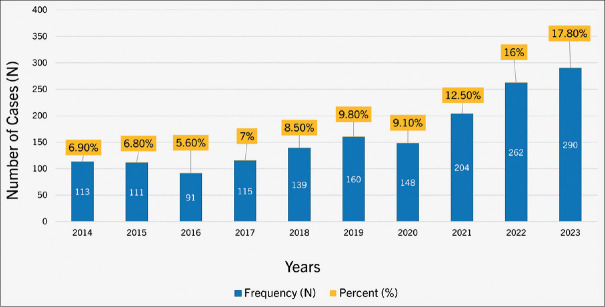
Results: A total of 1633 new cases of HIV infections were reported in the Eastern Province of Saudi Arabia between 2014 and 2023. Most patients were males (87.1%), aged 30-44 years (49.8%), and Saudis (60.5%). There was a year-on-year increase in the number of cases each year, except in 2016 and 2020. Overall, there was a >2.5-fold increase in the number of cases between 2014 and 2023; there was a 42% increase in the number of cases between 2021 and 2023. The most common source of HIV transmission was heterosexual contact (70.8%). Other modes of transmission, such as injection drug use, homosexual contact, and vertical transmission, were low.
Conclusion: The steady rise in the number of HIV cases reported in the Eastern Province of Saudi Arabia indicates the need for developing stronger surveillance, testing, and prevention programs.
期刊介绍:
Saudi Journal of Medicine & Medical Sciences (SJMMS) is the official scientific journal of Imam Abdulrahman Bin Faisal University. It is an international peer-reviewed, general medical journal. The scope of the Journal is to publish research that will be of interest to health specialties both in academic and clinical practice. The Journal aims at disseminating high-powered research results with the objective of turning research into knowledge. It seeks to promote scholarly publishing in medicine and medical sciences. The Journal is published in print and online. The target readers of the Journal include all medical and health professionals in the health cluster such as in medicine, dentistry, nursing, applied medical sciences, clinical pharmacology, public health, etc.


 求助内容:
求助内容: 应助结果提醒方式:

 京公网安备 11010802042870号


