
Integrative analysis reveals casing layer dynamics during Agaricus bisporus cultivation and the growth promoting effect of Pseudomonas putida AT130
IF 5.9
1区 农林科学
Q1 FOOD SCIENCE & TECHNOLOGY
引用次数: 0
Abstract
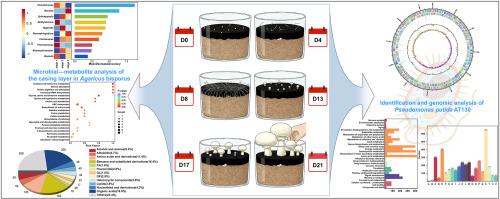
Agaricus bisporus is the most widely consumed edible mushroom and an important source of dietary protein and bioactive compounds. The casing layer plays a critical role in its cultivation, where microbial communities and metabolic activities strongly affect yield and quality, however, the stage-resolved research gap remains that it is still unclear which microbial and metabolic shifts in the casing layer are associated with primordia initiation and subsequent quality formation. In this study, the ecological and metabolic basis of mushroom quality formation was investigated by the combination of microbiome sequencing, non-targeted metabolomics, and functional genomics. Microbial communities exhibited stage-specific dynamics, with significant restructuring during primordia formation, when community cohesion and niche breadth reached their highest levels (0.68 ± 0.06 and 4.48 ± 1.05, respectively). A total of 1108 non-volatile metabolites were identified from metabolomic profiling. The adenosine and tryptophan exhibited significant changes and were enriched in energy and amino acid metabolism pathways. A representative strain, Pseudomonas putida AT130, was isolated from the genus Pseudomonas. The gene clusters related to phosphate solubilization, potassium mobilization, lignin degradation, and indole-3-acetic acid biosynthesis were revealed by genome analysis with the multifunctional activities being confirmed through in vitro assays. Pot experiments further showed that AT130 inoculation improved mushroom performance, increasing fruiting body yield by 123.55% and enhancing nutritional traits (protein and soluble sugars increased, whereas ash decreased) relative to the control. These findings linked casing-layer microbiota with mushroom quality and identified AT130 as a promising food-grade bioinoculant to enhance A. bisporus nutritional value and productivity.
综合分析双孢蘑菇栽培过程中衣壳层动态变化及腐臭假单胞菌AT130的促生作用
双孢蘑菇是食用最广泛的食用菌,也是膳食蛋白质和生物活性化合物的重要来源。套管层在其栽培中起着至关重要的作用,其中微生物群落和代谢活动对产量和品质有很大的影响,然而,阶段解决的研究空白仍然存在,即套管层中哪些微生物和代谢变化与原基起始和随后的品质形成有关尚不清楚。本研究采用微生物组测序、非靶向代谢组学和功能基因组学相结合的方法,研究了香菇品质形成的生态代谢基础。微生物群落表现出阶段性的动态变化,群落内聚力和生态位宽度在原基形成期间达到最高水平(分别为0.68±0.06和4.48±1.05),重构显著。从代谢组学分析中共鉴定出1108种非挥发性代谢物。腺苷和色氨酸在能量和氨基酸代谢途径中表现出明显的变化和富集。从假单胞菌属中分离到一株具有代表性的恶臭假单胞菌AT130。通过基因组分析揭示了与磷酸盐溶解、钾动员、木质素降解和吲哚-3-乙酸生物合成相关的基因簇,并通过体外实验证实了这些基因簇的多功能活性。盆栽试验进一步表明,接种AT130后,菌体产量比对照提高了123.55%,营养性状(蛋白质和可溶性糖增加,灰分减少)得到改善。这些发现将菌壳层微生物群与蘑菇品质联系起来,并确定AT130是一种有前途的食品级生物接种剂,可以提高双孢芽孢杆菌的营养价值和产量。
本文章由计算机程序翻译,如有差异,请以英文原文为准。
求助全文
约1分钟内获得全文
求助全文
来源期刊
Food Bioscience
Biochemistry, Genetics and Molecular Biology-Biochemistry
CiteScore
6.40
自引率
5.80%
发文量
671
审稿时长
27 days
期刊介绍:
Food Bioscience is a peer-reviewed journal that aims to provide a forum for recent developments in the field of bio-related food research. The journal focuses on both fundamental and applied research worldwide, with special attention to ethnic and cultural aspects of food bioresearch.
 求助内容:
求助内容: 应助结果提醒方式:

 京公网安备 11010802042870号


