
Bifidobacterium pseudocatenulatum AL44 ameliorates Enterococcus faecium-induced lung inflammation through NLRP3 suppression along the gut-lung axis

IF 5.9 1区 农林科学 Q1 FOOD SCIENCE & TECHNOLOGY
Food Bioscience Pub Date : 2026-04-01 Epub Date: 2026-02-04 DOI:10.1016/j.fbio.2026.108395
Shugang Li , Weiyun Zheng , Wudeng Wang , Xiaomeng Ren , Shuang Song , Chunqing Ai
{"title":"Bifidobacterium pseudocatenulatum AL44 ameliorates Enterococcus faecium-induced lung inflammation through NLRP3 suppression along the gut-lung axis","authors":"Shugang Li ,&nbsp;Weiyun Zheng ,&nbsp;Wudeng Wang ,&nbsp;Xiaomeng Ren ,&nbsp;Shuang Song ,&nbsp;Chunqing Ai","doi":"10.1016/j.fbio.2026.108395","DOIUrl":null,"url":null,"abstract":"<div><div>The gut microbiota plays an important role in regulating pulmonary inflammation via the gut-lung axis. In this study, <em>Bifidobacterium pseudocatenulatum</em> AL44, isolated from healthy infant feces, was evaluated in a mouse model of <em>Enterococcus faecium</em>-induced pneumonia. AL44 treatment markedly alleviated lung histopathological injury, oxidative stress, and inflammatory macrophage polarization. These protective effects were associated with modulation of the gut microbiota, characterized by the enrichment of beneficial taxa, enhanced intestinal barrier integrity, and reduced systemic endotoxin and inflammatory cytokine levels. Targeted serum metabolomics revealed significant alterations in amino acid metabolism, particularly within the glycine-serine-threonine-betaine pathway. <em>In vitro</em> studies showed that betaine, a key AL44-associated metabolite, suppressed lipopolysaccharide (LPS)-induced inflammatory response by inhibiting activation of NOD-like receptor family pyrin domain containing 3 (NLRP3) signaling pathway. Collectively, these results imply that AL44 mitigates pulmonary inflammation via modulation of the gut-lung axis, with betaine-mediated suppression of the NLRP3 signaling representing a potential pathway, supporting AL44 as a promising probiotic candidate for the management of pneumonia.</div></div>","PeriodicalId":12409,"journal":{"name":"Food Bioscience","volume":"78 ","pages":"Article 108395"},"PeriodicalIF":5.9000,"publicationDate":"2026-04-01","publicationTypes":"Journal Article","fieldsOfStudy":null,"isOpenAccess":false,"openAccessPdf":"","citationCount":"0","resultStr":null,"platform":"Semanticscholar","paperid":null,"PeriodicalName":"Food Bioscience","FirstCategoryId":"97","ListUrlMain":"https://www.sciencedirect.com/science/article/pii/S2212429226001677","RegionNum":1,"RegionCategory":"农林科学","ArticlePicture":[],"TitleCN":null,"AbstractTextCN":null,"PMCID":null,"EPubDate":"2026/2/4 0:00:00","PubModel":"Epub","JCR":"Q1","JCRName":"FOOD SCIENCE & TECHNOLOGY","Score":null,"Total":0}
引用次数: 0

Abstract

The gut microbiota plays an important role in regulating pulmonary inflammation via the gut-lung axis. In this study, Bifidobacterium pseudocatenulatum AL44, isolated from healthy infant feces, was evaluated in a mouse model of Enterococcus faecium-induced pneumonia. AL44 treatment markedly alleviated lung histopathological injury, oxidative stress, and inflammatory macrophage polarization. These protective effects were associated with modulation of the gut microbiota, characterized by the enrichment of beneficial taxa, enhanced intestinal barrier integrity, and reduced systemic endotoxin and inflammatory cytokine levels. Targeted serum metabolomics revealed significant alterations in amino acid metabolism, particularly within the glycine-serine-threonine-betaine pathway. In vitro studies showed that betaine, a key AL44-associated metabolite, suppressed lipopolysaccharide (LPS)-induced inflammatory response by inhibiting activation of NOD-like receptor family pyrin domain containing 3 (NLRP3) signaling pathway. Collectively, these results imply that AL44 mitigates pulmonary inflammation via modulation of the gut-lung axis, with betaine-mediated suppression of the NLRP3 signaling representing a potential pathway, supporting AL44 as a promising probiotic candidate for the management of pneumonia.
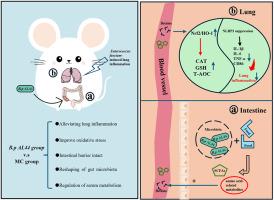
Abstract Image

假芽双歧杆菌AL44通过沿肠-肺轴抑制NLRP3改善粪肠球菌诱导的肺部炎症
肠道微生物群通过肠-肺轴在调节肺部炎症中起重要作用。在这项研究中,从健康的婴儿粪便中分离出假芽孢双歧杆菌AL44,在粪便肠球菌诱导的肺炎小鼠模型中进行了评估。AL44治疗可显著减轻肺组织病理学损伤、氧化应激和炎性巨噬细胞极化。这些保护作用与肠道菌群的调节有关,其特征是有益菌群的富集,肠道屏障完整性的增强,以及全身内毒素和炎症细胞因子水平的降低。靶向血清代谢组学揭示了氨基酸代谢的显著改变,特别是在甘氨酸-丝氨酸-苏氨酸-甜菜碱途径中。体外研究表明,甜菜碱是al44相关的关键代谢物,通过抑制nod样受体家族pyrin domain containing 3 (NLRP3)信号通路的激活,抑制脂多糖(LPS)诱导的炎症反应。总的来说,这些结果表明AL44通过调节肠-肺轴减轻肺部炎症,甜菜碱介导的NLRP3信号的抑制代表了一个潜在的途径,支持AL44作为治疗肺炎的有希望的益生菌候选物。
本文章由计算机程序翻译,如有差异,请以英文原文为准。
求助全文
约1分钟内获得全文 求助全文
来源期刊
Food Bioscience
Food Bioscience Biochemistry, Genetics and Molecular Biology-Biochemistry
CiteScore
6.40
自引率
5.80%
发文量
671
审稿时长
27 days
期刊介绍: Food Bioscience is a peer-reviewed journal that aims to provide a forum for recent developments in the field of bio-related food research. The journal focuses on both fundamental and applied research worldwide, with special attention to ethnic and cultural aspects of food bioresearch.

×
引用
GB/T 7714-2015
复制
MLA
复制
APA
复制
导出至
BibTeX EndNote RefMan NoteFirst NoteExpress
×
提示
您的信息不完整,为了账户安全,请先补充。
现在去补充
×
提示
您因"违规操作"
具体请查看互助需知
我知道了
×
提示
确定
请完成安全验证×
copy
已复制链接
快去分享给好友吧!
我知道了
右上角分享
点击右上角分享
0
联系我们:info@booksci.cn Book学术提供免费学术资源搜索服务,方便国内外学者检索中英文文献。致力于提供最便捷和优质的服务体验。 Copyright © 2023 布克学术 All rights reserved.
京ICP备2023020795号-1
ghs 京公网安备 11010802042870号
Book学术文献互助
Book学术文献互助群
群 号:604180095
Book学术官方微信
小红书


