
A microbial biorefinery for chitin and N-acetyl chitooligosaccharides from shrimp shell waste
IF 6.2
Q1 AGRICULTURE, MULTIDISCIPLINARY
Journal of Agriculture and Food Research
Pub Date : 2026-05-01
Epub Date: 2026-02-09
DOI:10.1016/j.jafr.2026.102759
引用次数: 0
Abstract
The global expansion of crustacean production has generated increasing volumes of chitinous waste, yet efficient recovery methods remain limited. Sustainable biorefinery approaches are urgently required to replace conventional chemical processes. This study proposes a microbial biorefinery strategy for comprehensive valorization of shrimp shell waste (SSW), focusing on the recovery of proteins, minerals, and chitin, as well as their conversion into value-added products. Three microbial strains were employed sequentially for deproteinization (DP), demineralization (DM), and chitin degradation. Strain GXUN-7 achieved a DP efficiency of 99.39%, yielding a hydrolysate enriched with free amino acids, 63.58% of which were essential. The hydrolysate exhibited a stimulatory effect on tobacco plant growth. Optimization of DM via orthogonal experimental design enabled GXUN-G1 to reach a 97.38% removal rate, with the resulting supernatant containing bioavailable calcium lactate suitable for plant nutrition. The recovered chitin exhibited a degree of acetylation of 88.93% and structural properties comparable to commercial chitin. The chitin-degrading strain GXUN-J6 produced hydrolysates with notable antioxidant activity, antimicrobial efficacy against Phytophthora nicotianae, and immunostimulatory effects, as evidenced by enhanced activities of superoxide dismutase, peroxidase, and phenylalanine ammonia-lyase. Operating under mild, non-corrosive, and energy-efficient conditions, the integrated bioprocess yielded ∼0.29 g of protein hydrolysate, ∼0.30 g of mineral supplement, ∼0.09 g of purified chitin, and ∼0.07 g of chitin hydrolysate per gram of SSW, demonstrating its environmental sustainability and economic viability. This eco-friendly, microbially driven biorefinery platform offers a promising and scalable solution for the circular utilization of shrimp shell waste.
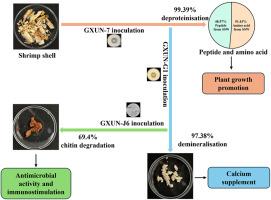
从虾壳废料中提取甲壳素和n -乙酰壳寡糖的微生物精炼厂
甲壳类动物生产的全球扩张产生了越来越多的几丁质废物,但有效的回收方法仍然有限。迫切需要可持续的生物炼制方法来取代传统的化学工艺。本研究提出了一种虾壳废物(SSW)综合增值的微生物生物精炼策略,重点是蛋白质、矿物质和几丁质的回收,以及它们转化为增值产品。3株微生物依次进行脱蛋白(DP)、脱矿(DM)和几丁质降解。菌株GXUN-7的DP效率为99.39%,水解产物富含游离氨基酸,其中必需氨基酸占63.58%。水解产物对烟草植株生长有促进作用。通过正交试验设计优化DM, GXUN-G1去除率达到97.38%,所得上清液含生物可利用乳酸钙,适合植物营养。所制得的甲壳素乙酰化率为88.93%,结构性能与商品甲壳素相当。甲壳素降解菌株GXUN-J6的水解产物具有显著的抗氧化活性、抗烟草疫霉活性和免疫刺激作用,表现为超氧化物歧化酶、过氧化物酶和苯丙氨酸解氨酶活性的增强。在温和、无腐蚀和节能的条件下,整合的生物过程每克SSW产生0.29 g蛋白质水解物、0.30 g矿物质补充物、0.09 g纯化几丁质和0.07 g几丁质水解物,证明了其环境可持续性和经济可行性。这个生态友好、微生物驱动的生物精炼平台为虾壳废物的循环利用提供了一个有前途的、可扩展的解决方案。
本文章由计算机程序翻译,如有差异,请以英文原文为准。
求助全文
约1分钟内获得全文
求助全文
来源期刊

Journal of Agriculture and Food Research
Multiple-
CiteScore
5.40
自引率
2.60%
发文量
193
审稿时长
69 days
 求助内容:
求助内容: 应助结果提醒方式:

 京公网安备 11010802042870号


