
ACF-SAP: A machine learning framework for predicting obstructive sleep apnea severity using anthropometric and clinical features

IF 2 Q3 NEUROSCIENCES
Clinical Neurophysiology Practice Pub Date : 2026-01-01 Epub Date: 2026-01-10 DOI:10.1016/j.cnp.2025.12.001
Abduladhim Ashtaiwi , Mohamed Eltwayeb
{"title":"ACF-SAP: A machine learning framework for predicting obstructive sleep apnea severity using anthropometric and clinical features","authors":"Abduladhim Ashtaiwi ,&nbsp;Mohamed Eltwayeb","doi":"10.1016/j.cnp.2025.12.001","DOIUrl":null,"url":null,"abstract":"<div><h3>Objective:</h3><div>This study aims to develop and evaluate ACF-SAP, a machine learning (ML) framework for predicting obstructive sleep apnea (OSA) severity using non-invasive, routinely collected clinical features.</div></div><div><h3>Methods:</h3><div>The proposed approach leverages common anthropometric and clinical variables, including sex, body mass index (BMI), height, weight, neck circumference, and nocturia. The methodology integrates machine-learning–based feature selection to identify the most informative predictors, followed by unsupervised clustering to generate data-driven sleep severity labels. These labeled data are then used to train and evaluate the ACF-SAP framework.</div></div><div><h3>Results:</h3><div>ACF-SAP, implemented with ensemble classifiers, achieved a classification accuracy of 0.84, with strong F1-scores and balanced sensitivity across OSA severity levels.</div></div><div><h3>Conclusions:</h3><div>The ACF-SAP model supports early identification of patients at high risk for OSA and may serve as a first-line screening tool to prioritize referrals for polysomnography (PSG).</div></div><div><h3>Significance:</h3><div>This work presents a scalable, low-cost screening framework that can improve triage efficiency and facilitate timely diagnosis, particularly in resource-constrained healthcare environments.</div></div>","PeriodicalId":45697,"journal":{"name":"Clinical Neurophysiology Practice","volume":"11 ","pages":"Pages 45-53"},"PeriodicalIF":2.0000,"publicationDate":"2026-01-01","publicationTypes":"Journal Article","fieldsOfStudy":null,"isOpenAccess":false,"openAccessPdf":"","citationCount":"0","resultStr":null,"platform":"Semanticscholar","paperid":null,"PeriodicalName":"Clinical Neurophysiology Practice","FirstCategoryId":"1085","ListUrlMain":"https://www.sciencedirect.com/science/article/pii/S2467981X25000691","RegionNum":0,"RegionCategory":null,"ArticlePicture":[],"TitleCN":null,"AbstractTextCN":null,"PMCID":null,"EPubDate":"2026/1/10 0:00:00","PubModel":"Epub","JCR":"Q3","JCRName":"NEUROSCIENCES","Score":null,"Total":0}
引用次数: 0

Abstract

Objective:

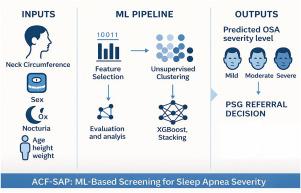
This study aims to develop and evaluate ACF-SAP, a machine learning (ML) framework for predicting obstructive sleep apnea (OSA) severity using non-invasive, routinely collected clinical features.

Methods:

The proposed approach leverages common anthropometric and clinical variables, including sex, body mass index (BMI), height, weight, neck circumference, and nocturia. The methodology integrates machine-learning–based feature selection to identify the most informative predictors, followed by unsupervised clustering to generate data-driven sleep severity labels. These labeled data are then used to train and evaluate the ACF-SAP framework.

Results:

ACF-SAP, implemented with ensemble classifiers, achieved a classification accuracy of 0.84, with strong F1-scores and balanced sensitivity across OSA severity levels.

Conclusions:

The ACF-SAP model supports early identification of patients at high risk for OSA and may serve as a first-line screening tool to prioritize referrals for polysomnography (PSG).

Significance:

This work presents a scalable, low-cost screening framework that can improve triage efficiency and facilitate timely diagnosis, particularly in resource-constrained healthcare environments.
Abstract Image

ACF-SAP:利用人体测量学和临床特征预测阻塞性睡眠呼吸暂停严重程度的机器学习框架
目的:本研究旨在开发和评估ACF-SAP,这是一个机器学习(ML)框架,用于预测阻塞性睡眠呼吸暂停(OSA)的严重程度,使用无创的,常规收集的临床特征。方法:提出的方法利用常见的人体测量和临床变量,包括性别、体重指数(BMI)、身高、体重、颈围和夜尿症。该方法集成了基于机器学习的特征选择,以识别最具信息量的预测因子,然后是无监督聚类,以生成数据驱动的睡眠严重程度标签。然后使用这些标记的数据来训练和评估ACF-SAP框架。结果:采用集成分类器实现的ACF-SAP的分类精度为0.84,具有较强的f1评分和跨OSA严重程度的平衡敏感性。结论:ACF-SAP模型支持OSA高危患者的早期识别,可作为优先转诊多导睡眠图(PSG)的一线筛查工具。意义:这项工作提出了一个可扩展的、低成本的筛查框架,可以提高分诊效率,促进及时诊断,特别是在资源有限的医疗环境中。
本文章由计算机程序翻译,如有差异,请以英文原文为准。
求助全文
约1分钟内获得全文 求助全文
来源期刊
CiteScore
3.90
自引率
0.00%
发文量
47
审稿时长
71 days
期刊介绍: Clinical Neurophysiology Practice (CNP) is a new Open Access journal that focuses on clinical practice issues in clinical neurophysiology including relevant new research, case reports or clinical series, normal values and didactic reviews. It is an official journal of the International Federation of Clinical Neurophysiology and complements Clinical Neurophysiology which focuses on innovative research in the specialty. It has a role in supporting established clinical practice, and an educational role for trainees, technicians and practitioners.

×
引用
GB/T 7714-2015
复制
MLA
复制
APA
复制
导出至
BibTeX EndNote RefMan NoteFirst NoteExpress
×
提示
您的信息不完整,为了账户安全,请先补充。
现在去补充
×
提示
您因"违规操作"
具体请查看互助需知
我知道了
×
提示
确定
请完成安全验证×
copy
已复制链接
快去分享给好友吧!
我知道了
右上角分享
点击右上角分享
0
联系我们:info@booksci.cn Book学术提供免费学术资源搜索服务,方便国内外学者检索中英文文献。致力于提供最便捷和优质的服务体验。 Copyright © 2023 布克学术 All rights reserved.
京ICP备2023020795号-1
ghs 京公网安备 11010802042870号
Book学术文献互助
Book学术文献互助群
群 号:604180095
Book学术官方微信
小红书


