
Feeding during off-flavour purging in recirculating aquaculture systems? An exploratory characterisation of waterborne and feedborne odour-active compounds in Russian sturgeon (Acipenser gueldenstaedtii)

IF 6.2 Q1 AGRICULTURE, MULTIDISCIPLINARY
Journal of Agriculture and Food Research Pub Date : 2026-03-01 Epub Date: 2026-01-10 DOI:10.1016/j.jafr.2025.102615
Matteo Egiddi , Mariana Rodrigues da Silva , Eva Ortner , Bastien Debeuf , Helene M. Loos , Andrea Buettner , Jonathan Beauchamp
{"title":"Feeding during off-flavour purging in recirculating aquaculture systems? An exploratory characterisation of waterborne and feedborne odour-active compounds in Russian sturgeon (Acipenser gueldenstaedtii)","authors":"Matteo Egiddi ,&nbsp;Mariana Rodrigues da Silva ,&nbsp;Eva Ortner ,&nbsp;Bastien Debeuf ,&nbsp;Helene M. Loos ,&nbsp;Andrea Buettner ,&nbsp;Jonathan Beauchamp","doi":"10.1016/j.jafr.2025.102615","DOIUrl":null,"url":null,"abstract":"<div><div>Off-flavours are a major challenge in recirculating aquaculture systems (RAS), with geosmin and 2-methylisoborneol (2-MIB) among key contributors to <em>earthy</em> taints. Purging unfed fish in flow-through (FT) water is a standard strategy for off-flavour removal, yet it entails high costs. This descriptive study examined off-flavour development in Russian sturgeon (<em>Acipenser gueldenstaedtii</em>) reared in two systems (RAS and FT depuration) under fed or unfed conditions. Sturgeon fillets, water of both systems, and the commercial feed were analysed via gas chromatography–mass spectrometry/olfactometry (GC–MS/O) combined with aroma extract dilution analysis (AEDA), leading to the identification of 85 odour-active compounds. Water and fillets from RAS showed greater off-odour diversity and potency in terms of their flavour dilution (FD) factors, including geosmin, 2-MIB, 1,3-benzothiazole and pyrazines. In contrast, water and fillets from depuration exhibited fewer off-odours and more desirable notes, such as <em>green</em>, <em>fruity</em> and <em>popcorn-like</em> attributes. The influence of feeding was system-dependent: in depuration, fed animals exhibited lower FD values of key compounds (e.g.<em>,</em> geosmin) but higher odour diversity, including both pleasant (e.g.<em>, mushroom-like, citrus-like</em>) and unpleasant (e.g.<em>, ink-like, sweaty, pungent</em>) notes, whereas in RAS, lower compound diversity and minor odour profile differences were detected in fed sturgeons. Although not statistically relevant, observed differences between groups arose from shifts in relative odour attribute frequencies, compound diversity and FD values across water types and between feeding groups. Overall, sturgeon fed during depuration exhibited a preferable odour profile and a lower geosmin level, but new feedborne odorants were also introduced. The hypotheses generated in this study warrant future targeted sensory assessments and suggest formulation of finishing feeds that can mitigate off-odours and improve the marketability of RAS-reared fish.</div></div>","PeriodicalId":34393,"journal":{"name":"Journal of Agriculture and Food Research","volume":"26 ","pages":"Article 102615"},"PeriodicalIF":6.2000,"publicationDate":"2026-03-01","publicationTypes":"Journal Article","fieldsOfStudy":null,"isOpenAccess":false,"openAccessPdf":"","citationCount":"0","resultStr":null,"platform":"Semanticscholar","paperid":null,"PeriodicalName":"Journal of Agriculture and Food Research","FirstCategoryId":"1085","ListUrlMain":"https://www.sciencedirect.com/science/article/pii/S266615432500986X","RegionNum":0,"RegionCategory":null,"ArticlePicture":[],"TitleCN":null,"AbstractTextCN":null,"PMCID":null,"EPubDate":"2026/1/10 0:00:00","PubModel":"Epub","JCR":"Q1","JCRName":"AGRICULTURE, MULTIDISCIPLINARY","Score":null,"Total":0}
引用次数: 0

Abstract

Off-flavours are a major challenge in recirculating aquaculture systems (RAS), with geosmin and 2-methylisoborneol (2-MIB) among key contributors to earthy taints. Purging unfed fish in flow-through (FT) water is a standard strategy for off-flavour removal, yet it entails high costs. This descriptive study examined off-flavour development in Russian sturgeon (Acipenser gueldenstaedtii) reared in two systems (RAS and FT depuration) under fed or unfed conditions. Sturgeon fillets, water of both systems, and the commercial feed were analysed via gas chromatography–mass spectrometry/olfactometry (GC–MS/O) combined with aroma extract dilution analysis (AEDA), leading to the identification of 85 odour-active compounds. Water and fillets from RAS showed greater off-odour diversity and potency in terms of their flavour dilution (FD) factors, including geosmin, 2-MIB, 1,3-benzothiazole and pyrazines. In contrast, water and fillets from depuration exhibited fewer off-odours and more desirable notes, such as green, fruity and popcorn-like attributes. The influence of feeding was system-dependent: in depuration, fed animals exhibited lower FD values of key compounds (e.g., geosmin) but higher odour diversity, including both pleasant (e.g., mushroom-like, citrus-like) and unpleasant (e.g., ink-like, sweaty, pungent) notes, whereas in RAS, lower compound diversity and minor odour profile differences were detected in fed sturgeons. Although not statistically relevant, observed differences between groups arose from shifts in relative odour attribute frequencies, compound diversity and FD values across water types and between feeding groups. Overall, sturgeon fed during depuration exhibited a preferable odour profile and a lower geosmin level, but new feedborne odorants were also introduced. The hypotheses generated in this study warrant future targeted sensory assessments and suggest formulation of finishing feeds that can mitigate off-odours and improve the marketability of RAS-reared fish.
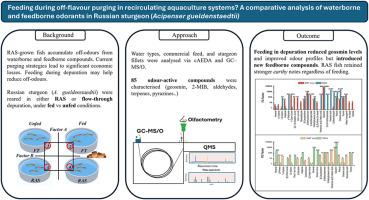
Abstract Image

循环水养殖系统异味净化期间的饲喂?俄罗斯鲟鱼(Acipenser gueldenstaedtii)水中和饲料中气味活性化合物的探索性特征
异味是循环水养殖系统(RAS)的主要挑战,土臭素和2-甲基异龙脑(2-MIB)是造成泥土污染的主要因素。在流通(FT)水中清洗未喂食的鱼是去除异味的标准策略,但它需要高昂的成本。本描述性研究考察了在两种系统(RAS和FT净化)中饲养的俄罗斯鲟鱼(Acipenser gueldenstaedtii)在喂食或不喂食条件下的变质发育。采用气相色谱-质谱联用(GC-MS /O)和香气萃取物稀释分析法(AEDA)对鲟鱼鱼片、两种系统的水和商业饲料进行分析,鉴定出85种气味活性化合物。RAS的水和鱼片在其风味稀释因子(FD)方面表现出更大的异味多样性和效力,包括土臭素,2-MIB, 1,3-苯并噻唑和吡嗪。相比之下,净化后的水和鱼片的异味更少,更令人满意的味道,比如绿色、水果味和爆米花味。喂食的影响是系统依赖的:在净化中,喂食的动物表现出较低的关键化合物(例如土臭素)的FD值,但更高的气味多样性,包括令人愉快的(例如,蘑菇样,柑橘样)和令人不快的(例如,墨水样,汗味,刺鼻)的气味,而在RAS中,喂食的鲟鱼检测到较低的化合物多样性和轻微的气味特征差异。虽然没有统计学上的相关性,但观察到的组间差异是由相对气味属性频率、化合物多样性和FD值在水类型和饲喂组之间的变化引起的。总体而言,在净化期间喂食的鲟鱼表现出较好的气味特征和较低的土臭素水平,但也引入了新的饲料气味剂。本研究中产生的假设为未来有针对性的感官评估提供了依据,并提出了可以减轻臭味和提高ras养殖鱼类适销性的育肥性饲料配方。
本文章由计算机程序翻译,如有差异,请以英文原文为准。
求助全文
约1分钟内获得全文 求助全文
来源期刊
CiteScore
5.40
自引率
2.60%
发文量
193
审稿时长
69 days

×
引用
GB/T 7714-2015
复制
MLA
复制
APA
复制
导出至
BibTeX EndNote RefMan NoteFirst NoteExpress
×
提示
您的信息不完整,为了账户安全,请先补充。
现在去补充
×
提示
您因"违规操作"
具体请查看互助需知
我知道了
×
提示
确定
请完成安全验证×
copy
已复制链接
快去分享给好友吧!
我知道了
右上角分享
点击右上角分享
0
联系我们:info@booksci.cn Book学术提供免费学术资源搜索服务,方便国内外学者检索中英文文献。致力于提供最便捷和优质的服务体验。 Copyright © 2023 布克学术 All rights reserved.
京ICP备2023020795号-1
ghs 京公网安备 11010802042870号
Book学术文献互助
Book学术文献互助群
群 号:604180095
Book学术官方微信
小红书


