
Screening of low-nitrogen tolerant winter wheat cultivars: integrated evaluation from hydroponics to the field
IF 6.2
Q1 AGRICULTURE, MULTIDISCIPLINARY
Journal of Agriculture and Food Research
Pub Date : 2026-03-01
Epub Date: 2026-01-16
DOI:10.1016/j.jafr.2026.102675
引用次数: 0
Abstract
The excessive application of nitrogen fertilizers has resulted in significant environmental pollution and economic losses while decreasing nitrogen use efficiency in wheat. This study comprehensively evaluated low-nitrogen (LN) tolerance across 77 winter wheat cultivars through integrated field trials and hydroponic experiments. Field assessments over two growing seasons evaluated eight yield-related traits under high-nitrogen (HN: 270 kg/ha) and LN (0 kg/ha) conditions, while hydroponic screening assessed ten seedling phenotypic parameters under HN (4 mmol/L) and LN (0.4 mmol/L) treatments. Principal component analysis and the membership function method were used to generate a comprehensive LN tolerance index (CLNTI), categorizing cultivars into four types: highly tolerant (HT), moderately tolerant, moderately sensitive, and highly sensitive (HS). A strong correlation was observed between field and hydroponic evaluations, with three cultivars consistently displaying HT characteristics. Under LN stress, all cultivars exhibited decreased plant height, flag leaf size, light utilization capacity, and nitrogen metabolism enzyme activities. However, HT cultivars maintained substantially higher physiological activity compared with HS cultivars, demonstrated by larger flag leaves, superior chlorophyll fluorescence parameters, and elevated relative chlorophyll content, along with enhanced activities of nitrate reductase, glutamine synthetase, and glutamate synthase. Notably, HT cultivars developed enhanced root architecture under LN condition, characterized by increased total root length, root surface area, and tip number—adaptations not observed in HS cultivars, which exhibited root trait reductions. These results indicate that HT wheat optimizes root morphology for nitrogen acquisition, maintains nitrogen assimilation enzyme activities, and sustains stable photosynthetic efficiency to minimize yield reduction.
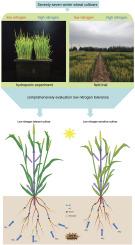
耐低氮冬小麦品种筛选:从水培到田间的综合评价
氮肥过量施用不仅降低了小麦氮素利用效率,还造成了严重的环境污染和经济损失。通过田间综合试验和水培试验,对77个冬小麦品种的耐低氮性进行了综合评价。两个生长季节的田间评价评估了高氮(270 kg/ha)和低氮(0 kg/ha)条件下的8个产量相关性状,而水培筛选评估了高氮(4 mmol/L)和低氮(0.4 mmol/L)处理下的10个幼苗表型参数。利用主成分分析和隶属函数法,建立了耐LN综合指数(CLNTI),并将品种分为高耐(HT)、中耐(moderate tolerance)、中敏感(moderate sensitive)和高敏感(HS) 4类。田间评价和水培评价之间存在很强的相关性,三个品种一致表现出高温胁迫特征。LN胁迫下,各品种株高、旗叶大小、光利用能力和氮代谢酶活性均下降。然而,与HS品种相比,HT品种保持了更高的生理活性,表现为更大的旗叶、更好的叶绿素荧光参数、更高的相对叶绿素含量,以及硝酸盐还原酶、谷氨酰胺合成酶和谷氨酸合酶的活性增强。值得注意的是,高温栽培品种在低温条件下根系构型增强,根系总长度、根表面积和根尖数增加,而高温栽培品种的根系性状减少。这些结果表明,高温小麦通过优化根系形态来获取氮素,维持氮素同化酶的活性,维持稳定的光合效率,最大限度地减少产量。
本文章由计算机程序翻译,如有差异,请以英文原文为准。
求助全文
约1分钟内获得全文
求助全文
来源期刊

Journal of Agriculture and Food Research
Multiple-
CiteScore
5.40
自引率
2.60%
发文量
193
审稿时长
69 days
 求助内容:
求助内容: 应助结果提醒方式:

 京公网安备 11010802042870号


