
Measurement properties of instruments assessing mindful eating in adults: A COSMIN systematic review
IF 3.8
2区 医学
Q1 BEHAVIORAL SCIENCES
引用次数: 0
Abstract
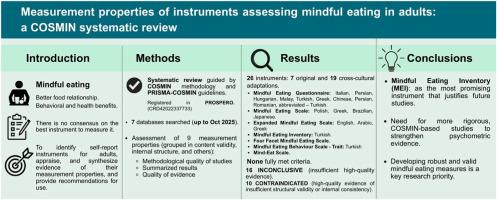
Mindful eating is a promising approach to improving individuals’ relationships with food, with evidence of behavioral and health benefits. However, there is no consensus on the most suitable instrument to assess it. This study aimed to identify self-report measures of mindful eating in adults, appraise their measurement properties, and provide recommendations for their use. This systematic review, registered in PROSPERO (CRD42022337733), adhered to the COSMIN methodology and PRISMA-COSMIN guidelines. Seven databases were searched up to October 2025 for studies on self-reported mindful eating instruments in adults. Measurement properties were assessed with the COSMIN risk of bias checklist and criteria for good measurement properties. The quality of evidence was classified using a modified GRADE approach. Twenty-five studies were included, describing seven original instruments and 19 cross-cultural versions. None met the criteria for recommendation. For sixteen, conclusions could not be drawn due to insufficient “high” quality evidence, and ten were contraindicated because of “high” quality evidence for “insufficient” results, particularly for structural validity or internal consistency. The Mindful Eating Inventory (MEI) showed the most promising evidence. Overall, the instrument demonstrated sufficient results for all measurement properties assessed, although the quality of evidence varied: very low (relevance and measurement invariance), low (comprehensibility and reliability), moderate (construct validity), and high (structural validity and internal consistency). There is a need for methodologically rigorous research that adheres to COSMIN standards to strengthen the psychometric evidence and ensure the validity, reliability, and responsiveness of mindful eating assessment tools.
评估成人正念饮食的仪器测量特性:COSMIN系统综述。
正念饮食是一种很有希望改善个人与食物关系的方法,有证据表明它对行为和健康都有好处。但是,对于评估它的最合适的工具没有达成一致意见。本研究旨在确定成年人正念进食的自我报告测量方法,评估其测量特性,并为其使用提供建议。该系统综述已在PROSPERO注册(CRD42022337733),遵循COSMIN方法和PRISMA-COSMIN指南。截至2025年10月,研究人员在七个数据库中搜索了关于成年人自我报告的正念饮食工具的研究。测量特性采用COSMIN偏倚风险检查表和良好测量特性标准进行评估。使用改进的GRADE方法对证据质量进行分类。包括25项研究,描述了7种原始乐器和19种跨文化版本。没有人符合推荐标准。其中16项研究因“高”质量证据不足而无法得出结论,10项研究因“高”质量证据不足而被禁忌症,特别是在结构效度或内部一致性方面。正念饮食量表(MEI)显示了最有希望的证据。总体而言,该工具对所有评估的测量属性显示了足够的结果,尽管证据质量各不相同:非常低(相关性和测量不变性),低(可理解性和可靠性),中等(结构效度)和高(结构效度和内部一致性)。有必要在方法上严格研究,坚持COSMIN标准,以加强心理测量证据,确保正念进食评估工具的有效性、可靠性和响应性。
本文章由计算机程序翻译,如有差异,请以英文原文为准。
求助全文
约1分钟内获得全文
求助全文
来源期刊
Appetite
医学-行为科学
CiteScore
9.10
自引率
11.10%
发文量
566
审稿时长
13.4 weeks
期刊介绍:
Appetite is an international research journal specializing in cultural, social, psychological, sensory and physiological influences on the selection and intake of foods and drinks. It covers normal and disordered eating and drinking and welcomes studies of both human and non-human animal behaviour toward food. Appetite publishes research reports, reviews and commentaries. Thematic special issues appear regularly. From time to time the journal carries abstracts from professional meetings. Submissions to Appetite are expected to be based primarily on observations directly related to the selection and intake of foods and drinks; papers that are primarily focused on topics such as nutrition or obesity will not be considered unless they specifically make a novel scientific contribution to the understanding of appetite in line with the journal's aims and scope.
 求助内容:
求助内容: 应助结果提醒方式:

 京公网安备 11010802042870号


