Liliana P Calderón-Bernal, Diego Alburez-Gutierrez, Emilio Zagheni
{"title":"Analysing Biases in Genealogies Using Demographic Microsimulation.","authors":"Liliana P Calderón-Bernal, Diego Alburez-Gutierrez, Emilio Zagheni","doi":"10.1007/s10680-025-09756-4","DOIUrl":null,"url":null,"abstract":"<p><p>An incomplete understanding of biases affecting the representativeness of genealogies has hindered their full exploitation. We report on a series of experiments on synthetic populations assessing how structural biases in ascendant genealogies affect the accuracy of demographic estimates. Using the SOCSIM microsimulation programme and Swedish fertility and mortality data (1751-2022), we analyse three biases: lineage survival, limited coverage of collateral kin, and selective omission. Comparing demographic measures from 'fully recorded' and 'bias-infused' synthetic populations, we find that across the period, including only direct ancestors can underestimate total fertility rate (TFR) ([Formula: see text]) and overestimate life expectancy at birth ([Formula: see text]) ([Formula: see text]), mainly due to missing infant, child, and some young adult deaths. Including direct ancestors' offspring shifts TFR to overestimation ([Formula: see text]) while improving mortality estimation across all ages, with [Formula: see text] overestimation reduced to [Formula: see text]. Our study shows that completeness of family trees is essential for obtaining accurate demographic estimates from genealogies.</p>","PeriodicalId":51496,"journal":{"name":"European Journal of Population-Revue Europeenne De Demographie","volume":" ","pages":"34"},"PeriodicalIF":2.6000,"publicationDate":"2025-12-05","publicationTypes":"Journal Article","fieldsOfStudy":null,"isOpenAccess":false,"openAccessPdf":"https://www.ncbi.nlm.nih.gov/pmc/articles/PMC12686277/pdf/","citationCount":"0","resultStr":null,"platform":"Semanticscholar","paperid":null,"PeriodicalName":"European Journal of Population-Revue Europeenne De Demographie","FirstCategoryId":"90","ListUrlMain":"https://doi.org/10.1007/s10680-025-09756-4","RegionNum":2,"RegionCategory":"社会学","ArticlePicture":[],"TitleCN":null,"AbstractTextCN":null,"PMCID":null,"EPubDate":"","PubModel":"","JCR":"Q2","JCRName":"DEMOGRAPHY","Score":null,"Total":0}
引用次数: 0
Abstract
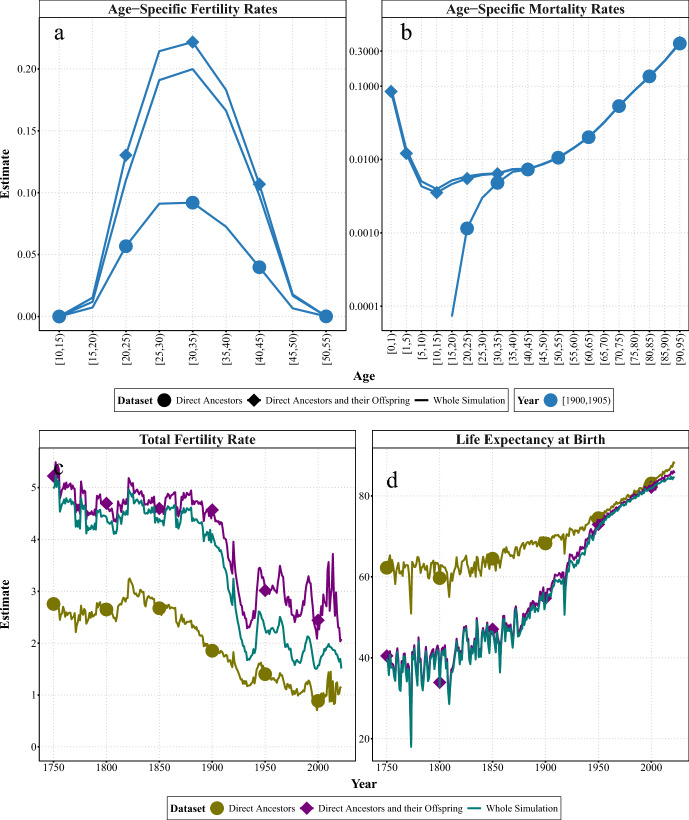
An incomplete understanding of biases affecting the representativeness of genealogies has hindered their full exploitation. We report on a series of experiments on synthetic populations assessing how structural biases in ascendant genealogies affect the accuracy of demographic estimates. Using the SOCSIM microsimulation programme and Swedish fertility and mortality data (1751-2022), we analyse three biases: lineage survival, limited coverage of collateral kin, and selective omission. Comparing demographic measures from 'fully recorded' and 'bias-infused' synthetic populations, we find that across the period, including only direct ancestors can underestimate total fertility rate (TFR) ([Formula: see text]) and overestimate life expectancy at birth ([Formula: see text]) ([Formula: see text]), mainly due to missing infant, child, and some young adult deaths. Including direct ancestors' offspring shifts TFR to overestimation ([Formula: see text]) while improving mortality estimation across all ages, with [Formula: see text] overestimation reduced to [Formula: see text]. Our study shows that completeness of family trees is essential for obtaining accurate demographic estimates from genealogies.
期刊介绍:
European Journal of Population addresses a broad public of researchers, policy makers and others concerned with population processes and their consequences. Its aim is to improve understanding of population phenomena by giving priority to work that contributes to the development of theory and method, and that spans the boundaries between demography and such disciplines as sociology, anthropology, economics, geography, history, political science, epidemiology and other sciences contributing to public health. The Journal is open to authors from all over the world, and its articles cover European and non-European countries (specifically including developing countries) alike.



 求助内容:
求助内容: 应助结果提醒方式:

 京公网安备 11010802042870号


