Saampras Ganesan, Nicholas T Van Dam, Sunjeev K Kamboj, Aki Tsuchiyagaito, Matthew D Sacchet, Masaya Misaki, Bradford A Moffat, Valentina Lorenzetti, Andrew Zalesky
{"title":"Neurofeedback Training Facilitates Awareness and Enhances Emotional Well-being Associated with Real-World Meditation Practice: A 7-T MRI Study.","authors":"Saampras Ganesan, Nicholas T Van Dam, Sunjeev K Kamboj, Aki Tsuchiyagaito, Matthew D Sacchet, Masaya Misaki, Bradford A Moffat, Valentina Lorenzetti, Andrew Zalesky","doi":"10.1007/s12671-025-02671-z","DOIUrl":null,"url":null,"abstract":"<p><strong>Objectives: </strong>Novice meditators often struggle to recognise and intentionally disengage from self-referential thought during meditation. We investigated whether personalised high-precision neurofeedback (NF) training improves volitional disengagement from self-referential thought during meditation and enhances meditation's outcomes.</p><p><strong>Method: </strong>In a single-blind, controlled study, novices received 2 days of veridical (<i>n</i> = 20) or sham (<i>n</i> = 20) 7-T fMRI NF targeting posterior cingulate cortex (PCC) deactivation during meditation. After NF training, at-home meditation practice was monitored for 1 week, followed by an in-lab behavioural assessment.</p><p><strong>Results: </strong>Both groups reported similar perceptions of NF contingency, performance, and expectancy (<i>p</i> > 0.05), suggesting effective participant blinding. PCC deactivation during NF-guided meditation was comparable across groups (<i>p</i> > 0.05). Veridical NF group showed significantly stronger negative functional coupling (<i>d</i> = 0.59) between PCC and dorsolateral prefrontal cortex (DLPFC), significantly greater mindful awareness (<i>d</i> = 0.41) and emotional well-being (<i>d</i> = 0.40) associated with 1-week practice, and significant correlation (<i>r</i> = 0.71, <i>p</i> < 0.01) between emotional well-being and PCC-DLPFC negative coupling.</p><p><strong>Conclusions: </strong>These findings suggest that high-precision NF can improve novices' ability to volitionally disengage from self-referential thought during meditation, thereby fostering greater mindful awareness in real-world practice and promoting emotional well-being.</p><p><strong>Preregistration: </strong>This exploratory study was not preregistered.</p><p><strong>Supplementary information: </strong>The online version contains supplementary material available at 10.1007/s12671-025-02671-z.</p>","PeriodicalId":18523,"journal":{"name":"Mindfulness","volume":"16 10","pages":"2787-2807"},"PeriodicalIF":3.5000,"publicationDate":"2025-01-01","publicationTypes":"Journal Article","fieldsOfStudy":null,"isOpenAccess":false,"openAccessPdf":"https://www.ncbi.nlm.nih.gov/pmc/articles/PMC12660472/pdf/","citationCount":"0","resultStr":null,"platform":"Semanticscholar","paperid":null,"PeriodicalName":"Mindfulness","FirstCategoryId":"3","ListUrlMain":"https://doi.org/10.1007/s12671-025-02671-z","RegionNum":2,"RegionCategory":"心理学","ArticlePicture":[],"TitleCN":null,"AbstractTextCN":null,"PMCID":null,"EPubDate":"2025/9/26 0:00:00","PubModel":"Epub","JCR":"Q2","JCRName":"PSYCHIATRY","Score":null,"Total":0}
引用次数: 0
Abstract
Objectives: Novice meditators often struggle to recognise and intentionally disengage from self-referential thought during meditation. We investigated whether personalised high-precision neurofeedback (NF) training improves volitional disengagement from self-referential thought during meditation and enhances meditation's outcomes.
Method: In a single-blind, controlled study, novices received 2 days of veridical (n = 20) or sham (n = 20) 7-T fMRI NF targeting posterior cingulate cortex (PCC) deactivation during meditation. After NF training, at-home meditation practice was monitored for 1 week, followed by an in-lab behavioural assessment.
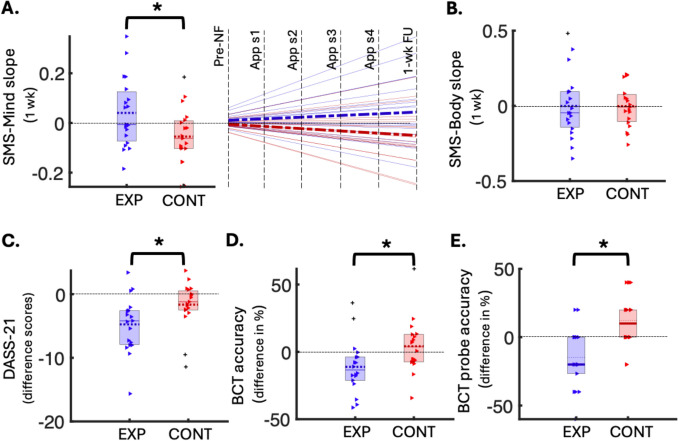
Results: Both groups reported similar perceptions of NF contingency, performance, and expectancy (p > 0.05), suggesting effective participant blinding. PCC deactivation during NF-guided meditation was comparable across groups (p > 0.05). Veridical NF group showed significantly stronger negative functional coupling (d = 0.59) between PCC and dorsolateral prefrontal cortex (DLPFC), significantly greater mindful awareness (d = 0.41) and emotional well-being (d = 0.40) associated with 1-week practice, and significant correlation (r = 0.71, p < 0.01) between emotional well-being and PCC-DLPFC negative coupling.
Conclusions: These findings suggest that high-precision NF can improve novices' ability to volitionally disengage from self-referential thought during meditation, thereby fostering greater mindful awareness in real-world practice and promoting emotional well-being.
Preregistration: This exploratory study was not preregistered.
Supplementary information: The online version contains supplementary material available at 10.1007/s12671-025-02671-z.
期刊介绍:
Mindfulness seeks to advance research, clinical practice, and theory on mindfulness. It is interested in manuscripts from diverse viewpoints, including psychology, psychiatry, medicine, neurobiology, psychoneuroendocrinology, cognitive, behavioral, cultural, philosophy, spirituality, and wisdom traditions. Mindfulness encourages research submissions on the reliability and validity of assessment of mindfulness; clinical uses of mindfulness in psychological distress, psychiatric disorders, and medical conditions; alleviation of personal and societal suffering; the nature and foundations of mindfulness; mechanisms of action; and the use of mindfulness across cultures. The Journal also seeks to promote the use of mindfulness by publishing scholarly papers on the training of clinicians, institutional staff, teachers, parents, and industry personnel in mindful provision of services. Examples of topics include: Mindfulness-based psycho-educational interventions for children with learning, emotional, and behavioral disorders Treating depression and clinical symptoms in patients with chronic heart failure Yoga and mindfulness Cognitive-behavioral mindfulness group therapy interventions Mindfulnessness and emotional regulation difficulties in children Loving-kindness meditation to increase social connectedness Training for parents and children with ADHD Recovery from substance abuse Changing parents’ mindfulness Child management skills Treating childhood anxiety and depression




 求助内容:
求助内容: 应助结果提醒方式:

 京公网安备 11010802042870号


