
Land availability and policy commitments limit global climate mitigation from forestation
IF 47.3
1区 综合性期刊
Q1 MULTIDISCIPLINARY SCIENCES
引用次数: 0
Abstract
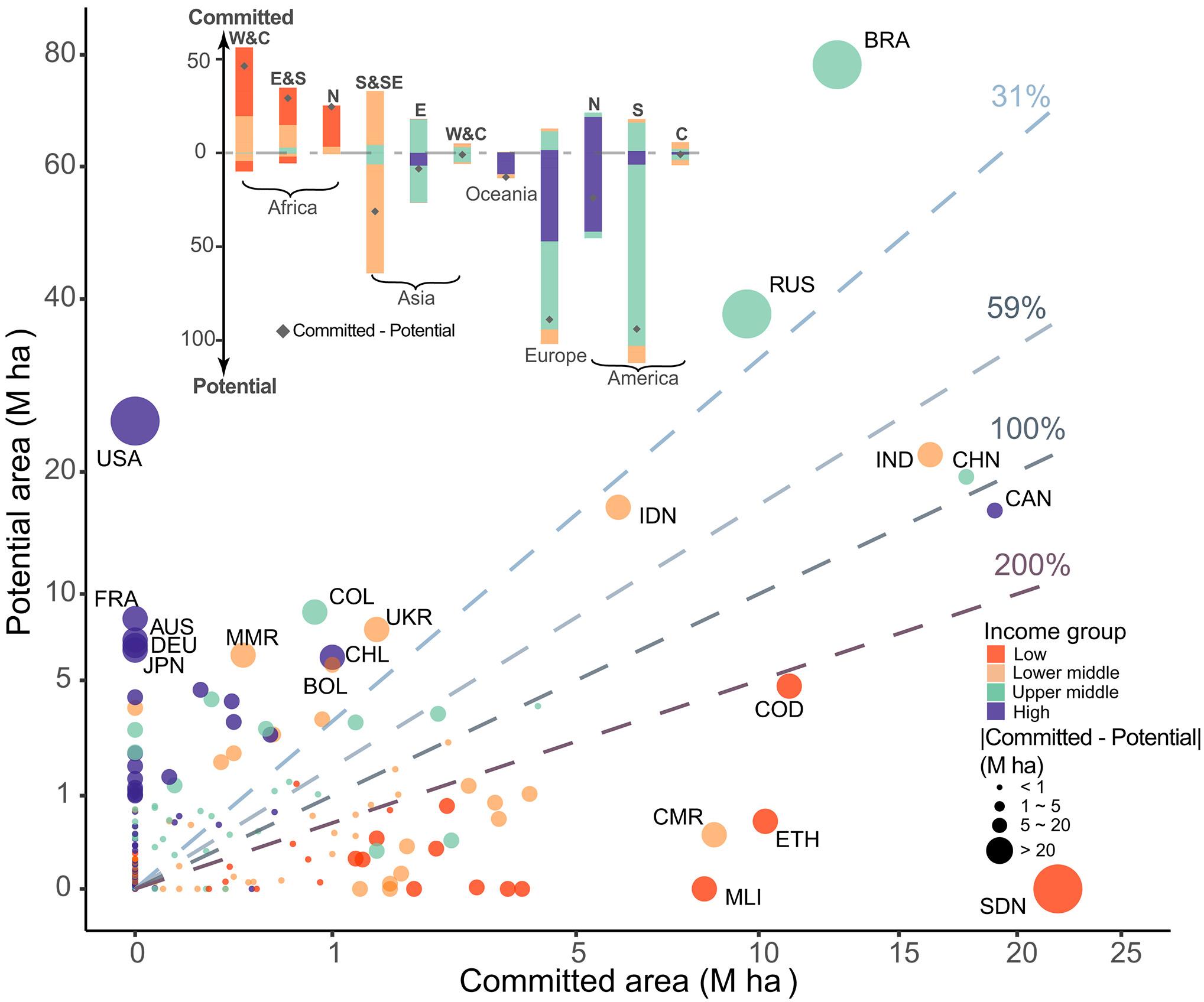
Forestation (afforestation and reforestation) could mitigate climate change by sequestering carbon within biomass and soils. However, global mitigation from forestation remains uncertain owing to varying estimates of carbon sequestration rates (notably in soil) and land availability. In this study, we developed global maps of soil carbon change that reveal carbon gains and losses with forestation, primarily in the topsoil. Constraining land availability to avoid unintended albedo-induced warming and safeguard water and biodiversity (389 million hectares available for forestation globally) would sequester 39.9 petagrams of carbon by 2050, substantially below previous estimates. This estimate drops to 12.5 petagrams of carbon with land further limited to existing policy commitments (120 million hectares). Achieving greater mitigation requires expanding dedicated forestation areas and strengthening commitments from nations with considerable but untapped potential.
土地可得性和政策承诺限制了造林对全球气候减缓的作用
造林(造林和再造林)可以通过将碳封存在生物质和土壤中来减缓气候变化。然而,由于对碳固存率(特别是在土壤中)和土地可得性的估计不一,造林带来的全球缓解仍然不确定。在这项研究中,我们开发了全球土壤碳变化图,揭示了造林带来的碳收益和损失,主要是表层土壤。限制土地供应以避免意外的反照率引起的变暖,并保护水和生物多样性(全球可用于造林的3.89亿公顷),到2050年将吸收39.9亿吨碳,大大低于此前的估计。这一估计值下降到12.5亿吨碳,同时土地进一步限制在现有政策承诺(1.2亿公顷)范围内。实现更大程度的缓解需要扩大专门的造林面积,并加强潜力巨大但尚未开发的国家的承诺。
本文章由计算机程序翻译,如有差异,请以英文原文为准。
求助全文
约1分钟内获得全文
求助全文
来源期刊
Science
综合性期刊-综合性期刊
CiteScore
61.10
自引率
0.90%
发文量
0
审稿时长
2.1 months
期刊介绍:
Science is a leading outlet for scientific news, commentary, and cutting-edge research. Through its print and online incarnations, Science reaches an estimated worldwide readership of more than one million. Science’s authorship is global too, and its articles consistently rank among the world's most cited research.
Science serves as a forum for discussion of important issues related to the advancement of science by publishing material on which a consensus has been reached as well as including the presentation of minority or conflicting points of view. Accordingly, all articles published in Science—including editorials, news and comment, and book reviews—are signed and reflect the individual views of the authors and not official points of view adopted by AAAS or the institutions with which the authors are affiliated.
Science seeks to publish those papers that are most influential in their fields or across fields and that will significantly advance scientific understanding. Selected papers should present novel and broadly important data, syntheses, or concepts. They should merit recognition by the wider scientific community and general public provided by publication in Science, beyond that provided by specialty journals. Science welcomes submissions from all fields of science and from any source. The editors are committed to the prompt evaluation and publication of submitted papers while upholding high standards that support reproducibility of published research. Science is published weekly; selected papers are published online ahead of print.
 求助内容:
求助内容: 应助结果提醒方式:

 京公网安备 11010802042870号


