Tong Wu, Bofei Liu, Chong Liu, Jiayu Wan, Ankun Yang, Kai Liu, Feifei Shi, Jie Zhao, Zhiyi Lu, Guangxu Chen, Allen Pei, Harold Y. Hwang, Yi Cui
{"title":"利用指纹MoS2组装太阳能驱动高效异质亚分钟水消毒纳米系统","authors":"Tong Wu, Bofei Liu, Chong Liu, Jiayu Wan, Ankun Yang, Kai Liu, Feifei Shi, Jie Zhao, Zhiyi Lu, Guangxu Chen, Allen Pei, Harold Y. Hwang, Yi Cui","doi":"10.1038/s44221-023-00079-4","DOIUrl":null,"url":null,"abstract":"Although heterogeneous water disinfection can avoid secondary pollution and other shortcomings in homogeneous systems, its low disinfection efficiency seriously hinders its development. Here we successfully address the aforementioned issues of heterogeneous disinfection by developing discrete nanoflakes of (Al2O3@v-MoS2)/Cu/Fe3O4. Three exciting features are integrated into such a novel structure: bifacial vertically aligned nanofingerprint MoS2 grown on both sides of the light-transparent Al2O3 nanoflakes that can largely absorb sunlight, where both sides can operate simultaneously; a Cu-MoS2 junction that enhances charge separation for the efficient generation of reactive oxygen species; and magnetic Fe3O4 nanoparticles that have magnetic separation capability and conveniently regenerate after disinfection. The (Al2O3@v-MoS2)/Cu/Fe3O4 nanostructures reported herein exhibit outstanding water disinfection with thorough inactivation of over 5.7 log10 colony-forming units ml−1 Escherichia coli within 1 min in real sunlight (the system thermal effect has little impact on disinfection performances) as well as facile separation and stable long cycle reuse, demonstrating broad application prospects. Heterogeneous water disinfection is a promising way to avoid secondary pollution, but it is not very efficient. The development of nanoflakes shows that a much higher efficiency than previously achieved can be achieved through solar-driven heterogeneous disinfection.","PeriodicalId":74252,"journal":{"name":"Nature water","volume":"1 5","pages":"462-470"},"PeriodicalIF":24.1000,"publicationDate":"2023-05-18","publicationTypes":"Journal Article","fieldsOfStudy":null,"isOpenAccess":false,"openAccessPdf":"","citationCount":"2","resultStr":"{\"title\":\"Solar-driven efficient heterogeneous subminute water disinfection nanosystem assembled with fingerprint MoS2\",\"authors\":\"Tong Wu, Bofei Liu, Chong Liu, Jiayu Wan, Ankun Yang, Kai Liu, Feifei Shi, Jie Zhao, Zhiyi Lu, Guangxu Chen, Allen Pei, Harold Y. Hwang, Yi Cui\",\"doi\":\"10.1038/s44221-023-00079-4\",\"DOIUrl\":null,\"url\":null,\"abstract\":\"Although heterogeneous water disinfection can avoid secondary pollution and other shortcomings in homogeneous systems, its low disinfection efficiency seriously hinders its development. Here we successfully address the aforementioned issues of heterogeneous disinfection by developing discrete nanoflakes of (Al2O3@v-MoS2)/Cu/Fe3O4. Three exciting features are integrated into such a novel structure: bifacial vertically aligned nanofingerprint MoS2 grown on both sides of the light-transparent Al2O3 nanoflakes that can largely absorb sunlight, where both sides can operate simultaneously; a Cu-MoS2 junction that enhances charge separation for the efficient generation of reactive oxygen species; and magnetic Fe3O4 nanoparticles that have magnetic separation capability and conveniently regenerate after disinfection. The (Al2O3@v-MoS2)/Cu/Fe3O4 nanostructures reported herein exhibit outstanding water disinfection with thorough inactivation of over 5.7 log10 colony-forming units ml−1 Escherichia coli within 1 min in real sunlight (the system thermal effect has little impact on disinfection performances) as well as facile separation and stable long cycle reuse, demonstrating broad application prospects. Heterogeneous water disinfection is a promising way to avoid secondary pollution, but it is not very efficient. The development of nanoflakes shows that a much higher efficiency than previously achieved can be achieved through solar-driven heterogeneous disinfection.\",\"PeriodicalId\":74252,\"journal\":{\"name\":\"Nature water\",\"volume\":\"1 5\",\"pages\":\"462-470\"},\"PeriodicalIF\":24.1000,\"publicationDate\":\"2023-05-18\",\"publicationTypes\":\"Journal Article\",\"fieldsOfStudy\":null,\"isOpenAccess\":false,\"openAccessPdf\":\"\",\"citationCount\":\"2\",\"resultStr\":null,\"platform\":\"Semanticscholar\",\"paperid\":null,\"PeriodicalName\":\"Nature water\",\"FirstCategoryId\":\"1085\",\"ListUrlMain\":\"https://www.nature.com/articles/s44221-023-00079-4\",\"RegionNum\":0,\"RegionCategory\":null,\"ArticlePicture\":[],\"TitleCN\":null,\"AbstractTextCN\":null,\"PMCID\":null,\"EPubDate\":\"\",\"PubModel\":\"\",\"JCR\":\"\",\"JCRName\":\"\",\"Score\":null,\"Total\":0}","platform":"Semanticscholar","paperid":null,"PeriodicalName":"Nature water","FirstCategoryId":"1085","ListUrlMain":"https://www.nature.com/articles/s44221-023-00079-4","RegionNum":0,"RegionCategory":null,"ArticlePicture":[],"TitleCN":null,"AbstractTextCN":null,"PMCID":null,"EPubDate":"","PubModel":"","JCR":"","JCRName":"","Score":null,"Total":0}
Solar-driven efficient heterogeneous subminute water disinfection nanosystem assembled with fingerprint MoS2
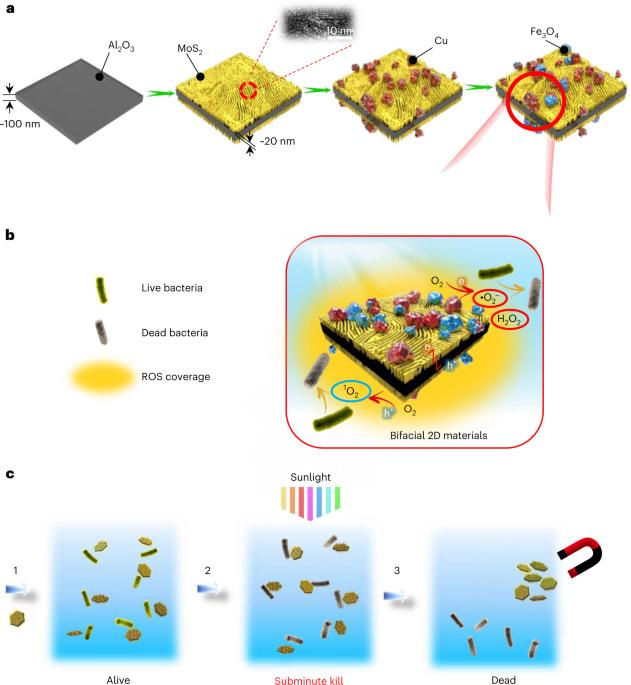
Although heterogeneous water disinfection can avoid secondary pollution and other shortcomings in homogeneous systems, its low disinfection efficiency seriously hinders its development. Here we successfully address the aforementioned issues of heterogeneous disinfection by developing discrete nanoflakes of (Al2O3@v-MoS2)/Cu/Fe3O4. Three exciting features are integrated into such a novel structure: bifacial vertically aligned nanofingerprint MoS2 grown on both sides of the light-transparent Al2O3 nanoflakes that can largely absorb sunlight, where both sides can operate simultaneously; a Cu-MoS2 junction that enhances charge separation for the efficient generation of reactive oxygen species; and magnetic Fe3O4 nanoparticles that have magnetic separation capability and conveniently regenerate after disinfection. The (Al2O3@v-MoS2)/Cu/Fe3O4 nanostructures reported herein exhibit outstanding water disinfection with thorough inactivation of over 5.7 log10 colony-forming units ml−1 Escherichia coli within 1 min in real sunlight (the system thermal effect has little impact on disinfection performances) as well as facile separation and stable long cycle reuse, demonstrating broad application prospects. Heterogeneous water disinfection is a promising way to avoid secondary pollution, but it is not very efficient. The development of nanoflakes shows that a much higher efficiency than previously achieved can be achieved through solar-driven heterogeneous disinfection.


 求助内容:
求助内容: 应助结果提醒方式:

 京公网安备 11010802042870号


