Rujia Chen,Kejia Wu,Xiudan Zhao,Yun Tian,Zhenping Cai,Jinrong Liang,Weilu Ding,Wentao Mu,Xuehui Li
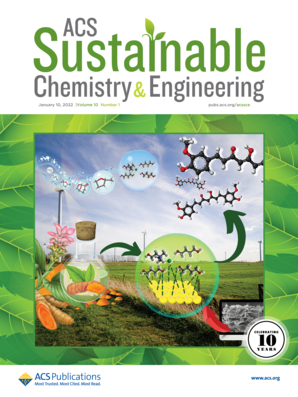
{"title":"工程铁在USY沸石上支持木质素氧化裂解生成生物基马来酸二乙酯","authors":"Rujia Chen,Kejia Wu,Xiudan Zhao,Yun Tian,Zhenping Cai,Jinrong Liang,Weilu Ding,Wentao Mu,Xuehui Li","doi":"10.1021/acssuschemeng.6c08496","DOIUrl":null,"url":null,"abstract":"The development of sustainable routes for polymer monomers is crucial for the chemical industry. Herein, we report a highly efficient and selective oxidative depolymerization strategy for converting lignin into diethyl maleate (DEM), a valuable precursor for polyaspartic polyurea resins. A series of iron oxide catalysts supported on commercial USY zeolites via a simple impregnation-calcination method were developed. Notably, the catalyst prepared using iron sulfate (Fe2(SO4)3) as the precursor exhibited superior performance, achieving a maximum DEM yield of 53.0 wt % and a selectivity of 72.4% from organosolv bagasse lignin, outperforming the iron nitrate- and chloride-derived catalysts by 29.2 and 31.9 wt % in yield, respectively. Comprehensive characterizations revealed that the unique highly dispersed Fe(SO4)x phases significantly increased the proportion of Fe3+ species and facilitated electron transfer across the support-iron interface. The synergistic interplay between sulfur-induced Brønsted acid sites and isolated octahedral iron sites was identified as the key factor driving the efficient cleavage of lignin linkages and subsequent oxidative ring-opening. By combining commercially available supports and earth-abundant metals, this work offers an environmentally viable pathway for lignin depolymerization into polymer monomers, demonstrating significant potential for industrial scalability.","PeriodicalId":25,"journal":{"name":"ACS Sustainable Chemistry & Engineering","volume":"73 1","pages":""},"PeriodicalIF":7.6000,"publicationDate":"2026-10-21","publicationTypes":"Journal Article","fieldsOfStudy":null,"isOpenAccess":false,"openAccessPdf":"","citationCount":"0","resultStr":"{\"title\":\"Engineering Fe Species on USY Zeolite Support for the Oxidative Cleavage of Lignin to Bio-Based Diethyl Maleate\",\"authors\":\"Rujia Chen,Kejia Wu,Xiudan Zhao,Yun Tian,Zhenping Cai,Jinrong Liang,Weilu Ding,Wentao Mu,Xuehui Li\",\"doi\":\"10.1021/acssuschemeng.6c08496\",\"DOIUrl\":null,\"url\":null,\"abstract\":\"The development of sustainable routes for polymer monomers is crucial for the chemical industry. Herein, we report a highly efficient and selective oxidative depolymerization strategy for converting lignin into diethyl maleate (DEM), a valuable precursor for polyaspartic polyurea resins. A series of iron oxide catalysts supported on commercial USY zeolites via a simple impregnation-calcination method were developed. Notably, the catalyst prepared using iron sulfate (Fe2(SO4)3) as the precursor exhibited superior performance, achieving a maximum DEM yield of 53.0 wt % and a selectivity of 72.4% from organosolv bagasse lignin, outperforming the iron nitrate- and chloride-derived catalysts by 29.2 and 31.9 wt % in yield, respectively. Comprehensive characterizations revealed that the unique highly dispersed Fe(SO4)x phases significantly increased the proportion of Fe3+ species and facilitated electron transfer across the support-iron interface. The synergistic interplay between sulfur-induced Brønsted acid sites and isolated octahedral iron sites was identified as the key factor driving the efficient cleavage of lignin linkages and subsequent oxidative ring-opening. By combining commercially available supports and earth-abundant metals, this work offers an environmentally viable pathway for lignin depolymerization into polymer monomers, demonstrating significant potential for industrial scalability.\",\"PeriodicalId\":25,\"journal\":{\"name\":\"ACS Sustainable Chemistry & Engineering\",\"volume\":\"73 1\",\"pages\":\"\"},\"PeriodicalIF\":7.6000,\"publicationDate\":\"2026-10-21\",\"publicationTypes\":\"Journal Article\",\"fieldsOfStudy\":null,\"isOpenAccess\":false,\"openAccessPdf\":\"\",\"citationCount\":\"0\",\"resultStr\":null,\"platform\":\"Semanticscholar\",\"paperid\":null,\"PeriodicalName\":\"ACS Sustainable Chemistry & Engineering\",\"FirstCategoryId\":\"92\",\"ListUrlMain\":\"https://doi.org/10.1021/acssuschemeng.6c08496\",\"RegionNum\":1,\"RegionCategory\":\"化学\",\"ArticlePicture\":[],\"TitleCN\":null,\"AbstractTextCN\":null,\"PMCID\":null,\"EPubDate\":\"\",\"PubModel\":\"\",\"JCR\":\"Q1\",\"JCRName\":\"CHEMISTRY, MULTIDISCIPLINARY\",\"Score\":null,\"Total\":0}","platform":"Semanticscholar","paperid":null,"PeriodicalName":"ACS Sustainable Chemistry & Engineering","FirstCategoryId":"92","ListUrlMain":"https://doi.org/10.1021/acssuschemeng.6c08496","RegionNum":1,"RegionCategory":"化学","ArticlePicture":[],"TitleCN":null,"AbstractTextCN":null,"PMCID":null,"EPubDate":"","PubModel":"","JCR":"Q1","JCRName":"CHEMISTRY, MULTIDISCIPLINARY","Score":null,"Total":0}
Engineering Fe Species on USY Zeolite Support for the Oxidative Cleavage of Lignin to Bio-Based Diethyl Maleate
The development of sustainable routes for polymer monomers is crucial for the chemical industry. Herein, we report a highly efficient and selective oxidative depolymerization strategy for converting lignin into diethyl maleate (DEM), a valuable precursor for polyaspartic polyurea resins. A series of iron oxide catalysts supported on commercial USY zeolites via a simple impregnation-calcination method were developed. Notably, the catalyst prepared using iron sulfate (Fe2(SO4)3) as the precursor exhibited superior performance, achieving a maximum DEM yield of 53.0 wt % and a selectivity of 72.4% from organosolv bagasse lignin, outperforming the iron nitrate- and chloride-derived catalysts by 29.2 and 31.9 wt % in yield, respectively. Comprehensive characterizations revealed that the unique highly dispersed Fe(SO4)x phases significantly increased the proportion of Fe3+ species and facilitated electron transfer across the support-iron interface. The synergistic interplay between sulfur-induced Brønsted acid sites and isolated octahedral iron sites was identified as the key factor driving the efficient cleavage of lignin linkages and subsequent oxidative ring-opening. By combining commercially available supports and earth-abundant metals, this work offers an environmentally viable pathway for lignin depolymerization into polymer monomers, demonstrating significant potential for industrial scalability.
期刊介绍:
ACS Sustainable Chemistry & Engineering is a prestigious weekly peer-reviewed scientific journal published by the American Chemical Society. Dedicated to advancing the principles of green chemistry and green engineering, it covers a wide array of research topics including green chemistry, green engineering, biomass, alternative energy, and life cycle assessment.
The journal welcomes submissions in various formats, including Letters, Articles, Features, and Perspectives (Reviews), that address the challenges of sustainability in the chemical enterprise and contribute to the advancement of sustainable practices. Join us in shaping the future of sustainable chemistry and engineering.