{"title":"从微观机理到过程强化:离子液体萃取精馏分离苯/甲醇的调控策略及多尺度研究","authors":"Biao Liu,Qiang Wang,Haoyang Lin,Liangliang Peng,Dingkai Hu,Miaofeng Zhang,Fangying Zhang","doi":"10.1021/acs.iecr.6c03992","DOIUrl":null,"url":null,"abstract":"Benzene (BEN) and methanol (MeOH) form an azeotrope that severely hinders efficient separation in coal chemical production. This study investigates the separation performance of three ionic liquids (ILs), [C2C1im][Gly], [C2C1im][DEP], and [C4C1im][DBP], for the BEN-MeOH azeotropic system through thermodynamic characterization and molecular simulation, and further optimizes the process based on the selected IL. Vapor–liquid equilibrium (VLE) experiments demonstrate that all three ILs eliminate the azeotrope, with selectivity ranking as [C2C1im][Gly] > [C2C1im][DEP] > [C4C1im][DBP]. However, the first two ILs exhibit poor miscibility with BEN and are prone to liquid–liquid phase separation, whereas [C4C1im][DBP] balances selectivity and complete miscibility, making it the optimal homogeneous entrainer. Molecular simulations reveal that hydrogen bonding between the anions and MeOH is the core mechanism for azeotrope breaking. Based on [C4C1im][DBP], four extractive distillation processes (EDPs), namely, dimethyl sulfoxide (DMSO) EDP, IL EDP, IL(85%) EDP, and heat pump-assisted IL (HP-IL) EDP, were further evaluated. The IL EDP exhibits better economic and environmental performance than the conventional DMSO EDP. Although MeOH dilution reduces the viscosity of the IL entrainer, it increases energy consumption and pollutant emissions. Compared with the IL EDP, the HP-IL EDP reduces total annual cost by 13.70%, energy consumption by 27.45%, and gas emissions by 27.00%. This work provides a reliable route for the green and efficient separation of azeotropic mixtures.","PeriodicalId":39,"journal":{"name":"Industrial & Engineering Chemistry Research","volume":"13 1","pages":""},"PeriodicalIF":3.9000,"publicationDate":"2026-10-20","publicationTypes":"Journal Article","fieldsOfStudy":null,"isOpenAccess":false,"openAccessPdf":"","citationCount":"0","resultStr":"{\"title\":\"From Microscopic Mechanisms to Process Intensification: Regulation Strategy and Multiscale Investigation of Ionic Liquid Extractive Distillation for Benzene/Methanol Separation\",\"authors\":\"Biao Liu,Qiang Wang,Haoyang Lin,Liangliang Peng,Dingkai Hu,Miaofeng Zhang,Fangying Zhang\",\"doi\":\"10.1021/acs.iecr.6c03992\",\"DOIUrl\":null,\"url\":null,\"abstract\":\"Benzene (BEN) and methanol (MeOH) form an azeotrope that severely hinders efficient separation in coal chemical production. This study investigates the separation performance of three ionic liquids (ILs), [C2C1im][Gly], [C2C1im][DEP], and [C4C1im][DBP], for the BEN-MeOH azeotropic system through thermodynamic characterization and molecular simulation, and further optimizes the process based on the selected IL. Vapor–liquid equilibrium (VLE) experiments demonstrate that all three ILs eliminate the azeotrope, with selectivity ranking as [C2C1im][Gly] > [C2C1im][DEP] > [C4C1im][DBP]. However, the first two ILs exhibit poor miscibility with BEN and are prone to liquid–liquid phase separation, whereas [C4C1im][DBP] balances selectivity and complete miscibility, making it the optimal homogeneous entrainer. Molecular simulations reveal that hydrogen bonding between the anions and MeOH is the core mechanism for azeotrope breaking. Based on [C4C1im][DBP], four extractive distillation processes (EDPs), namely, dimethyl sulfoxide (DMSO) EDP, IL EDP, IL(85%) EDP, and heat pump-assisted IL (HP-IL) EDP, were further evaluated. The IL EDP exhibits better economic and environmental performance than the conventional DMSO EDP. Although MeOH dilution reduces the viscosity of the IL entrainer, it increases energy consumption and pollutant emissions. Compared with the IL EDP, the HP-IL EDP reduces total annual cost by 13.70%, energy consumption by 27.45%, and gas emissions by 27.00%. This work provides a reliable route for the green and efficient separation of azeotropic mixtures.\",\"PeriodicalId\":39,\"journal\":{\"name\":\"Industrial & Engineering Chemistry Research\",\"volume\":\"13 1\",\"pages\":\"\"},\"PeriodicalIF\":3.9000,\"publicationDate\":\"2026-10-20\",\"publicationTypes\":\"Journal Article\",\"fieldsOfStudy\":null,\"isOpenAccess\":false,\"openAccessPdf\":\"\",\"citationCount\":\"0\",\"resultStr\":null,\"platform\":\"Semanticscholar\",\"paperid\":null,\"PeriodicalName\":\"Industrial & Engineering Chemistry Research\",\"FirstCategoryId\":\"5\",\"ListUrlMain\":\"https://doi.org/10.1021/acs.iecr.6c03992\",\"RegionNum\":3,\"RegionCategory\":\"工程技术\",\"ArticlePicture\":[],\"TitleCN\":null,\"AbstractTextCN\":null,\"PMCID\":null,\"EPubDate\":\"\",\"PubModel\":\"\",\"JCR\":\"Q2\",\"JCRName\":\"ENGINEERING, CHEMICAL\",\"Score\":null,\"Total\":0}","platform":"Semanticscholar","paperid":null,"PeriodicalName":"Industrial & Engineering Chemistry Research","FirstCategoryId":"5","ListUrlMain":"https://doi.org/10.1021/acs.iecr.6c03992","RegionNum":3,"RegionCategory":"工程技术","ArticlePicture":[],"TitleCN":null,"AbstractTextCN":null,"PMCID":null,"EPubDate":"","PubModel":"","JCR":"Q2","JCRName":"ENGINEERING, CHEMICAL","Score":null,"Total":0}
From Microscopic Mechanisms to Process Intensification: Regulation Strategy and Multiscale Investigation of Ionic Liquid Extractive Distillation for Benzene/Methanol Separation
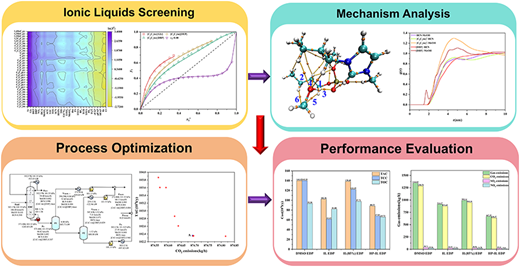
Benzene (BEN) and methanol (MeOH) form an azeotrope that severely hinders efficient separation in coal chemical production. This study investigates the separation performance of three ionic liquids (ILs), [C2C1im][Gly], [C2C1im][DEP], and [C4C1im][DBP], for the BEN-MeOH azeotropic system through thermodynamic characterization and molecular simulation, and further optimizes the process based on the selected IL. Vapor–liquid equilibrium (VLE) experiments demonstrate that all three ILs eliminate the azeotrope, with selectivity ranking as [C2C1im][Gly] > [C2C1im][DEP] > [C4C1im][DBP]. However, the first two ILs exhibit poor miscibility with BEN and are prone to liquid–liquid phase separation, whereas [C4C1im][DBP] balances selectivity and complete miscibility, making it the optimal homogeneous entrainer. Molecular simulations reveal that hydrogen bonding between the anions and MeOH is the core mechanism for azeotrope breaking. Based on [C4C1im][DBP], four extractive distillation processes (EDPs), namely, dimethyl sulfoxide (DMSO) EDP, IL EDP, IL(85%) EDP, and heat pump-assisted IL (HP-IL) EDP, were further evaluated. The IL EDP exhibits better economic and environmental performance than the conventional DMSO EDP. Although MeOH dilution reduces the viscosity of the IL entrainer, it increases energy consumption and pollutant emissions. Compared with the IL EDP, the HP-IL EDP reduces total annual cost by 13.70%, energy consumption by 27.45%, and gas emissions by 27.00%. This work provides a reliable route for the green and efficient separation of azeotropic mixtures.
期刊介绍:
ndustrial & Engineering Chemistry, with variations in title and format, has been published since 1909 by the American Chemical Society. Industrial & Engineering Chemistry Research is a weekly publication that reports industrial and academic research in the broad fields of applied chemistry and chemical engineering with special focus on fundamentals, processes, and products.