Hanyu Zhang, Hexiang Peng, Huangda Guo, Tianjiao Hou, Yixin Li, Yi Zheng, Yinxi Tan, Xinyao Ye, Haodong Zhang, Huan Yu, Xueheng Wang, Meng Fan, Yiqun Wu, Xueying Qin, Jing Li, Dafang Chen, Yonghua Hu, Tao Wu, Mengying Wang
{"title":"[三甲胺- n -氧化物与心血管代谢指标的相关性]。","authors":"Hanyu Zhang, Hexiang Peng, Huangda Guo, Tianjiao Hou, Yixin Li, Yi Zheng, Yinxi Tan, Xinyao Ye, Haodong Zhang, Huan Yu, Xueheng Wang, Meng Fan, Yiqun Wu, Xueying Qin, Jing Li, Dafang Chen, Yonghua Hu, Tao Wu, Mengying Wang","doi":"","DOIUrl":null,"url":null,"abstract":"<p><strong>Objective: </strong>To explore the correlation between serum trimethylamine-N-oxide (TMAO) levels and cardiovascular metabolic biomarkers, so as to provide a basis for clarifying the impact of TMAO on cardiovascular metabolic disease.</p><p><strong>Methods: </strong>Based on baseline data from the Beijing Fangshan Family Cohort collected from 2013 to 2017, totally 500 participants from 173 families were selected from the survey subjects. Serum TMAO concentrations were measured using enzyme-linked immunosorbent assay kits. The correlation between TMAO and cardiovascular and metabolic disease indicators was analyzed by a linear mixed effects model.</p><p><strong>Results: </strong>The mean age of the participants was (56.52±12.52) years, with 54.20% being male. Serum TMAO levels showed significant positive correlations with systolic blood pressure (SBP) and pulse pressure (PP). Each 1 μmol/L increase in TMAO was associated with a 0.74 mmHg increase in SBP (95%<i>CI</i>: 0.19-1.30, <i>P</i>=0.009) and a 0.64 mmHg increase in PP (95%<i>CI</i>: 0.21-1.08, <i>P</i>=0.004). Subgroup analysis showed that for each 1 μmol/l increase in TMAO in men, SBP and PP increased by 0.91 mmHg (95%<i>CI</i>: 0.24-1.57, <i>P</i> < 0.05) and 0.85 mmHg (95%<i>CI</i>: 0.37-1.35, <i>P</i> < 0.05), respectively. No significant correlation was found in women. In the population aged ≥60 years, each 1 μmol/L increase in TMAO was associated with a 1.10 mmHg increase in SBP (95%<i>CI</i>: 0.23-1.96, <i>P</i> < 0.05) and a 0.98 mmHg increase in PP (95%<i>CI</i>: 0.23-1.73, <i>P</i> < 0.05). No significant correlation was found in people aged < 60 years.</p><p><strong>Conclusion: </strong>The current study found that high TMAO level was correlated with the increase of SBP and PP, and TMAO might be an influencing factor of blood pressure level. No statistically significant correlation was found between TMAO and blood glucose and lipid indicators.</p>","PeriodicalId":8790,"journal":{"name":"北京大学学报(医学版)","volume":"58 5","pages":"992-999"},"PeriodicalIF":0.0000,"publicationDate":"2026-10-18","publicationTypes":"Journal Article","fieldsOfStudy":null,"isOpenAccess":false,"openAccessPdf":"https://www.ncbi.nlm.nih.gov/pmc/articles/PMC13672094/pdf/","citationCount":"0","resultStr":"{\"title\":\"[Correlation between trimethylamine-N-oxide and cardiovascular metabolic markers].\",\"authors\":\"Hanyu Zhang, Hexiang Peng, Huangda Guo, Tianjiao Hou, Yixin Li, Yi Zheng, Yinxi Tan, Xinyao Ye, Haodong Zhang, Huan Yu, Xueheng Wang, Meng Fan, Yiqun Wu, Xueying Qin, Jing Li, Dafang Chen, Yonghua Hu, Tao Wu, Mengying Wang\",\"doi\":\"\",\"DOIUrl\":null,\"url\":null,\"abstract\":\"<p><strong>Objective: </strong>To explore the correlation between serum trimethylamine-N-oxide (TMAO) levels and cardiovascular metabolic biomarkers, so as to provide a basis for clarifying the impact of TMAO on cardiovascular metabolic disease.</p><p><strong>Methods: </strong>Based on baseline data from the Beijing Fangshan Family Cohort collected from 2013 to 2017, totally 500 participants from 173 families were selected from the survey subjects. Serum TMAO concentrations were measured using enzyme-linked immunosorbent assay kits. The correlation between TMAO and cardiovascular and metabolic disease indicators was analyzed by a linear mixed effects model.</p><p><strong>Results: </strong>The mean age of the participants was (56.52±12.52) years, with 54.20% being male. Serum TMAO levels showed significant positive correlations with systolic blood pressure (SBP) and pulse pressure (PP). Each 1 μmol/L increase in TMAO was associated with a 0.74 mmHg increase in SBP (95%<i>CI</i>: 0.19-1.30, <i>P</i>=0.009) and a 0.64 mmHg increase in PP (95%<i>CI</i>: 0.21-1.08, <i>P</i>=0.004). Subgroup analysis showed that for each 1 μmol/l increase in TMAO in men, SBP and PP increased by 0.91 mmHg (95%<i>CI</i>: 0.24-1.57, <i>P</i> < 0.05) and 0.85 mmHg (95%<i>CI</i>: 0.37-1.35, <i>P</i> < 0.05), respectively. No significant correlation was found in women. In the population aged ≥60 years, each 1 μmol/L increase in TMAO was associated with a 1.10 mmHg increase in SBP (95%<i>CI</i>: 0.23-1.96, <i>P</i> < 0.05) and a 0.98 mmHg increase in PP (95%<i>CI</i>: 0.23-1.73, <i>P</i> < 0.05). No significant correlation was found in people aged < 60 years.</p><p><strong>Conclusion: </strong>The current study found that high TMAO level was correlated with the increase of SBP and PP, and TMAO might be an influencing factor of blood pressure level. No statistically significant correlation was found between TMAO and blood glucose and lipid indicators.</p>\",\"PeriodicalId\":8790,\"journal\":{\"name\":\"北京大学学报(医学版)\",\"volume\":\"58 5\",\"pages\":\"992-999\"},\"PeriodicalIF\":0.0000,\"publicationDate\":\"2026-10-18\",\"publicationTypes\":\"Journal Article\",\"fieldsOfStudy\":null,\"isOpenAccess\":false,\"openAccessPdf\":\"https://www.ncbi.nlm.nih.gov/pmc/articles/PMC13672094/pdf/\",\"citationCount\":\"0\",\"resultStr\":null,\"platform\":\"Semanticscholar\",\"paperid\":null,\"PeriodicalName\":\"北京大学学报(医学版)\",\"FirstCategoryId\":\"3\",\"ListUrlMain\":\"\",\"RegionNum\":0,\"RegionCategory\":null,\"ArticlePicture\":[],\"TitleCN\":null,\"AbstractTextCN\":null,\"PMCID\":null,\"EPubDate\":\"\",\"PubModel\":\"\",\"JCR\":\"Q3\",\"JCRName\":\"Medicine\",\"Score\":null,\"Total\":0}","platform":"Semanticscholar","paperid":null,"PeriodicalName":"北京大学学报(医学版)","FirstCategoryId":"3","ListUrlMain":"","RegionNum":0,"RegionCategory":null,"ArticlePicture":[],"TitleCN":null,"AbstractTextCN":null,"PMCID":null,"EPubDate":"","PubModel":"","JCR":"Q3","JCRName":"Medicine","Score":null,"Total":0}
[Correlation between trimethylamine-N-oxide and cardiovascular metabolic markers].
Objective: To explore the correlation between serum trimethylamine-N-oxide (TMAO) levels and cardiovascular metabolic biomarkers, so as to provide a basis for clarifying the impact of TMAO on cardiovascular metabolic disease.
Methods: Based on baseline data from the Beijing Fangshan Family Cohort collected from 2013 to 2017, totally 500 participants from 173 families were selected from the survey subjects. Serum TMAO concentrations were measured using enzyme-linked immunosorbent assay kits. The correlation between TMAO and cardiovascular and metabolic disease indicators was analyzed by a linear mixed effects model.
Results: The mean age of the participants was (56.52±12.52) years, with 54.20% being male. Serum TMAO levels showed significant positive correlations with systolic blood pressure (SBP) and pulse pressure (PP). Each 1 μmol/L increase in TMAO was associated with a 0.74 mmHg increase in SBP (95%CI: 0.19-1.30, P=0.009) and a 0.64 mmHg increase in PP (95%CI: 0.21-1.08, P=0.004). Subgroup analysis showed that for each 1 μmol/l increase in TMAO in men, SBP and PP increased by 0.91 mmHg (95%CI: 0.24-1.57, P < 0.05) and 0.85 mmHg (95%CI: 0.37-1.35, P < 0.05), respectively. No significant correlation was found in women. In the population aged ≥60 years, each 1 μmol/L increase in TMAO was associated with a 1.10 mmHg increase in SBP (95%CI: 0.23-1.96, P < 0.05) and a 0.98 mmHg increase in PP (95%CI: 0.23-1.73, P < 0.05). No significant correlation was found in people aged < 60 years.
Conclusion: The current study found that high TMAO level was correlated with the increase of SBP and PP, and TMAO might be an influencing factor of blood pressure level. No statistically significant correlation was found between TMAO and blood glucose and lipid indicators.
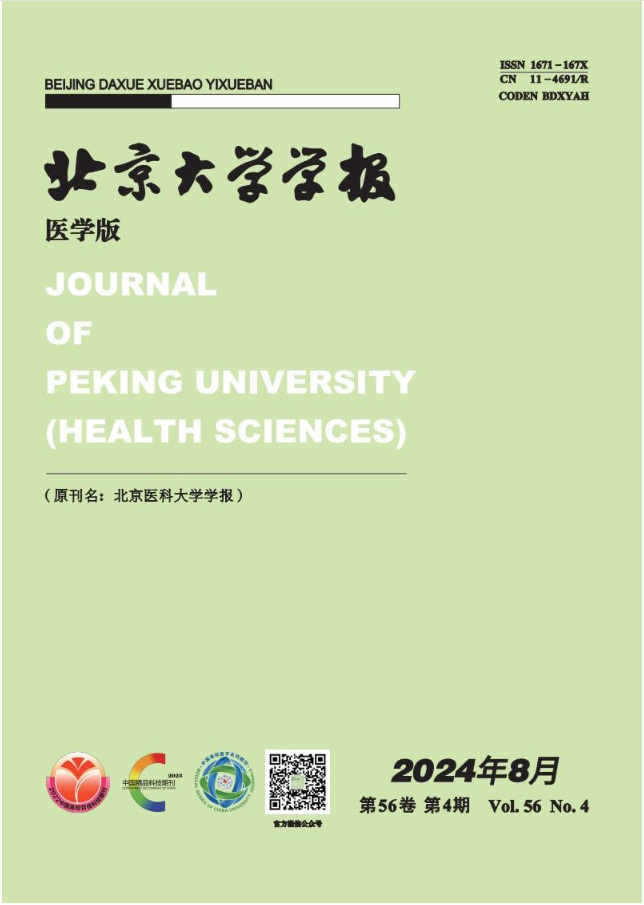
期刊介绍:
Beijing Da Xue Xue Bao Yi Xue Ban / Journal of Peking University (Health Sciences), established in 1959, is a national academic journal sponsored by Peking University, and its former name is Journal of Beijing Medical University. The coverage of the Journal includes basic medical sciences, clinical medicine, oral medicine, surgery, public health and epidemiology, pharmacology and pharmacy. Over the last few years, the Journal has published articles and reports covering major topics in the different special issues (e.g. research on disease genome, theory of drug withdrawal, mechanism and prevention of cardiovascular and cerebrovascular diseases, stomatology, orthopaedic, public health, urology and reproductive medicine). All the topics involve latest advances in medical sciences, hot topics in specific specialties, and prevention and treatment of major diseases.
The Journal has been indexed and abstracted by PubMed Central (PMC), MEDLINE/PubMed, EBSCO, Embase, Scopus, Chemical Abstracts (CA), Western Pacific Region Index Medicus (WPR), JSTChina, and almost all the Chinese sciences and technical index systems, including Chinese Science and Technology Paper Citation Database (CSTPCD), Chinese Science Citation Database (CSCD), China BioMedical Bibliographic Database (CBM), CMCI, Chinese Biological Abstracts, China National Academic Magazine Data-Base (CNKI), Wanfang Data (ChinaInfo), etc.

 求助内容:
 应助结果提醒方式:


 京公网安备 11010802042870号


