Carlos Cristi-Montero, Humberto Peña-Jorquera, Javier Sanchez-Martinez, Gastón Pavez-San Martin, Patricio Solis-Urra, Gerson Ferrari, José Francisco López-Gil
{"title":"垃圾食品的重量:青少年海马、杏仁核和前额叶体积较小——认知行动项目。","authors":"Carlos Cristi-Montero, Humberto Peña-Jorquera, Javier Sanchez-Martinez, Gastón Pavez-San Martin, Patricio Solis-Urra, Gerson Ferrari, José Francisco López-Gil","doi":"10.1111/aphw.70226","DOIUrl":null,"url":null,"abstract":"<p><p>Most studies investigating diet-brain relationships in youth focus on single foods. Whether the joint consumption of multiple food groups is associated with neuroanatomy during adolescence remains largely unexplored, particularly outside high-income countries. In this cross-sectional study, 61 Chilean adolescents (11.6 ± 1.07 years; 42.6% girls) underwent T1-weighted MRI. Volumes of total gray matter, hippocampus, amygdala, and selected prefrontal regions were extracted. Dietary intake was assessed using the Global Food Quality Index questionnaire. Confounder-adjusted linear regressions examined individual food group-brain associations, with correction for multiple comparisons. Canonical correlation analysis (CCA) was used to identify multivariate food group-brain covariation with permutation-based inference. Univariate analyses showed a significant inverse association between pastry consumption and hippocampal volume (β = -0.402, 95% CI: -0.571 to -0.228, adjusted R<sup>2</sup> = 0.34). CCA identified one significant multivariate mode linking higher unhealthy food consumption to brain volumes (r = -0.70, p = .008). Pastries, fried foods, and soft drinks showed the strongest contributions, whereas the corresponding brain variate was characterized by smaller hippocampal, amygdala, and anterior cingulate/prefrontal volumes. In conclusion, higher consumption of unhealthy food groups is associated with smaller limbic-prefrontal volumes in adolescents. Although causality cannot be inferred from these cross-sectional data, these findings highlight adolescence as a critical window for diet-brain health research.</p>","PeriodicalId":8127,"journal":{"name":"Applied psychology. Health and well-being","volume":"18 5","pages":"e70226"},"PeriodicalIF":3.3000,"publicationDate":"2026-10-01","publicationTypes":"Journal Article","fieldsOfStudy":null,"isOpenAccess":false,"openAccessPdf":"https://www.ncbi.nlm.nih.gov/pmc/articles/PMC13655188/pdf/","citationCount":"0","resultStr":"{\"title\":\"The weight of junk food: Smaller hippocampal, amygdala, and prefrontal volumes in adolescents-The Cogni-Action Project.\",\"authors\":\"Carlos Cristi-Montero, Humberto Peña-Jorquera, Javier Sanchez-Martinez, Gastón Pavez-San Martin, Patricio Solis-Urra, Gerson Ferrari, José Francisco López-Gil\",\"doi\":\"10.1111/aphw.70226\",\"DOIUrl\":null,\"url\":null,\"abstract\":\"<p><p>Most studies investigating diet-brain relationships in youth focus on single foods. Whether the joint consumption of multiple food groups is associated with neuroanatomy during adolescence remains largely unexplored, particularly outside high-income countries. In this cross-sectional study, 61 Chilean adolescents (11.6 ± 1.07 years; 42.6% girls) underwent T1-weighted MRI. Volumes of total gray matter, hippocampus, amygdala, and selected prefrontal regions were extracted. Dietary intake was assessed using the Global Food Quality Index questionnaire. Confounder-adjusted linear regressions examined individual food group-brain associations, with correction for multiple comparisons. Canonical correlation analysis (CCA) was used to identify multivariate food group-brain covariation with permutation-based inference. Univariate analyses showed a significant inverse association between pastry consumption and hippocampal volume (β = -0.402, 95% CI: -0.571 to -0.228, adjusted R<sup>2</sup> = 0.34). CCA identified one significant multivariate mode linking higher unhealthy food consumption to brain volumes (r = -0.70, p = .008). Pastries, fried foods, and soft drinks showed the strongest contributions, whereas the corresponding brain variate was characterized by smaller hippocampal, amygdala, and anterior cingulate/prefrontal volumes. In conclusion, higher consumption of unhealthy food groups is associated with smaller limbic-prefrontal volumes in adolescents. Although causality cannot be inferred from these cross-sectional data, these findings highlight adolescence as a critical window for diet-brain health research.</p>\",\"PeriodicalId\":8127,\"journal\":{\"name\":\"Applied psychology. Health and well-being\",\"volume\":\"18 5\",\"pages\":\"e70226\"},\"PeriodicalIF\":3.3000,\"publicationDate\":\"2026-10-01\",\"publicationTypes\":\"Journal Article\",\"fieldsOfStudy\":null,\"isOpenAccess\":false,\"openAccessPdf\":\"https://www.ncbi.nlm.nih.gov/pmc/articles/PMC13655188/pdf/\",\"citationCount\":\"0\",\"resultStr\":null,\"platform\":\"Semanticscholar\",\"paperid\":null,\"PeriodicalName\":\"Applied psychology. Health and well-being\",\"FirstCategoryId\":\"102\",\"ListUrlMain\":\"https://doi.org/10.1111/aphw.70226\",\"RegionNum\":2,\"RegionCategory\":\"心理学\",\"ArticlePicture\":[],\"TitleCN\":null,\"AbstractTextCN\":null,\"PMCID\":null,\"EPubDate\":\"\",\"PubModel\":\"\",\"JCR\":\"Q1\",\"JCRName\":\"PSYCHOLOGY, APPLIED\",\"Score\":null,\"Total\":0}","platform":"Semanticscholar","paperid":null,"PeriodicalName":"Applied psychology. Health and well-being","FirstCategoryId":"102","ListUrlMain":"https://doi.org/10.1111/aphw.70226","RegionNum":2,"RegionCategory":"心理学","ArticlePicture":[],"TitleCN":null,"AbstractTextCN":null,"PMCID":null,"EPubDate":"","PubModel":"","JCR":"Q1","JCRName":"PSYCHOLOGY, APPLIED","Score":null,"Total":0}
The weight of junk food: Smaller hippocampal, amygdala, and prefrontal volumes in adolescents-The Cogni-Action Project.
Most studies investigating diet-brain relationships in youth focus on single foods. Whether the joint consumption of multiple food groups is associated with neuroanatomy during adolescence remains largely unexplored, particularly outside high-income countries. In this cross-sectional study, 61 Chilean adolescents (11.6 ± 1.07 years; 42.6% girls) underwent T1-weighted MRI. Volumes of total gray matter, hippocampus, amygdala, and selected prefrontal regions were extracted. Dietary intake was assessed using the Global Food Quality Index questionnaire. Confounder-adjusted linear regressions examined individual food group-brain associations, with correction for multiple comparisons. Canonical correlation analysis (CCA) was used to identify multivariate food group-brain covariation with permutation-based inference. Univariate analyses showed a significant inverse association between pastry consumption and hippocampal volume (β = -0.402, 95% CI: -0.571 to -0.228, adjusted R2 = 0.34). CCA identified one significant multivariate mode linking higher unhealthy food consumption to brain volumes (r = -0.70, p = .008). Pastries, fried foods, and soft drinks showed the strongest contributions, whereas the corresponding brain variate was characterized by smaller hippocampal, amygdala, and anterior cingulate/prefrontal volumes. In conclusion, higher consumption of unhealthy food groups is associated with smaller limbic-prefrontal volumes in adolescents. Although causality cannot be inferred from these cross-sectional data, these findings highlight adolescence as a critical window for diet-brain health research.
期刊介绍:
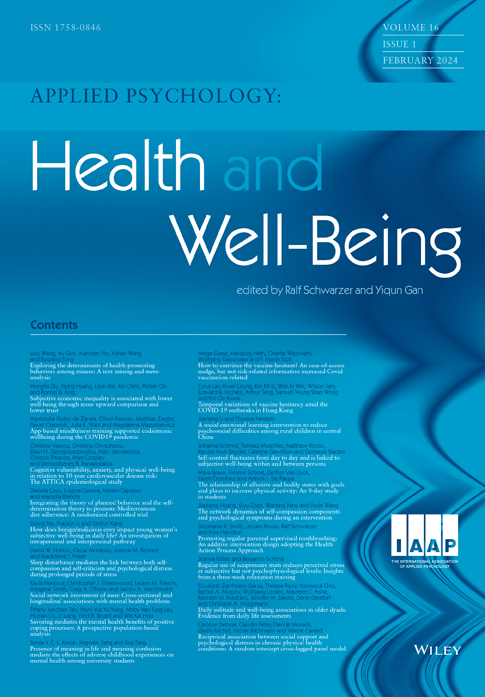
Applied Psychology: Health and Well-Being is a triannual peer-reviewed academic journal published by Wiley-Blackwell on behalf of the International Association of Applied Psychology. It was established in 2009 and covers applied psychology topics such as clinical psychology, counseling, cross-cultural psychology, and environmental psychology.

 求助内容:
 应助结果提醒方式:


 京公网安备 11010802042870号


