Qiwen Hu, Tingting Li, Hanzhi Xie, Yao Huang, Josep G Canadell, Jingxian Li, Pete Smith, Wenping Yuan, Wen Zhang, Jianwen Zou, Jing Liu, Jiawen Zhang, Zhangcai Qin, Shilong Piao
{"title":"在过去60年里,随着排放强度的下降,全球水稻甲烷排放量增加了两倍。","authors":"Qiwen Hu, Tingting Li, Hanzhi Xie, Yao Huang, Josep G Canadell, Jingxian Li, Pete Smith, Wenping Yuan, Wen Zhang, Jianwen Zou, Jing Liu, Jiawen Zhang, Zhangcai Qin, Shilong Piao","doi":"10.1093/nsr/nwag555","DOIUrl":null,"url":null,"abstract":"<p><p>Rice paddies are among the largest anthropogenic sources of methane (CH<sub>4</sub>), yet substantial uncertainties persist in the long-term magnitude and spatiotemporal dynamics of the emissions. Here, we show a spatially explicit global estimate of rice CH<sub>4</sub> emissions from 1961 to 2020, leveraging a new high-resolution dataset and two Tier 3 modeling approaches (process-based and machine-learning-based). We find that global emissions have more than tripled over the past six decades, reaching a record high of 38.8 Tg CH<sub>4</sub> yr<sup>-1</sup> in 2020 based on the mean of the two Tier 3 estimates, with both the rate and magnitude substantially higher than those of conventional emission-factor-based inventories. Traditional rice-producing regions (e.g. Asia) dominate the increase due to expanded cultivation and intensified organic inputs, while Africa emerged as a rapidly growing source. Beyond trends in absolute emissions, the CH<sub>4</sub> emission intensity (per unit of rice production) declined across 70% of the global paddy area, mainly reflecting yield-driven efficiency gains. Notably, 44% of global rice production in the 2010s occurred in countries with below-average emission intensity, with China being the largest contributor. By resolving long-term spatial heterogeneity with new data and models, this study provides a robust reassessment of the global rice methane budget and highlights pathways to reconcile food production with climate mitigation.</p>","PeriodicalId":18842,"journal":{"name":"National Science Review","volume":"13 19","pages":"nwag555"},"PeriodicalIF":18.1000,"publicationDate":"2026-08-29","publicationTypes":"Journal Article","fieldsOfStudy":null,"isOpenAccess":false,"openAccessPdf":"https://www.ncbi.nlm.nih.gov/pmc/articles/PMC13637625/pdf/","citationCount":"0","resultStr":"{\"title\":\"Global rice methane emissions tripled over six decades amid declining emission intensity.\",\"authors\":\"Qiwen Hu, Tingting Li, Hanzhi Xie, Yao Huang, Josep G Canadell, Jingxian Li, Pete Smith, Wenping Yuan, Wen Zhang, Jianwen Zou, Jing Liu, Jiawen Zhang, Zhangcai Qin, Shilong Piao\",\"doi\":\"10.1093/nsr/nwag555\",\"DOIUrl\":null,\"url\":null,\"abstract\":\"<p><p>Rice paddies are among the largest anthropogenic sources of methane (CH<sub>4</sub>), yet substantial uncertainties persist in the long-term magnitude and spatiotemporal dynamics of the emissions. Here, we show a spatially explicit global estimate of rice CH<sub>4</sub> emissions from 1961 to 2020, leveraging a new high-resolution dataset and two Tier 3 modeling approaches (process-based and machine-learning-based). We find that global emissions have more than tripled over the past six decades, reaching a record high of 38.8 Tg CH<sub>4</sub> yr<sup>-1</sup> in 2020 based on the mean of the two Tier 3 estimates, with both the rate and magnitude substantially higher than those of conventional emission-factor-based inventories. Traditional rice-producing regions (e.g. Asia) dominate the increase due to expanded cultivation and intensified organic inputs, while Africa emerged as a rapidly growing source. Beyond trends in absolute emissions, the CH<sub>4</sub> emission intensity (per unit of rice production) declined across 70% of the global paddy area, mainly reflecting yield-driven efficiency gains. Notably, 44% of global rice production in the 2010s occurred in countries with below-average emission intensity, with China being the largest contributor. By resolving long-term spatial heterogeneity with new data and models, this study provides a robust reassessment of the global rice methane budget and highlights pathways to reconcile food production with climate mitigation.</p>\",\"PeriodicalId\":18842,\"journal\":{\"name\":\"National Science Review\",\"volume\":\"13 19\",\"pages\":\"nwag555\"},\"PeriodicalIF\":18.1000,\"publicationDate\":\"2026-08-29\",\"publicationTypes\":\"Journal Article\",\"fieldsOfStudy\":null,\"isOpenAccess\":false,\"openAccessPdf\":\"https://www.ncbi.nlm.nih.gov/pmc/articles/PMC13637625/pdf/\",\"citationCount\":\"0\",\"resultStr\":null,\"platform\":\"Semanticscholar\",\"paperid\":null,\"PeriodicalName\":\"National Science Review\",\"FirstCategoryId\":\"103\",\"ListUrlMain\":\"https://doi.org/10.1093/nsr/nwag555\",\"RegionNum\":1,\"RegionCategory\":\"综合性期刊\",\"ArticlePicture\":[],\"TitleCN\":null,\"AbstractTextCN\":null,\"PMCID\":null,\"EPubDate\":\"2026/10/1 0:00:00\",\"PubModel\":\"eCollection\",\"JCR\":\"Q1\",\"JCRName\":\"MULTIDISCIPLINARY SCIENCES\",\"Score\":null,\"Total\":0}","platform":"Semanticscholar","paperid":null,"PeriodicalName":"National Science Review","FirstCategoryId":"103","ListUrlMain":"https://doi.org/10.1093/nsr/nwag555","RegionNum":1,"RegionCategory":"综合性期刊","ArticlePicture":[],"TitleCN":null,"AbstractTextCN":null,"PMCID":null,"EPubDate":"2026/10/1 0:00:00","PubModel":"eCollection","JCR":"Q1","JCRName":"MULTIDISCIPLINARY SCIENCES","Score":null,"Total":0}
Global rice methane emissions tripled over six decades amid declining emission intensity.
Rice paddies are among the largest anthropogenic sources of methane (CH4), yet substantial uncertainties persist in the long-term magnitude and spatiotemporal dynamics of the emissions. Here, we show a spatially explicit global estimate of rice CH4 emissions from 1961 to 2020, leveraging a new high-resolution dataset and two Tier 3 modeling approaches (process-based and machine-learning-based). We find that global emissions have more than tripled over the past six decades, reaching a record high of 38.8 Tg CH4 yr-1 in 2020 based on the mean of the two Tier 3 estimates, with both the rate and magnitude substantially higher than those of conventional emission-factor-based inventories. Traditional rice-producing regions (e.g. Asia) dominate the increase due to expanded cultivation and intensified organic inputs, while Africa emerged as a rapidly growing source. Beyond trends in absolute emissions, the CH4 emission intensity (per unit of rice production) declined across 70% of the global paddy area, mainly reflecting yield-driven efficiency gains. Notably, 44% of global rice production in the 2010s occurred in countries with below-average emission intensity, with China being the largest contributor. By resolving long-term spatial heterogeneity with new data and models, this study provides a robust reassessment of the global rice methane budget and highlights pathways to reconcile food production with climate mitigation.
期刊介绍:
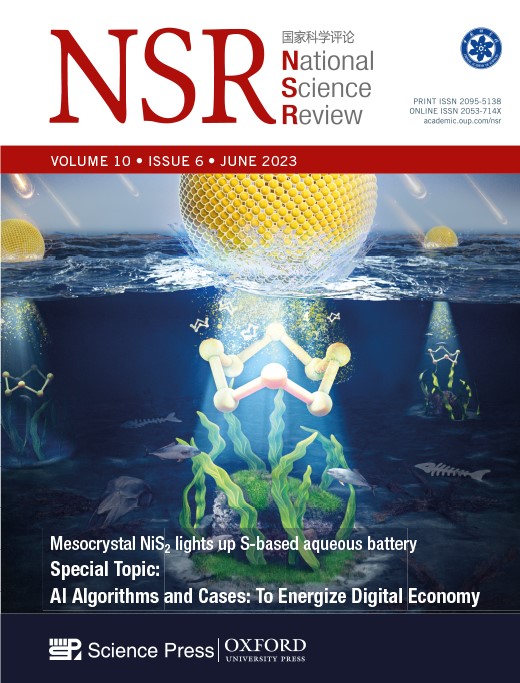
National Science Review (NSR; ISSN abbreviation: Natl. Sci. Rev.) is an English-language peer-reviewed multidisciplinary open-access scientific journal published by Oxford University Press under the auspices of the Chinese Academy of Sciences.According to Journal Citation Reports, its 2021 impact factor was 23.178.
National Science Review publishes both review articles and perspectives as well as original research in the form of brief communications and research articles.

 求助内容:
 应助结果提醒方式:


 京公网安备 11010802042870号


